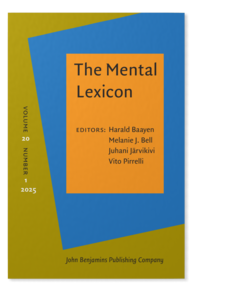
The Mental Lexicon

Editors
ORCiD logo with linkHarald Baayen | Eberhard Karls University Tübingen
ORCiD logo with linkMelanie J. Bell | Anglia Ruskin University
ORCiD logo with linkVito Pirrelli | Institute for Computational Linguistics - CNR, Pisa
Founding Editors
Gonia Jarema | Université de Montréal

Journal metrics

Impact Factor: 1.3 (5-year: 1.3)
Journal Citation Indicator: 0.69
CiteScore: 1.5
SNIP: 0.569 SJR: 0.604

This journal is peer reviewed and indexed in: CNKI Scholar ; Dimensions ; ERIH PLUS ; Glottolog ; IBR/IBZ ; Linguistics Abstracts Online ; Linguistics and Language Behavior Abstracts (LLBA ) ; MLA International Bibliography ; Scopus ; WoS Emerging Sources Citation Index (ESCI )

The Mental Lexicon is an interdisciplinary journal that provides an international forum for research that bears on the issues of the representation and processing of words in the mind and brain. We encourage both the submission of original research and reviews of significant new developments in the understanding of the mental lexicon. The journal publishes work that includes, but is not limited to the following:

  • Models of the representation of words in the mind
  • Computational models of lexical access and production
  • Experimental investigations of lexical processing
  • Neurolinguistic studies of lexical impairment.
  • Functional neuroimaging and lexical representation in the brain
  • Lexical development across the lifespan
  • Lexical processing in second language acquisition
  • The bilingual mental lexicon
  • Lexical and morphological structure across languages
  • Formal models of lexical structure
  • Corpus research on the lexicon
  • New experimental paradigms and statistical techniques for mental lexicon research

The Mental Lexicon publishes its articles Online First.


“In an era when the highly specialized journal may fail to draw a large enough audience and the overly generalized journal may fail to find a coherent voice, the Journal of the Mental Lexicon seems to have found that ideal niche: a clear scholarly conception, an openness to multidisciplinary approaches and a broad appeal to the researcher, the clinician, the theoretician and the historian. John Benjamins Publishing is to be congratulated both on the foresight to support this worthwhile project and the acumen to have selected two outstanding scholars to edit what promises to be a bellwether among competing journals.”

Prof. Dr. Harry A. Whitaker, Department of Psychology, Northern Michigan University

ISSN: 1871-1340 | E-ISSN: 1871‑1375
DOI logo with link
https://doi.org/10.1075/ml
Latest articles

20 March 2026

  • The effect of spelling errors on reading tasks: A study on Russian
    Natalia Slioussar, Daria Chernova, Varvara Magomedova, Polina MaximovaIvan Gurkov
  • 22 January 2026

  • The impact of walking and visual distraction on lexicality judgements
    Naomi Vingron, Nancy Azevedo, Gonia Jarema, Joyce Fung, Roya Khalili, Sarah Lee, Anouk Lamontagne, Ruthann Atchley, Paul Atchley, Juhani Järvikivi, Debra Titone, †Gary LibbenEva Kehayia | ML 20:1 (2025) p. 93
  • 2 December 2025

  • Morphological processing in Alzheimer’s disease: A network analysis of word recognition and inflection in Finnish
    Alexandre Nikolaev, Eve Higby, Merja Hallikainen, Tuomo Hänninen, Soininen HilkkaJungmoon Hyun
  • 18 November 2025

  • Haemodynamic correlate of the mismatch negativity response reflects memory-trace activation for spoken words: An fMRI study
    Yury Shtyrov, Kristina S. Memetova, Lyudmila N. Stankevich, Irina G. MalanchukAleksander A. Aleksandrov | ML 20:1 (2025) pp. 67–92
  • 5 November 2025

  • Grammatical gender systems in the bilingual mental lexicon: Evidence from gender assignment in Russian-Hebrew code-switching
    Oksana RekunNatalia Meir | ML 20:1 (2025) pp. 37–66
  • 12 September 2025

  • Morpho-phonology is not independent of semantics: The case of German nominal number marking
    Ingo Plag, Maria HeitmeierFrank Domahs
  • 5 August 2025

  • Morphological processing in written word recognition: New evidence on visual priming with stem-homographs and stem-allomorphs in Italian
    Giulia Bracco, Maria De MartinoAlessandro Laudanna
  • 3 July 2025

  • Morphological salience effects of prefixes and suffixes embedded in French words
    Hélène Giraudo, Karla OrihuelaSerena Dal Maso
  • 6 May 2025

  • Recognition advantage of proper names: A case of categorial semantics
    Natividad Hernández Muñoz, Claudia H. Sánchez-GutiérrezAna C. Contreras Guedes | ML 20:1 (2025) pp. 1–36
  • 28 April 2025

  • Modeling lexical attrition in L2 mental lexicon for Chinese EFL learners
    Jie Liu, Shifa ChenXuefang Feng | ML 19:3 (2024) pp. 341–371
  • 14 April 2025

  • From ‘jellyfish’ to ‘poisson de gelée’ : Compound production in bilingual aphasia
    Mareike Moormann, Antje Lorenz, Lyndsey Nickels, Neville HennesseyBritta Biedermann | ML 19:2 (2024) pp. 308–339
  • 8 April 2025

  • Is there a hip or a pie in hippie? The influence of phonology on the morphological decomposition of pseudo-compound words
    Juana Park, Christina L. GagnéThomas L. Spalding | ML 19:2 (2024) pp. 285–307
  • 1 April 2025

  • Finnish noun inflections and the FLH from two perspectives
    Bruce Derwing, James MyersJuhani Järvikivi | ML 19:2 (2024) pp. 191–223
  • Long-lag morphological priming and inflectional paradigm size effects in Estonian and Finnish text reading
    Kaidi Lõo, Raymond BertramVictor Kuperman | ML 19:2 (2024) pp. 253–284
  • 25 February 2025

  • Word processing through lexical decision in Brazilian Portuguese: Blends, derived, and simplex words
    Gustavo Estivalet, José Ferrari-Neto, Rafael MinussiAlina Villalva | ML 19:1 (2024) pp. 145–160
  • 6 February 2025

  • The synchronic status of historical bound roots in the mental lexicon: A dynamic, psychocentric perspective
    Matthew T. CarlsonAmy C. Crosson | ML 19:2 (2024) pp. 224–252
  • Orthographic uncertainty: An entropy-based measure of word form typicality
    Chris WestburyMichelle Yang | ML 19:3 (2024) pp. 439–495
  • Words in the World
    Laura Teddiman, Lori BuchananHamad Al-Azary | ML 19:1 (2024) pp. 1–5
  • 3 February 2025

  • Gary Libben’s Mental Lexicon
    Lori BuchananRoberto G. de Almeida | ML 19:2 (2024) pp. 189–190
  • 17 January 2025

  • A psycholinguistic analysis of clinical list-learning tests
    Brette LansueLori Buchanan | ML 19:1 (2024) p. 6
  • 14 January 2025

  • The moral Foreign Language Effect beyond the L2: Non-first languages behave similarly (but there are nuances)
    Zofia StańczykowskaMichał B. Paradowski | ML 19:1 (2024) pp. 55–67
  • 10 January 2025

  • Xiaosi ‘die laughing’ as a discourse marker: A Corpus-based study during the COVID-19 pandemic in Taiwan
    Siaw-Fong ChungYu-Che Yen | ML 19:1 (2024) pp. 180–188
  • Thermal and metaphorical meanings: Analysing temperature adjectives in European Portuguese
    Yichang Ge, Fátima SilvaFátima Oliveira | ML 19:1 (2024) pp. 170–179
  • What can emotion and abstract words tell us about context availability ratings?
    Catherine Jane Mason, Solène HameauLyndsey Nickels | ML 19:1 (2024) pp. 68–77
  • Symbols to shapes processing
    Ghadir NassereddineLori Buchanan | ML 19:1 (2024) pp. 135–144
  • Processing costs in Cantonese-Latin script-mixing
    Janessa Pui Ling Tam, Philip J. MonahanRena Helms-Park | ML 19:1 (2024) pp. 111–125
  • How words can guide our eyes: Increasing engagement with art through audio-guided visual search in young and older adults
    Naomi Vingron, Lea Alexandra Müller Karoza, Nancy Azevedo, Aaron Johnson, Evdokimos Konstantinidis, Panagiotis Bamidis, Melissa Eva Kehayia | ML 19:1 (2024) pp. 78–89
  • NLP and education: Using semantic similarity to evaluate filled gaps in a large-scale Cloze test in the classroom
    Túlio Sousa de Gois, Flávia Oliveira Freitas, Julian TejadaRaquel Meister Ko. Freitag | ML 19:1 (2024) pp. 90–99
  • 16 December 2024

  • Intralingual and interlingual effects in a pure language list: Evidence for language-selective lexical access?
    Lisan Broekhuis, Sarah BernoletDominiek Sandra | ML 19:1 (2024) pp. 37–54
  • The influence of uppercase letter location on typing multiword passphrases
    Keira Gow, Alexander TaikhMorshedul Islam | ML 19:1 (2024) pp. 161–169
  • The role of orthography and phonology during L1 vs. L2 typed production
    Merel MuylleGonia Jarema | ML 19:1 (2024) pp. 100–110
  • Tense and agreement processing in native Spanish speakers with aphasia
    Camila Stecher, María Elina Sánchez, Julia Roberta CardenVirginia Irene Jaichenco | ML 19:1 (2024) pp. 25–36
  • 9 December 2024

  • The influence of semantic primes on the typing of word targets
    Ajay MangatAlexander Taikh | ML 19:1 (2024) pp. 126–134
  • IssuesOnline-first articles

    Volume 20 (2025)

    Volume 19 (2024)

    Volume 18 (2023)

    Volume 17 (2022)

    Volume 16 (2021)

    Volume 15 (2020)

    Volume 14 (2019)

    Volume 13 (2018)

    Volume 12 (2017)

    Volume 11 (2016)

    Volume 10 (2015)

    Volume 9 (2014)

    Volume 8 (2013)

    Volume 7 (2012)

    Volume 6 (2011)

    Volume 5 (2010)

    Volume 4 (2009)

    Volume 3 (2008)

    Volume 2 (2007)

    Volume 1 (2006)

    Editorial info
    Editors
    ORCiD logo with linkHarald Baayen | Eberhard Karls University Tübingen
    ORCiD logo with linkMelanie J. Bell | Anglia Ruskin University
    ORCiD logo with linkVito Pirrelli | Institute for Computational Linguistics - CNR, Pisa
    Advisory Board
    ORCiD logo with linkBruce L. Derwing | University of Alberta
    Kenneth I. Forster | University of Arizona
    Angela D. Friederici | Max Planck Institute for Human Cognitive and Brain Sciences
    ORCiD logo with linkLoraine K. Obler | City University of New York
    Founding Editors
    Gonia Jarema | Université de Montréal
    Editorial Board
    Iris Berent | Northeastern University
    ORCiD logo with linkSami Boudelaa | United Arab Emirates University
    ORCiD logo with linkLori Buchanan | University of Windsor
    ORCiD logo with linkAudrey Bürki | University of Potsdam
    Clara Cohen | University of Glasgow
    ORCiD logo with linkSimon De Deyne | University of Melbourne
    ORCiD logo with linkTon Dijkstra | Radboud University Nijmegen
    ORCiD logo with linkMirjam Ernestus | Radboud University Nijmegen
    ORCiD logo with linkMira Goral | Lehman College, CUNY
    Peter Hendrix | Tilburg University
    ORCiD logo with linkShu-kai Hsieh | National Taiwan University
    ORCiD logo with linkMinna Lehtonen | University of Turku & University of Oslo
    ORCiD logo with linkMarco Marelli | University Milano Bicocca
    ORCiD logo with linkPetar Milin | University of Birmingham
    Fermín Moscoso del Prado Martín | University of Cambridge
    ORCiD logo with linkJames Myers | National Chung Cheng University
    ORCiD logo with linkIngo Plag | University of Düsseldorf
    ORCiD logo with linkDominiek Sandra | University of Antwerp
    ORCiD logo with linkJohn W. Schwieter | Wilfrid Laurier University & McMaster University
    ORCiD logo with linkEva Smolka | University of Konstanz
    ORCiD logo with linkChris Westbury | University of Alberta
    Lee H. Wurm | Gonzaga University
    Subscription Info
    Current issue: 20:1, available as of March 2026

    General information about our electronic journals.

    Subscription rates

    All prices for print + online include postage/handling.

    Online-onlyPrint + online
    Volume 21 (2026): 3 issues; ca. 360 pp.EUR 266.00EUR 371.00
    Volume 20 (2025): 3 issues; ca. 450 pp.EUR 323.00EUR 437.00

    Individuals may apply for a special online-only subscription rate of EUR 65.00 per volume.
    Private subscriptions are for personal use only, and must be pre-paid and ordered directly from the publisher.

    Available back-volumes

    Online-onlyPrint + online
    Complete backset
    (Vols. 1‒19; 2006‒2024)
    56 issues;
    8,430 pp.
    EUR 5,392.00EUR 5,959.00
    Volume 19 (2024) 3 issues; 450 pp.EUR 314.00EUR 397.00
    Volume 18 (2023) 3 issues; 450 pp.EUR 305.00EUR 361.00
    Volumes 15‒17 (2020‒2022) 3 issues; avg. 450 pp.EUR 305.00 per volumeEUR 354.00 per volume
    Volume 14 (2019) 3 issues; 450 pp.EUR 299.00EUR 347.00
    Volume 13 (2018) 3 issues; 450 pp.EUR 290.00EUR 337.00
    Volume 12 (2017) 3 issues; 450 pp.EUR 282.00EUR 327.00
    Volume 11 (2016) 3 issues; 450 pp.EUR 282.00EUR 317.00
    Volume 10 (2015) 3 issues; 450 pp.EUR 282.00EUR 308.00
    Volume 9 (2014) 3 issues; 450 pp.EUR 282.00EUR 299.00
    Volume 8 (2013) 3 issues; 450 pp.EUR 282.00EUR 290.00
    Volumes 2‒7 (2007‒2012) 3 issues; avg. 450 pp.EUR 274.00 per volumeEUR 282.00 per volume
    Volume 1 (2006) 2 issues; 330 pp.EUR 215.00EUR 222.00
    Author info

    The Mental Lexicon offers online submission. Manuscripts should be submitted through the journal’s online submission and manuscript tracking site. Please consult the guidelines and the Short Guide to EM for Authors before you submit your paper.

    If you are not able to submit online, please contact the editors: MentalLexicon at protonmail.com

    Ethics

    John Benjamins journals are committed to maintaining the highest standards of publication ethics and to supporting ethical research practices.

    Authors and reviewers are kindly requested to read this Ethics Statement.

    Please also note the guidance on (the declaration of) the use of Artificial Intelligence.

    Rights and Permissions

    Authors must ensure that they have permission to use any third-party material in their contribution; the permission should include perpetual (not time-limited) world-wide distribution in print and electronic format.

    For information on authors' rights, please consult the rights information page.

    Open Access

    Articles accepted for this journal can be made Open Access through payment of an Article Publication Charge (APC) of EUR 1800 (excl. tax). To arrange this, please contact openaccess at benjamins.nl as soon as your paper has been accepted for publication. More information can be found on the publisher's Open Access Policy page.

    Corresponding authors from institutions with which John Benjamins has a Read & Publish arrangement can publish Open Access without paying a fee. Please consult this list of institutions for up-to-date information on which articles qualify.

    For information about permission to post a version of your article online or in an institutional repository ('green' open access or self-archiving), please consult the rights information page.

    If the article is not (to be made) Open Access, there is no fee for the author to publish in this journal.

    Archiving

    John Benjamins Publishing Company has an agreement in place with Portico for the archiving of all its online journals and e-books.

    Mobile Menu Logo with link to supplementary files background Layer 1 prag Twitter_Logo_Blue