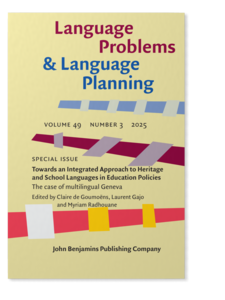
Language Problems and Language Planning
Main information
Journal metrics
Impact Factor: 0.6 (5-year: 0.4)Journal Citation Indicator: 0.37
CiteScore: 1.3
SNIP: 0.755 SJR: 0.149
This journal is peer reviewed and indexed in: ANVUR Riviste scientifiche (ANVUR ) ; CNKI Scholar ; Dimensions ; ERIH PLUS ; Glottolog ; IBR/IBZ ; International Bibliography of Social Sciences ; Journal Citation Reports/Social Sciences ; Linguistic Bibliography/Bibliographie Linguistique ; Linguistics Abstracts Online ; Linguistics and Language Behavior Abstracts (LLBA ) ; MLA International Bibliography ; Scopus ; Social Scisearch ; Sociological Abstracts ; WoS Arts & Humanities Citation Index ; WoS Social Sciences Citation Index
Language Problems and Language Planning (LPLP) is a peer-reviewed international and multilingual journal which focuses on language issues and the challenges they raise for contemporary societies at various levels and for various actors, with a particular emphasis on how these issues are addressed and processed through language policies. The three subject areas under which LPLP is listed in Scopus are: Linguistics and Language; Sociology and Political Science; Communication.
LPLP is particularly interested in topics such as:
• fundamental theory in language policy and planning (corpus, status, and acquisition planning);
• minority language protection and promotion; migration/mobility and linguistic integration; the management of multinational organisations and entities (whether public or private); macro-level language dynamics; multilingualism and geopolitics;
• ethnicity, nationalism and their interplay with language policy and planning;
• analyses of language policy and planning in specific domains, such as, but not limited to: education; public administration; justice system; economic life; culture; local/regional/international cooperation in those areas;
• design, implementation and evaluation of language policies in general, or of specific language policy measures;
• national or regional language policies, with consideration of their political, institutional and historical dimensions;
• representations of, attitudes towards and discourse about multilingualism and language policies;
• the political economy of language and the economics of language policy;
• historical and contemporary aspect of interlinguistics, which analyzes the development and use of planned languages, including but not limited to Esperanto. (Articles in this section have explored, for instance, the links between religion and language planning, the use of digital media in the making of the transnational Esperanto community, and Slavic constructed languages on the internet);
• the history of language policy and planning as an area of scientific investigation;
• high-level commentary of the work or other scholars on the above questions.
LPLP publishes four types of papers: Original research articles, Research notes, Review articles, and Book reviews. All submitted manuscripts undergo an initial assessment by the editorial team and, if deemed suitable for further consideration, are sent for peer review to two independent expert referees who remain anonymous. Please refer to the tab ‘Author Info’ for more details. LPLP publishes its articles Online First.

Latest articles
4 March 2026
24 October 2025
19 August 2025
18 August 2025
4 July 2025
5 June 2025
23 May 2025
28 April 2025
25 April 2025
24 April 2025
18 April 2025
14 April 2025
13 March 2025
24 February 2025
4 February 2025
23 January 2025
16 January 2025
14 January 2025
17 December 2024
16 December 2024
Issues
Online-first articlesVolume 49 (2025)
Volume 48 (2024)
Volume 47 (2023)
Volume 46 (2022)
Volume 45 (2021)
Volume 44 (2020)
Volume 43 (2019)
Volume 42 (2018)
Volume 41 (2017)
Volume 40 (2016)
Volume 39 (2015)
Volume 38 (2014)
Volume 37 (2013)
Volume 36 (2012)
Volume 35 (2011)
Volume 34 (2010)
Volume 33 (2009)
Volume 32 (2008)
Volume 31 (2007)
Volume 30 (2006)
Volume 29 (2005)
Volume 28 (2004)
Volume 27 (2003)
Volume 26 (2002)
Volume 25 (2001)
Volume 24 (2000)
Volume 23 (1999)
Volume 22 (1998)
Volume 21 (1997)
Volume 20 (1996)
Volume 19 (1995)
Volume 18 (1994)
Volume 17 (1993)
Volume 16 (1992)
Volume 15 (1991)
Volume 14 (1990)
Volume 13 (1989)
Volume 12 (1988)
Volume 11 (1987)
Volume 10 (1986)
Volume 9 (1985)
Volume 8 (1984)
Volume 7 (1983)
Volume 6 (1982)
Volume 5 (1981)
Volume 4 (1980)
Volume 3 (1979)
Volume 2 (1978)
Volume 1 (1977)
Editorial info
Subscription Info
General information about our electronic journals.
Subscription rates
All prices for print + online include postage/handling.
| Online-only | Print + online | ||
|---|---|---|---|
| Volume 50 (2026): 3 issues; ca. 300 pp. | EUR | EUR | |
| Volume 49 (2025): 3 issues; ca. 300 pp. | EUR | EUR |
Individuals may apply for a special online-only subscription rate of EUR
Private subscriptions are for personal use only, and must be pre-paid and ordered directly from the publisher.
Available back-volumes
| Online-only | Print + online | ||
|---|---|---|---|
| Complete backset (Vols. 1‒48; 1977‒2024) | 144 issues; 14,100 pp. | EUR 9,965.00 | EUR 10,556.00 |
| Volume 48 (2024) | 3 issues; 300 pp. | EUR | EUR |
| Volume 47 (2023) | 3 issues; 300 pp. | EUR | EUR |
| Volumes 44‒46 (2020‒2022) | 3 issues; avg. 300 pp. | EUR | EUR |
| Volume 43 (2019) | 3 issues; 300 pp. | EUR | EUR |
| Volume 42 (2018) | 3 issues; 300 pp. | EUR | EUR |
| Volume 41 (2017) | 3 issues; 300 pp. | EUR | EUR |
| Volume 40 (2016) | 3 issues; 300 pp. | EUR | EUR |
| Volume 39 (2015) | 3 issues; 300 pp. | EUR | EUR |
| Volume 38 (2014) | 3 issues; 300 pp. | EUR | EUR |
| Volume 37 (2013) | 3 issues; 300 pp. | EUR | EUR |
| Volumes 4‒36 (1980‒2012) | 3 issues; avg. 300 pp. | EUR | EUR |
| Volumes 1‒3 (1977‒1979) | 3 issues; avg. 200 pp. | EUR | EUR |
Author info
LPLP cultivates a strongly interdisciplinary spirit. Scholars from the full range of the social sciences and humanities are invited to submit work that contextualises and analyses the ways in which language functions in modern societies, particularly as an object of regulation, management, and contestation. LPLP therefore welcomes work from a wide array of disciplines, such as (but not limited to) sociolinguistics/applied linguistics, sociology of language, political science, economics, normative political theory, psychology, geography, history and law. A clear language policy angle, however, remains indispensable. On the other hand, LPLP does not normally carry, for example, pieces devoted strictly to pedagogy and language learning. The journal invites articles in line with the journal's aims & scope. While case studies of particular national or regional issues are welcome, preference is given to work offering generalisable insights of relevance across diverse contexts.
LPLP welcomes papers combining a strong theoretical approach with high standards of empirical treatment. Knowledge claims are expected to display high standards of scientific rigour, including close attention to the definition of concepts and assumptions, methodological transparency, and the reliability and verifiability of data. Given the journal’s interdisciplinary scope, all authors are requested to explain their work in a way that is accessible to curious, open-minded scholars from any discipline in the social sciences and humanities.
Guidelines and general information
Manuscript submissions are invited in any language, and the editors welcome articles in languages other than English. Manuscripts are normally reviewed anonymously by two competent scholars. When preparing your article for submission to LPLP, please follow these Instructions to Authors.
Submissions for consideration should be sent to Dr. Michele Gazzola, Editor-in-Chief, via the Editorial Manager portal. For additional information about electronic submission, please consult the Short Guide to EM for Authors.
Editorial inquiries
Inquiries should be sent to:
Michele Gazzola, Editor-in-Chief, editor-in-chief-lplpulster.ac.uk
with copy to Fatima Zucchi, Editorial Assistant, editorial-assistant-lplpulster.ac.uk
School of Applied Social and Policy Sciences, Ulster University,
2-24 York Street, Belfast BT15 1AP, United Kingdom
Types of publications
- Original research articles: Contributions normally between 7,000 and 9,000 words all inclusive (i.e., including tables, figures, references, and notes). These usually consist of analyses of findings from a scientific study or research project, underscoring the study's significance in advancing or challenging debates in the relevant field.
- Research notes: Contributions normally between 3,000 and 4,000 words all inclusive (i.e., including tables, figures, references and notes). These can take various forms, such as reports on work in progress or delineating the first steps of innovative, critical approaches to existing scholarship; discussions of methods or approaches that did not yield expected results; more practice-focused analyses of novel pedagogical approaches to acquisition planning, experiences by language policy-makers, or proposals for interventions in language policy and planning.
- Review articles: Contributions normally between 7,000 and 9,000 words all inclusive (i.e., including tables, figures, references and notes). These usually summarise and synthesise existing published research on a specific topic to provide an overview of the current state of knowledge, focusing on recent publications in the field (e.g, books dealing with similar topics). Unlike a research article, it does not present new experimental data but provides a critical evaluation of previously published studies to identify trends, gaps, and areas for future research. Unlike a book review, they do not focus on one book only.
- Book reviews: These contributions are normally solicited and are between 1,500 and 2,000 words. Occasionally, unsolicited reviews may be considered—in this case, please provide information about your reviewing and publishing experience and research expertise in the area of the book to be reviewed. Once the book has been received by the author, the review will usually be due within 2-3 months. The reviewer’s name, full address and a short bibliographical note (max 4 lines) should also be provided at the end of the review. Reviews should be sent to the review editor: Alice Leal, alice.lealwits.ac.za, University of the Witwatersrand, School of Literature, Languages and Media, Dept of Translation and Interpreting Studies, Private Bag 3, Wits 2050, South Africa.
For further details, see also the journal's Instructions to Authors.
Ethics
John Benjamins journals are committed to maintaining the highest standards of publication ethics and to supporting ethical research practices.
Authors and reviewers are kindly requested to read this Ethics Statement.
Please also note the guidance on (the declaration of) the use of Artificial Intelligence.
Rights and Permissions
Authors must ensure that they have permission to use any third-party material in their contribution; the permission should include perpetual (not time-limited) world-wide distribution in print and electronic format.
For information on authors' rights, please consult the rights information page.
Open Access
Articles accepted for this journal can be made Open Access through payment of an Article Publication Charge (APC) of EUR 1800 (excl. tax). To arrange this, please contact openaccessbenjamins.nl as soon as your paper has been accepted for publication. More information can be found on the publisher's Open Access Policy page.
Corresponding authors from institutions with which John Benjamins has a Read & Publish arrangement can publish Open Access without paying a fee. Please consult this list of institutions for up-to-date information on which articles qualify.
For information about permission to post a version of your article online or in an institutional repository ('green' open access or self-archiving), please consult the rights information page.
If the article is not (to be made) Open Access, there is no fee for the author to publish in this journal.
Archiving
John Benjamins Publishing Company has an agreement in place with Portico for the archiving of all its online journals and e-books.