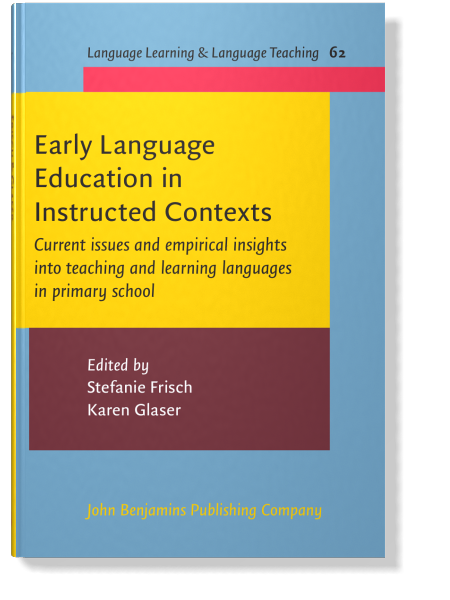
In:Early Language Education in Instructed Contexts: Current issues and empirical insights into teaching and learning languages in primary school
Edited by Stefanie Frisch and Karen Glaser
[Language Learning & Language Teaching 62] 2025
► pp. 140–159
Get fulltext
Chapter 7Faktör — factoure —
facteure?
The development of French vowel spelling in a German-French bilingual primary school
Available under the Creative Commons Attribution-NonCommercial-NoDerivatives (CC BY-NC-ND) 4.0 license.
For any use beyond this license, please contact the publisher at rights@benjamins.nl.
Published online: 22 May 2025
https://doi.org/10.1075/lllt.62.07lor
https://doi.org/10.1075/lllt.62.07lor
Abstract
The present study investigates how primary school
children whose first language of literacy is German acquire vowel
spelling in French as a second writing system. The paper
distinguishes the children’s vowel spelling in three vowel groups:
vowels that are phonologically and graphematically identical in
French and German; vowels that are phonologically but not
graphematically identical in both languages; and vowels that exist
only in French. In this longitudinal study, we used dictations to
collect French vowel spellings from students in Grade 2 to Grade 4
in a bilingual school in Germany. The results indicate that the
influence of the first writing system is largest at the beginning of
the acquisition process for all vowel spellings and that children
tend to spell French vowels differently depending on the
phonological and graphematic similarities and differences between
German and French. The results are discussed in the framework of
spelling research in biliterate contexts as well as in the
educational context of primary school.
Article outline
- 1.Introduction
- 2.Theoretical background
- 2.1Graphematic solution space
- 2.2Learner languages
- 2.3Written learner languages
- 3.Research aims, participants, and methodology
- 3.1Research questions
- 3.2Participants and language instructional setting
- 3.3Methodology
- 3.3.1Test material and data collection
- 3.3.2Data analysis
- 4.Results
- 4.1The spelling of French vowels with respect to similarities
and differences in the first writing system German- 4.1.1Spelling solutions in the vowel group F==G
- 4.1.2Spelling solutions in the vowel group F=≠G
- 4.1.3Spelling solutions in the vowel group F≠≠G
- 4.2The longitudinal development of the spelling of French vowels
from Grade 2 to Grade 4 with respect to similarities and differences
in the first writing system German- 4.2.1The longitudinal development of spellings in vowel group F==G
- 4.2.2The longitudinal development of spellings in vowel group F=≠G
- 4.2.3The longitudinal development of spellings in vowel group F≠≠G
- 4.1The spelling of French vowels with respect to similarities
- 5.Discussion
- 6.Conclusion: Implications for early language teaching and future research
Notes References

References (35)
Ahrenholz, B. (2014). Lernersprachenanalyse. In J. Settinieri, S. Demirkaya, A. Feldmeier, N. Gültekin-Karakoç, & C. Riemer (Eds.), Empirische
Forschungsmethoden für Deutsch als Fremd- und Zweitsprache:
Eine
Einführung (pp. 167–182). Schöningh.
Bahr, R. H., Silliman, E. R., Berninger, V. W., & Dow, M. (2012). Typically
developing writers in grades
1–9. Journal of Speech,
Language and Hearing
Research, 55, 1587–1599.
Berkemeier, A. (1997). Kognitive
Prozesse beim Zweitschrifterwerb: Zweitalphabetisierung
griechisch-deutsch-bilingualer Kinder im
Deutschen. Peter Lang.
Brdar-Szabó, R. (2010). Nutzen
und Grenzen der kontrastiven Analyse für Deutsch als Fremd-
und
Zweitsprache. In H.-J. Krumm, C. Fandrych, B. Hufeisen, & C. Riemer (Eds.), Handbücher
zur Sprach- und Kommunikationswissenschaft. Deutsch als
Fremd- und Zweitsprache. Ein internationales
Handbuch (pp. 518–531). De Gruyter Mouton.
Catach, N. (2016). L’orthographe
française: Traité théorique et pratique avec des travaux
d’application et leurs
corrigés. Armand Colin.
Corvacho del Toro, I. (2021). Zweitalphabetisierung
deutsch-spanisch bilingualer
Kinder. In I. Corvacho del Toro & E. Hack-Cengizalp (Eds.), Literalität
und
Mehrsprachigkeit (pp. 91–110). Universitätsbibliothek der Universität Siegen.
Granger, S. (2002). A
bird’s eye view of learner corpus
research. In S. Granger, J. Hung, & S. Petch-Tyson (Eds.), Computer
learner corpora, second language acquisition and foreign
language
teaching (pp. 3–33). John Benjamins.
(2015). Contrastive
interlanguage
analysis. International
Journal of Learner Corpus
Research, 1(1), 7–24.
Grießhaber, W. (2006). Die
Entwicklung der Grammatik in Texten vom 1. bis zum 4.
Schuljahr. In B. Ahrenholz (Ed.), Kinder
mit Migrationshintergrund: Spracherwerb und
Fördermöglichkeiten (pp. 150–167). Fillibach.
Han, Z., & Odlin, T. (2005). Studies
of fossilization in second language
acquisition. Multilingual Matters.
Hoole, P., & Mooshammer, C. (2002). Articulatory
analysis of the German vowel
system. In P. Auer, P. Gilles, & H. Spiekermann (Eds.), Silbenschnitt
und
Tonakzente (pp. 129–152). De Gruyter.
Labusch, M., Massol, S., Marcet, A., & Perea, M. (2023). Are
goats chèvres, chévres, chēvres, and chevres? Unveiling the
orthographic code of diacritical
vowels. Journal of
Experimental Psychology: Learning, Memory, and
Cognition, 49(2), 301–319.
Larsen, L., Schauber, S. K., Kohnen, S., Nickels, L., & McArthur, G. (2020). Children’s
knowledge of single- and multiple-letter grapheme-phoneme
correspondences: An exploratory
study. Early Childhood
Research
Quarterly, 51, 379–391.
Lorenz, A. (2024). Vokale
im Zweitschrifterwerb des Französischen — Empirische
Untersuchungen im deutsch-französischen
Grundschulkontext. Leipzig University and University of Luxembourg. [URL]
Meletis, D. & Dürscheid, C. (2022). Writing
systems and their use: An overview of
grapholinguistics. De Gruyter Mouton.
Pacton, S., Sobaco, A., Fayol, M., & Treiman, R. (2013). How
does graphotactic knowledge influence children’s learning of
new spellings? Frontiers in
Psychology, 4, 710.
Perea, M., Labusch, M., & Marcet, A. (2022). How
are words with diacritical vowels represented in the mental
lexicon? Evidence from Spanish and
German. Language, Cognition
and
Neuroscience, 37(4), 457–468.
Read, C., & Treiman, R. (2012). Children’s
invented spelling. What have we learned in 40
years? In M. Piattelli-Palmarini & R. C. Berwick (Eds.), Rich
languages from poor
inputs (pp. 195–209). Oxford University Press.
Rymarczyk, J. (2008). “Paralleler
Schriftspracherwerb in Erst- und Fremdsprache ist
unmöglich!“ Take Off!
Englisch für die
Grundschule, 4, 48.
Şahiner, P. (2018). Vokalschreibung bei bilingual deutsch-türkischen Grundschüler/innen: Eine Fallstudie. Erich Schmidt.
Selinker, L. (1972). Interlanguage. IRAL
— International Review of Applied Linguistics in Language
Teaching, 10(1–4), 209–232.
Tolchinsky, L., Aparici, M., & Vilar, H. (2022). Macro-
and micro-developmental changes in analytical writing of
bilinguals from elementary to higher
education. International
Journal of Bilingual Education and
Bilingualism, 25(7), 2511–2526.
Treiman, R., Kessler, B. & Bick, S. (2002). Context
sensitivity in the spelling of English
vowels. Journal of Memory and
Language, 47(3), 448–468.
Walkenhorst, A. (2020). Der
Erwerb der graphematischen Kennzeichnung der Vokale des
Deutschen bei deutsch-einsprachigen und zweisprachigen
Kindern: Verschriftungsstrategien statt phonologischer
Interferenzen (Unpublished
doctoral
dissertation). Bielefeld University.
Weth, C. (2008). Mehrsprachige
Schriftpraktiken in Frankreich. Eine ethnographische und
linguistische Untersuchung zum Umgang mehrsprachiger
Grundschüler mit
Schrift. ibidem-Verlag.