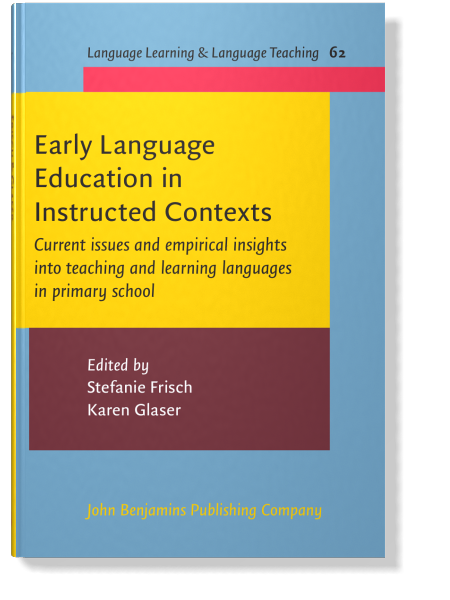
In:Early Language Education in Instructed Contexts: Current issues and empirical insights into teaching and learning languages in primary school
Edited by Stefanie Frisch and Karen Glaser
[Language Learning & Language Teaching 62] 2025
► pp. 118–140
Get fulltext
Chapter 6L2 spelling predictors of young German learners of
English
Available under the Creative Commons Attribution-NonCommercial-NoDerivatives (CC BY-NC-ND) 4.0 license.
For any use beyond this license, please contact the publisher at rights@benjamins.nl.
Published online: 22 May 2025
https://doi.org/10.1075/lllt.62.06mla
https://doi.org/10.1075/lllt.62.06mla
Abstract
Specific cognitive and linguistic factors have
been shown to underpin second language (L2) spelling attainment
across different alphabetic orthographies. While previous studies
into young English language learners’ (YELLs) literacy development
have focused predominantly on reading skills,
empirical findings on L2 spelling are scarce. The present study
investigated how cognitive and linguistic factors as well as reading
skills affect L2 English spelling performance in YELLs from a first
language (L1) German background (n = 75). Multiple
regression analyses and a mediation model revealed that L2 reading
comprehension and L2 reading accuracy predicted learners’ L2
spelling outcomes. Learners’ cognitive and linguistic abilities did
not predict spelling directly, whereas phonological awareness
and L2 grammar had predictive effects on spelling mediated by
L2 reading comprehension and reading accuracy.
Article outline
- 1.Introduction
- 2.Literature review and theoretical background
- 2.1Cross-linguistic influence
- 2.2Predictors of L2 spelling
- 2.3Differences in English and German orthographies
- 3.Research aims and methodology
- 3.1The present study
- 3.2Participants
- 3.3Data elicitation and assessment measures
- 3.3.1Cognitive measures
- 3.3.1.1Non-verbal intelligence
- 3.3.1.2Phonological short-term memory
- 3.3.1.3Working memory
- 3.3.1.4Phonological awareness
- 3.3.2L2 English linguistic measures
- 3.3.2.1L2 English receptive grammar
- 3.3.2.2L2 English receptive vocabulary knowledge
- 3.3.3L2 English reading measures
- 3.3.3.1L2 Reading comprehension
- 3.3.3.2L2 Oral reading fluency (rate and accuracy)
- 3.3.4L2 Spelling measures
- 3.3.4.1L2 real word spelling test
- 3.3.1Cognitive measures
- 4.Results: The role of cognitive, linguistic, and reading skills in L2 spelling
- 5.Discussion
- 5.1L2 reading skills as the strongest predictors of L2 spelling
- 5.2Predictive effects of L2 grammar and phonological awareness on spelling mediated by reading skills
- 5.3Limitations
- 6.Conclusion and implications for the classroom
Note References

References (77)
Abbott, R. D., Berninger, V. W., & Fayol, M. (2010). Longitudinal
relationships of levels of language in writing and between
writing and reading in grades 1 to
7. Journal of Educational
Psychology, 102(2), 281–298.
Baddeley, A. D., Gathercole, S. E., & Papagno, C. (1998). The
phonological loop as a language learning
device. Psychological
Review, 105(1), 158–173.
Berninger, V. W., Abbott, R. D., Nagy, W., & Carlisle, J. (2009). Growth
in phonological, orthographic, and morphological awareness
in grades 1 to 6. Journal of
Psycholinguistic
Research, 39(2), 141–163.
BIG-Kreis (2015). Der
Lernstand im Englischunterricht am Ende von Klasse 4.
Ergebnisse der
BIG-Studie. Domino Verlag.
Bosman, A. M. T., & van Orden, G. C. (1997). Why
spelling is more difficult than
reading. In C. A. Perfetti, L. Rieben, & M. Fayol (Eds.), Learning
to spell: Research, theory, and practice across
languages (pp. 173–194). Lawrence Erlbaum Associates.
Caravolas, M., Lervåg, A., Mikulajová, M., Defior, S., Seidlová-Málková, G., & Hulme, C. (2019). A
cross-linguistic, longitudinal study of the foundations of
decoding and reading comprehension
ability. Scientific Studies
of
Reading, 23(5), 386–402.
Caravolas, M., Lervåg, A., Mousikou, P., Efrim, C., Litavský, M., Onochie-Quintanilla, E., Salas, N., Schöffelová, M., Defior, S., Mikulajová, M., Seidlová-Málková, G., & Hulme, C. (2012). Common
patterns of prediction of literacy development in different
alphabetic
orthographies. Psychological
Science, 23(6), 678–686.
Chiappe, P., Siegel, L., & Gottardo, A. (2002). Reading-related
skills of kindergartners from diverse linguistic
backgrounds. Applied
Psycholinguistics, 23, 95–116.
Clahsen, H., & Felser, C. (2006). Grammatical
processing in language
learners. Applied
Psycholinguistics, 27(1), 3–42.
(2018). Some
notes on the shallow structure
hypothesis. Studies in Second
Language
Acquisition, 40(3), 693–706.
Cook, V. J. (1997). L2
users and English
spelling. Journal of
Multilingual and Multicultural
Development, 18(6), 474–488.
Cook, V. J., & Bassetti, B. (2005). An
introduction to researching second language writing
systems. In V. J. Cook & B. Bassetti (Eds.), Second
language writing
systems, (pp. 1–6). Routledge.
Cormier, P., & Kelson, S. (2000). The
roles of phonological and syntactic awareness in the use of
plural morphemes among children in French
immersion. Scientific Studies
of
Reading, 4(4), 267–293.
Council of
Europe (2020). Common
European Framework of Reference for Languages: Learning,
teaching, assessment — Companion
volume. Council of Europe Publishing. [URL]
Dunn, L. M., Dunn, D. M., & Styles, B. (2009). The
British Picture Vocabulary Scale — Third
Edition. GL Assessment.
Ehri, L. C. (2000). Learning
to read and learning to spell: Two sides of a
coin. Topics in Language
Disorders, 20(3), 19–36.
Engel de Abreu, P. M. J., & Gathercole, S. E. (2012). Executive
and phonological processes in second-language
acquisition. Journal of
Educational
Psychology, 104(4), 974–986.
Esser, G., Wyschkon, A., & Ballaschk, K. (2008). Basisdiagnostik
umschriebener Entwicklungsstörungen im Grundschulalter
(BUEGA). Hogrefe.
Fraser, C., Massey-Garrison, A., & Geva, E. (2016). Problems
with
reading. In X. Chen, V. Dronjic, & R. Helms-Park (Eds.), Reading
in a second language: Cognitive and psycholinguistic
issues (pp. 236–281). Routledge.
Frisch, S., & Rymarczyk, J. (2021). Current
research into young foreign language learners’ literacy
skills. Peter Lang.
Genesee, F., Geva, E., Dressler, C., & Kamil, M. (2006). Synthesis:
Cross-linguistic
relationships. In D. August & T. Shanahan (Eds.), Developing
literacy in second-language learners: Report of the National
Literacy Panel on language minority children and
youth (pp. 153–174). Lawrence Erlbaum Associates.
Geva, E., & Ryan, E. B. (1993). Linguistic
and cognitive correlates of academic skills in first and
second languages. Language
Learning, 43(1), 5–42.
Geva, E., & Siegel, L. S. (2000). Orthographic
and cognitive factors in the concurrent development of basic
reading skills in two
languages. Reading and
Writing, 12, 1–30.
Glaser, K. (2021). Scaffolding
creative writing in the primary EFL classroom: Exploring the
role of picture dictionaries and composition guidelines in
the creation of Elfchen
poems. In S. Frisch & J. Rymarczyk (Eds.), Current
research into young foreign language learners’ literacy
skills (pp. 257–287). Peter Lang.
Halatschev, N., Ivanic, A., Kinze, J., & May, P. (2018). KEKS
4 Englisch Übergang — Kompetenzerfassung in Kindergarten und
Schule. Cornelsen.
Harrison, G. L. (2021). Error
analyses and the cognitive or linguistic influences on
children’s spelling: Comparisons between first- and
second-language
learners. Canadian Journal of
Applied
Linguistics, 24(3), 79–97.
Harrison, G., Goegan, L. D., Jalbert, R., McManus, K., Sinclair, K., & Spurling, J. (2016). Predictors
of spelling and writing skills in first- and second-language
learners. Reading and
Writing, 29(1), 69–89.
Hempel, M., Kötter, M., & Rymarczyk, J. (2018). Fremdsprachenunterricht
in der Grundschule in den Bundesländern Deutschlands: Eine
Bestandsaufnahme des Status quo und seiner gewünschten
Weiterentwicklung. Peter Lang.
Jeon, E. H., & Yamashita, J. (2014). L2
reading comprehension and its correlates: A
meta-analysis. Language
Learning, 64(1), 160–212.
Jongejan, W., Verhoeven, L., & Siegel, L. S. (2007). Predictors
of reading and spelling abilities in first- and
second-language
learners. Journal of
Educational
Psychology, 99(4), 835–851.
Joshi, R. M., Treiman, R., Carreker, S., & Moats, L. C. (2008). How words cast their spell. American Educator, 32(4), 6–16.
Kahn-Horwitz, J., Sparks, R. L., & Goldstein, Z. (2012). Relevance
of the linguistic coding difference hypothesis to English as
an additional language literacy in
Israel. In M. Leikin, M. Schwartz, & Y. Tobin (Eds.), Current
issues in
bilingualism (pp. 21–42). Springer.
Katz, L., & Frost, R. (1992). Reading
in different orthographies: The orthographic depth
hypothesis. In R. Frost (Ed.), Orthography,
phonology, morphology and meaning in advances in
Psychology (pp. 67–84). Elsevier.
Keilty, M., & Harrison, G. L. (2015). Linguistic
and literacy predictors of early spelling in first and
second language
learners. Canadian Journal of
Applied
Linguistics, 18(1), 87–106.
Kersten, K. (2023). The
proximity of stimulation hypothesis: Investigating the
interplay of social and instructional variables with the
cognitive-linguistic skills of young L2
learners. In K. Kersten & A. Winsler (Eds.), Understanding
variability in second language acquisition, bilingualism,
and cognition: A multi-layered
perspective (pp. 131–159). Routledge.
Kersten, K., Bruhn, A.-C., Ponto, K., Böhnke, J., & Greve, W. (2018). Teacher
Input Observation Scheme
(TIOS). Studies on
Multilingualism in Language
Education, 4, Hildesheim University.
Kersten, K., Piske, T., Rohde, A., Steinlen, A. K., Weitz, M., Couve de Murville, S., & Kurth, S. (2012). ELIAS
Grammar Test II. Studies on
Multilingualism in Language Education,
1. Hildesheim University.
Koch, M., Kersten, K., & Greve, W. (2021). Implicational
scaling in L2 receptive grammatical skills: Deterministic or
probabilistic? [Paper
presentation]. AAAL, University of Houston.
Koda, K. (2007). Reading
and language learning: Crosslinguistic constraints on second
language reading
development. Language
Learning, 57, 1–44.
Landerl, K. (2005). Reading
acquisition in different orthographies: Evidence from direct
comparisons. In R. Malatesha Joshi & P. G. Aaron (Eds.), Handbook
of orthography and
literacy, (pp. 513–530). Routledge.
Martin, K. I., Lawson, E., Carpenter, K., & Hummer, E. (2020). English
word and pseudoword spellings and phonological awareness:
Detailed comparisons from three L1 writing
systems. Frontiers in
Psychology, 11, 1309.
McCutchen, D. (1996). A
capacity theory of writing: Working memory in
composition. Educational
Psychology
Review, 8(3), 299–325.
Miralpeix, I., & Muñoz, C. (2018). Receptive
vocabulary size and its relationship to EFL language
skills. International Review
of Applied Linguistics in Language
Teaching, 56(1), 1–24.
Mlakar, H. (2022). Cognitive
mechanisms in L1 and L2 spelling: A
review [Paper for conference
proceedings]. European
Conference on Literacy
2022, Dublin,
Ireland. [URL]
Mlakar, H., Hirst-Plein, J., & Koch, M. J. (2024). Spelling
error analysis in young English language learners from a
German background: A comparison of three literacy
intervention
programmes. JESLA — Journal
of the European Second Language
Association, 8(1), 131–147.
Mlakar, H., & Schilk, M. (in
press). L2 English reading,
spelling, and cognitive-linguistic development: Evaluating
the effects of phonics versus whole word instruction in L1
German elementary
students. Language &
Literacy.
Moats, L. C. (2005). How
spelling supports reading: And why it is more regular and
predictable than you
think. American
Educator, 12–22, 42–43. [URL]
(2009). Knowledge
foundations for teaching reading and
spelling. Reading and
Writing, 22(4), 379–399.
(2019). Phonics
and spelling: Learning the structure of language at the word
level. In D. Kilpatrick, R. Joshi, & R. Wagner (Eds.), Reading
development and difficulties: Bridging the gap between
research and
practice (pp. 39–62). Springer.
Moll, K., Ramus, F., Bartling, J., Bruder, J., Kunze, S., Neuhoff, N., Streiftau, S., Lyytinen, H., Leppänen, P. H., Lohvansuu, K., Tóth, D., Honbolygó, F., Csépe, V., Bogliotti, C., Iannuzzi, S., Démonet, J., Longeras, E., Valdois, S., George, F., Soares-Boucaud, I., Heuzey, M. F., Billard, C., O’Donovan, M. C., Hill, G., Williams, J., Brandeis, D., Maurer, U., Schulz, E., Mark, S. V., Müller-Myhsok, B., Schulte-Körne, G., & Landerl, K. (2014). Cognitive
mechanisms underlying reading and spelling development in
five European
orthographies. Learning and
Instruction, 29, 65–77.
Niolaki, G. Z., Vousden, J. I., Terzopoulos, A., Taylor, L. M., Sephton, S., & Masterson, J. (2020). Predictors
of single word spelling in English speaking children: A
cross sectional
study. Journal of Research in
Reading, 43(4), 577–596.
Niolaki, G. Z., Vousden, J., Terzopoulos, A., Shepherd, D. L., Debney, L., & Masterson, J. (2022). Spelling
predictors: Investigating the role of phonological ability
and rapid naming in a large cross-sectional British
study. Learning and
Instruction, 80, 101635.
Petermann, F., & Petermann, U. (2011). Wechsler
Intelligence Scale for Children
(WISC-IV). Pearson Assessment.
Ponto, K. (2024). Die
Erfassung des rezeptiven Wortschatzes im Fremdsprachenerwerb
in der Grundschule — eine testkritische
Untersuchung [Manuscript in
preparation]. University of Hildesheim.
Purcell, J. J., Jiang, X., & Eden, G. F. (2017). Shared
orthographic neuronal representations for spelling and
reading. NeuroImage, 147, 554–567.
Russak, S., & Zaretsky, E. (2022). Investigating
spelling across typologically diverse
orthographies. Written
Language and
Literacy, 25(1), 1–10.
Rymarczyk, J. (2010). Früher
Schriftspracherwerb in der ersten Fremdsprache Englisch bei
Kindern mit
Migrationshintergrund. Forum
Sprache. Die Online-Zeitschrift für Fremdsprachenforschung
und
Fremdsprachenunterricht, 4, 60–78. [URL]
(2021). Teachers’
diagnostic skills in feedback on German primary school
students’ first attempts to spell in
English. In S. Frisch & J. Rymarczyk (Eds.), Current
research into young FL and EAL learners’ literacy
skills (pp. 25–51). Peter Lang.
Rymarczyk, J., & Musall, A. (2010). Reading
skills of first graders who learn to read and write in
German and
English. In B. Diehr & J. Rymarczyk (Eds.), Researching
literacy in a foreign language among primary school
learners. Forschung zum Schrifterwerb in der Fremdsprache
bei
Grundschülern (pp. 69–88). Peter Lang.
Schrader, A., & Glaser, K. (2023). Fostering
literacy skills in the primary English classroom: A
Design-Based Research (DBR)
project. In E. Wilden (Ed.), Standortbestimmungen
in der
Fremdsprachenforschung (pp. 244–259). wbv.
Sparks, R. L., Patton, J., Ganschow, L., Humbach, N., & Javorsky, J. (2008). Early
first-language reading and spelling skills predict later
second-language reading and spelling
skills. Journal of
Educational
Psychology, 100(1), 162–174.
Steinlen, A. (2021). English
in elementary schools. Research and implications on minority
and majority language children’s reading and writing skills
in regular and bilingual
programs. Narr.
Stock, C., Marx, P., & Schneider, W. (2017). BAKO
1–4. Basiskompetenzen für
Lese-Rechtschreibleistungen. Hogrefe.
Treiman, R. (2017). Learning
to spell words: Findings, theories, and
issues, Scientific Studies of
Reading, 21(4), 265276.
Wade-Woolley, L., & Siegel, L. S. (1997). The
spelling performance of ESL and native speakers of English
as a function of reading
skill. Reading and
Writing, 9(5–6), 387–406.
Wolter, B., & Helms-Park, R. (2016). The
role of lexical knowledge in second language
reading. In X. Chen, V. Dronjic, & R. Helms-Park (Eds.), Reading
in a second language: Cognitive and psycholinguistic
issues (pp. 133–158). Routledge.
Yeung, S. S., Siegel, L. S., & Chan, C. K. (2013). Effects
of a phonological awareness program on English reading and
spelling among Hong Kong Chinese ESL
children. Reading and
Writing, 26(5), 681–704.
Zaretsky, E. (2020). English
spelling acquisition by English language learners from
Spanish-speaking background: The role of cognitive and
linguistic resources and L1 reading
status. Cognitive
Development, 55, 100918.