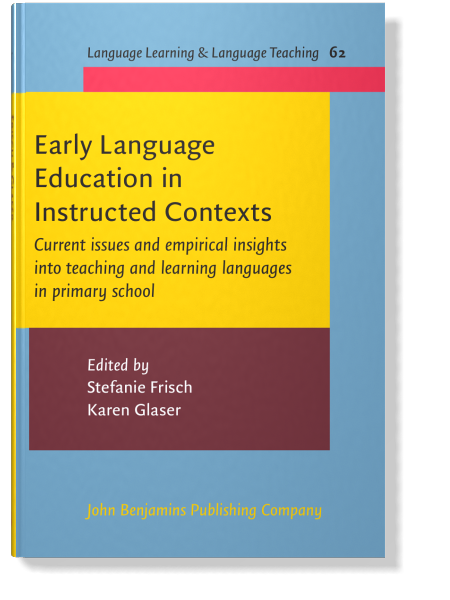
In:Early Language Education in Instructed Contexts: Current issues and empirical insights into teaching and learning languages in primary school
Edited by Stefanie Frisch and Karen Glaser
[Language Learning & Language Teaching 62] 2025
► pp. 2–18
Get fulltext
Chapter 1Early language education in instructed contexts
An introduction
Available under the Creative Commons Attribution-NonCommercial-NoDerivatives (CC BY-NC-ND) 4.0 license.
For any use beyond this license, please contact the publisher at rights@benjamins.nl.
Published online: 22 May 2025
https://doi.org/10.1075/lllt.62.01gla
https://doi.org/10.1075/lllt.62.01gla
Article outline
- 1.On the genesis of this book
- 2.Early Language Education in Instructed Contexts (ELEIC)
- 2.1Global scope and curricular trends
- 2.2Research trends
- 2.2.1Assessment and teaching practices
- 2.2.2Emergent L2 literacy in instructed contexts
- 2.2.3Teaching and learning materials
- 2.2.4Teacher, parent and learner views of early language education
- 3.The papers in this volume
References

References (59)
Agudo, R. R. (2021). Can
we rid language departments of the
f-word? Inside Higher
Ed. Retrieved
from [URL]
Alsoufi, E., & AbuSeileek, A. (2021). A
meta-analysis of studies on the effectiveness of using games
strategies in English language learning and
teaching. International
Journal of Linguistics, Literature and
Translation, 4(9), 179–193.
Bassetti, B. (2009). Orthographic
input and second language
phonology. In T. Piske & M. Young-Scholten (Eds.), Input
matters in
SLA (pp. 191–206). Multilingual Matters.
BIG-Kreis
(Ed.). (2015). Der
Lernstand im Englischunterricht am Ende von Klasse 4.
Ergebnisse der
BIG-Studie. Domino Verlag. Retrieved
from [URL]
Britton, M. (2021). Assessment
for learning in primary language learning and
teaching. Multilingual Matters.
Carmel, R. (2022). Parents’
discourse on English for young
learners. Language Teaching
Research, 26(1), 141–159.
Chalmers, H., Faitaki, F., & Murphy, V. (2023). Setting
research priorities for English as an Additional Language:
What do research users want from EAL
research? Teaching Languages
to Young
Learners, 6(1), 5–31.
Copland, F., Garton, S. & Barnett, C. (2024). Global
practices in teaching English to young learners: Ten years
on. British Council. Retrieved
from [URL]
De Wilde, V. (2023). Lexical
characteristics of young L2 English learners’ narrative
writing at the start of formal
instruction. Journal of
Second Language
Writing, 59, 100960.
De Wolf, S., Smit, N., & Lowie, W. (2017). Influences
of early English language teaching on oral
fluency. ELT
Journal, 71(3), 341–353.
Duscha, M. (2007). Der
Einfluss der Schrift auf das Fremdsprachenlernen in der
Grundschule. Doctoral
dissertation. Technische Universität Braunschweig.
European
Commission (2023). Key
data on teaching languages at school in Europe. 2023
edition. Eurydice Report. Retrieved
from [URL]
Garton, S., & Copland, F. (2019). Introduction. In S. Garton & F. Copland (Eds.), The
Routledge handbook of teaching English to young
learners (pp. 1–10). Routledge.
Garton, S., Copland, F., Meke, E., Lopez-Gopar Zein, S., & Kirkgöz, Y. (2024). Emerging
patterns in global primary English language
teaching. Paper presented at
the 5th ELLRA
Webinar, 7 May
2022.
Hoang, V. V. (2016). Renovation
in curriculum design and textbook development: An effective
solution to improving the quality of English teaching in
Vietnamese schools in the context of integration and
globalization. VNU Journal of
Science: Education
Research, 32(4), 9–20.
Holtappels, P. (2022). Automatisierte
Worterkennung im Englischunterricht der Primarstufe. Onset-,
Reim- und Ganzwortebene als mögliche Zugänge zur
Schriftsprache im frühen
Englischunterricht. Peter Lang.
Inostroza, M. J., Perez-Villalobos, C., & Tabalí, P. (2024). Chilean
primary learners’ motivation and attitude towards English as
a foreign language. Education
Sciences, 14(3), 262.
Jin, L., & Cortazzi, M. (2019). Early
English language learning in East
Asia. In S. Garton & F. Copland (Eds.), The
Routledge handbook of teaching English to young
learners (pp. 477–492). Routledge.
Kersten, K. (2021). L2
input and characteristics of instructional techniques in
early foreign language classrooms: Underlying theory and
pedagogical practice. The
European Journal of Applied Linguistics and
TEFL, 10, 27–59.
Kersten, K., Bruhn, A.-C., Ponto, K., Böhnke, J., & Greve, W. (2018). Teacher
Input Observation Scheme
(TIOS). Studies on
Multilingualism in Language
Education, 4, Hildesheim University.
Kim, T. Y. (2012). The
L2 motivational self system of Korean EFL students:
Cross-grade survey
analysis. English
Teaching, 67(1), 29–56.
Klippel, F. (2000). Englisch
in der Grundschule: Handbuch für einen kindgemäßen
Fremdsprachenunterricht. Cornelsen Scriptor.
Kolb, A., & Schocker, M. (2021). Teaching
English in the primary school: A task-based introduction for
pre- and in-service
teachers. Klett Kallmeyer.
Lagerwaard, H. D. (2022). Implementing
agency-based approaches in upper-primary English language
education. In D. Valente & D. Xerri (Eds.), Innovative
practices in early English language
education (pp. 37–55). Palgrave Macmillan.
Lázaro-Ibarrola, A., & Hidalgo, M. A. (2024). Collaborative
writing among young EFL learners in a school context:
Product and process. Language
Learning
Journal, 52(3), 285–300.
Le, V. C. (2019). Unpacking
the complexity of learning to teach English to young
learners: A narrative
inquiry. In S. Zein, & S. Garton (Eds.), Early
language learning and teacher
education (pp. 41–58). Multilingual Matters.
Legutke, M., Müller-Hartmann, A., & Schocker-von Ditfurth, M. (2014). Teaching
English in the primary
school (2nd ed.). Klett.
Leung, C. (2019). English
as an additional language: Integrating school-aged learners
into mainstream
curriculum. In X. Gao (Ed.), Second
handbook of English language
teaching (pp. 297–316). Springer.
Li, Y., Han, Y., & Gao, X. (2019). Young
learners’ motivation for learning
English. In S. Garton & F. Copland (Eds.), The
Routledge handbook of teaching English to young
learners (pp. 60–72). Routledge.
Littlejohn, A. (2022). Integrating
language learning into education in the primary English
classroom. In D. Valente & D. Xerri (Eds.), Innovative
practices in early English language
education. (pp. 15–36). Palgrave Macmillan.
Macrory, G. (2021). ‘Commas
in the air’: Young children’s experiences of learning the
orthographies of French and Spanish as a foreign
language. In S. Frisch & J. Rymarczyk (Eds.), Current
research into young foreign language learners‘ literacy
skills (pp. 169–196). Peter Lang.
Martínez-Flor, A., Sánchez-Hernández, A., & Barón, J. (2023). L2
pragmatics in action: Teachers, learners and the
teaching-learning interaction
process. In A. Martínez-Flor, A. Sánchez-Hernández & J. Barón (Eds.), L2
pragmatics in
action (pp. 3–27). John Benjamins.
Mestres, E. T., & Lundberg, G. (2011). The
teacher’s role: What is its significance in early language
learning? In J. Enever (Ed.), ELLiE:
Early language learning in
Europe (pp. 81–102). British Council.
Mihaljević Djigunović, J., & Lopriore, L. (2011). The
learner: Do individual differences
matter? In J. Enever (Ed.), ELLiE:
Early language learning in
Europe (pp. 43–59). British Council.
Miller, I. K., Cunha, M. I., Bezerra, I. C., Nóbrega, A. N., Ewald, C. X., & Braga, W. G. (2019). Teaching
English to young learners: Some reflective voices from Latin
America. In S. Garton & F. Copland (Eds.), The
Routledge handbook of teaching English to young
learners (pp. 508–522). Routledge.
Mourão, S., Leslie, C., Moreira, M. A. & Monteiro, E. (2021). Battling
against a traditional assessment culture: The case of early
English learning in
Portugal. In S. Frisch & J. Rymarczyk (Eds.), Current
research into young foreign language learners‘ literacy
skills (141–164). Peter Lang.
Murphy, V. A. (2014). Second
language learning in the early school years: Trends and
contexts. Oxford University Press.
Proctor, C. P., Carlo, M., August, D., & Snow, C. (2005). Native
Spanish-speaking children reading in English: Toward a model
of comprehension. Journal of
Educational
Psychology, 97(2), 246–256.
Reckermann, J. (2018). Reading
authentic English picture books in the primary school EFL
classroom. A study of reading comprehension, reading
strategies and FL
development Peter Lang.
Rendón Romero, S. I., Navarro Pablo, M., & García Jiménez, E. (2021). Using
phonics to develop the emergent English literacy skills of
Spanish learners. Porta
Linguarum, 35, 111–128.
Rokita-Jaśkow, J. (2019). Parental
involvement in very early FL
education. In J. Rokita-Jaśkow & M. Ellis (Eds.), Early
instructed second language acquisition: Pathways to
competence (pp. 191–205). Multilingual Matters.
Rymarczyk, J. (2016). Early
reading and writing in the foreign language classroom —
maybe not as controversial as one might
think. Babylonia, 2(2016), 53–57.
Rymarczyk, J., & Musall, A. (2010). Reading
skills of first graders who learn to read and write in
German and
English. In B. Diehr & J. Rymarczyk (Eds.), Researching
literacy in a foreign language among primary school
learners. Forschung zum Schrifterwerb in der Fremdsprache
bei
Grundschülern (pp. 69–88). Peter Lang.
Saban, M., Grünke, M., & Kahn-Horwitz, J. (2024). Enhancing
spelling competence for English as a foreign language young
learners through digital escape
rooms. Frontiers in
Education, 9, 434336.
Sammour-Shehadeh, R., Kahn-Horwitz, J., & Prior, A. (2023). Spelling
English as a foreign language: A narrative review of
cross-language influences due to distance in writing system,
orthography and
phonology. Reading and
Writing, 36(8), 2147–2173.
Schauer, G. A. (2019). Teaching
and learning English in the primary school — Interlanguage
pragmatics in the EFL
context. Springer.
Schrader, A., & Glaser, K. (2023). Fostering
literacy skills in the primary English classroom: A
Design-Based Research (DBR)
project. In Wilden, E., Alfes, L., Cantone, K., Cikrikci, S. & Reimann, D. (Eds.), Standortbestimmungen
in der
Fremdsprachenforschung (pp. 244–259). wbv.
Spolsky, B. (2018). Language
policy in French colonies and after
independence. Current Issues
in Language
Planning, 19(3), 231–315.
Ssentanda, M. E., & Ngwaru, J. M. (2019). Early
English language learning in Africa: Challenges and
opportunities. In S. Garton & F. Copland (Eds.), The
Routledge handbook of teaching English to young
learners (pp. 461–476). Routledge.
Takahashi, S. (2019). Individual
learner considerations in SLA and L2
pragmatics. In N. Taguchi (Ed.), The
Routledge handbook of second language acquisition and
pragmatics (pp. 429–444). Routledge.
Terasawa, T. (2022). What
made primary English education in Japan different from the
global trend? A policy process
analysis. Linguistics and
Education, 71, 101084.
Treutlein, A., Landerl, K., & Schöler, H. (2013). (Frühe)
Schrifteinführung im Englischunterricht — Überlegungen zu
Zeitpunkt und Methode auf Grundlage von psycholinguistischen
Studien. Zeitschrift für
Fremdsprachenforschung, 24(1), 3–27.
Weth, C. (2010). “Wörter,
Wendungen und Sätze so aus dem Gedächtnis schreiben, dass
sie eindeutig erkennbar sind”: Überlegungen zum Umgang mit
Schrift im frühen
Fremdsprachenunterricht. In B. Diehr & J. Rymarczyk (Eds.), Researching
literacy in a foreign language among primary school
learners. (pp. 147–165). Peter Lang.