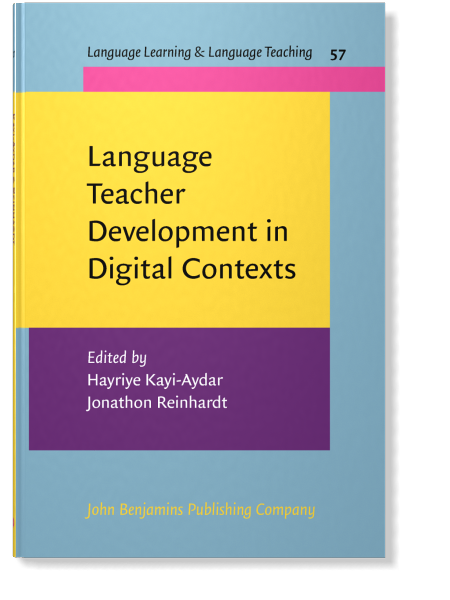
In:Language Teacher Development in Digital Contexts
Edited by Hayriye Kayi-Aydar and Jonathon Reinhardt
[Language Learning & Language Teaching 57] 2022
► pp. 179–192
Chapter 9Developing online language teacher identities
Interdisciplinary insights
Published online: 20 January 2022
https://doi.org/10.1075/lllt.57.09rei
https://doi.org/10.1075/lllt.57.09rei
Abstract
Informed by the other studies of the volume, this chapter argues that online language teacher education (OLTE) should make
five considerations in reconceptualizing curricula and provides examples of learning activities that address each. First it should
acknowledge that online digital language use differs considerably from in-person language equivalents, and second, that technology
knowledge includes not only how to teach online but what digital language use is. Third, it should recognize that learners and teachers
have modern techno-identities developed not only in their academic but their everyday lives as well. Fourth, it should leverage the power
of the Internet to develop translanguacultural awareness and fifth, recognize that social presence is key to socio-collaborative learning,
both in-person and online.
Article outline
- A new imperative
- Reconceptualizing OLTE
- Technology-mediated language use
- Technological knowledge
- Modern techno-identities
- Social presence and community
- Translanguacultural awareness
- Conclusion
References

References (37)
Bax, S. (2011) Normalisation
revisited: The effective use of technology in language education. International
Journal of Computer Assisted Language Learning and
Teaching, 1(2), 1–15.
Baym, N. (1998). The
emergence of on-line
community. In S. G. Jones (Ed.), New
media cultures, Vol. 2. Cybersociety 2.0: Revisiting computer-mediated communication and
community (pp. 35–68). Sage.
Boczkowski, P. (1999). Mutual
shaping of users and technologies in a national virtual community. Journal of
Communication, 49(2), 86–108.
Garrison, R., Anderson, T., & Archer, W. (2000). Critical
inquiry in a text-based environment: Computer conferencing in higher
education. The Internet and Higher
Education, 2(2–3), 87–105.
Goertler, S., & Winke, P. (2008). The
effectiveness of technology-enhanced foreign language
teaching. In Goertler, S. & Winke, P. (Eds.), Opening
doors through distance language education: Principles, perspectives, and
practices (pp. 233–260). CALICO Publications.
Herring, S. C. (2004). Computer-mediated discourse analysis: An approach to
researching online
behavior. In S. A. Barab, R. Kling, & J. H. Gray (Eds.), Learning
in doing: Designing for virtual communities in the service of
learning (pp. 338–376). Cambridge University Press.
Hubbard, P., & Levy, M. (2006). Teacher
education in CALL. John Benjamins.
Johnson, K. (2016) Practitioner
and professional development research. Language Teaching
Research, 20(2) 143–145.
Johnson, K., & Golombek, P. (2011). The
transformative power of narrative in second language teacher education. TESOL
Quarterly, 45(3), 486–509.
Kiddle, T., & Prince, T. (2019). Digital
and online approaches to language teacher
education. In S. Walsh & S. Mann (Eds.), The
Routledge handbook of English language teacher
education. Routledge.
Kiesler, S., Siegel, J., & McGuire, T. W. (1984). Social
psychological aspects of computer-mediated communication. American
Psychologist, 39(10), 1123–1134.
Koehler, M., & Mishra, P. (2009). What
is technological pedagogical content knowledge? Contemporary Issues in Technology
and Teacher
Education, 9(1). Retrieved
on 7 July 2021 from [URL]
Kozinets, R. (1998). On
netnography: Initial reflections on consumer research investigations of
Cyberculture. In J. Alba & W. Hutchinson (Eds.), Advances
in consumer
research, (Vol. 25, pp. 366–371). Association for Consumer Research.
Lave, J., & Wenger, E. (1991). Situated
learning: Legitimate peripheral participation. Cambridge University Press.
Lomicka, L., & Lord, G. (2011). A
tale of tweets: Analyzing microblogging among language
learners. System, 40, 48–63.
Murray, D., & Christison, M. (2018). Online
language teacher education: A Review of the literature. Aqueduto, Norwich.
New London Group. (1996). A pedagogy of multiliteracies:
Designing social futures. Harvard Educational
Review, 66(1), 60–92.
Pettes-Guikema, J., & Williams, L. (2014). Digital
literacies in foreign language education: Research, perspectives, and best
practices. CALICO.
Reinhardt, J., & Thorne, S. (2019). Digital
literacies as emergent multifarious
repertoires. In N. Arnold & L. Ducate (Eds.), Engaging
language learners through CALL: From theory and research to informed
practice (pp. 208–239). Equinox.
Reinhardt, J. (2020). Metaphors
for social media-enhanced foreign language teaching and learning. Foreign Language
Annals, 53(2), 234–242.
(2019). Gameful
second and foreign language teaching and learning: Theory, research, and
practice. Palgrave.
(In
press). Everyday technology-mediatized language learning: New opportunities and
challenges. In C. Lütge & M. Stannard (Eds.), Foreign
language learning in the digital age: Theory and pedagogy for developing
literacies. Routledge.
Schmid, E. C. (2017). Teacher
education in computer-assisted language learning: A sociocultural and linguistic
perspective. Bloomsbury.
Short, J., Williams, E., & Christie, B. (1976). The
social psychology of telecommunications. John Wiley.
Shulman, L. (1987). Knowledge
and teaching: Foundations of the new reform. Harvard Educational
Review, 57(1), 1–22.
Thorne, S. L. (2003). Artifacts and
cultures-of-use in intercultural communication. Language Learning and
Technology, 7(2), 38–67.
Walther, J. (1996). Computer-mediated
communication: Impersonal, interpersonal and hyperpersonal
interaction. Communication
Research, 23(1), 3–43.
Warschauer, M., & Healey, D. (1998). Computers
and language learning: An overview. Language
Teaching, 31, 57–71.
Yates, S. (1996). Oral
and written linguistic aspects of computer
conferencing. In S. Herring (Ed.), Computer-mediated
communication (pp. 29–46). John Benjamins.
Cited by (1)
Cited by one other publication
This list is based on CrossRef data as of 26 november 2025. Please note that it may not be complete. Sources presented here have been supplied by the respective publishers. Any errors therein should be reported to them.