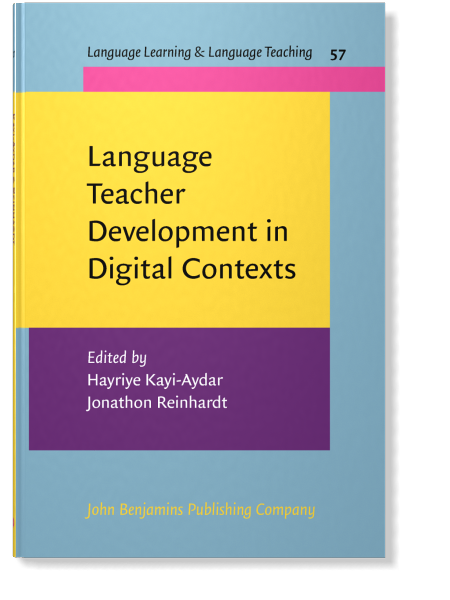
In:Language Teacher Development in Digital Contexts
Edited by Hayriye Kayi-Aydar and Jonathon Reinhardt
[Language Learning & Language Teaching 57] 2022
► pp. 67–90
Chapter 4‘We will have to remember this as teachers’
A micro-analytical approach to student-teacher online interaction and teacher identity
Published online: 20 January 2022
https://doi.org/10.1075/lllt.57.04doo
https://doi.org/10.1075/lllt.57.04doo
Abstract
Applying interaction analysis to transcriptions of online meetings held weekly over a ten-week period between two groups of
student-teachers, this chapter considers how telecollaboration (also known as Virtual Exchange) in teacher education can support the
development of teachers’ digital competences and teacher identity through peer-supported online collaboration. The analysis shows how
sustained use of online collaborative learning allows for moments of alignment and misalignment (dissonance) that afford learning
opportunities for the participants as they become increasingly participative and cohesive in their online professional community.
Article outline
- Development of VE teacher identities
- Identity negotiation explored through interaction analysis
- Context
- Telecollaboration/virtual exchange
- Class description and study participants
- Data analysis through a multimodal interactional approach
- Ongoing development of VE teacher competences and identity
- Analysis 1: Meeting 1
- Analysis 2: Meeting 4
- Analysis 3: Meeting 7
- Analysis 4: Meeting 9
- Discussion
- Conclusion
Acknowledgements References Transcription key

References (50)
Antoniadou, V. (2011). Using
activity theory to understand the contradictions in an online transatlantic collaboration between student-teachers of English as a
Foreign
Language. ReCALL, 23(3), 233–251.
Balaman, U., & Sert, O. (2017). The
coordination of online L2 interaction and orientations to task interface for epistemic
progression. Journal of
Pragmatics 115, 115–129.
Baxter, J. A. (2012). The
impact of professional learning on the teaching identities of higher education
lecturers. The European Journal of Open, Distance and
E-Learning, 15(10), 1–11.
Beauchamp, C., & Thomas, L. (2009). Understanding
teacher identity: An overview of issues in the literature and implications for teacher
education. Cambridge Journal of
Education, 39(2), 175–189.
Beijaard, D. (2019). Teacher
learning as identity learning: models, practices, and topics, Teachers and
Teaching, 25(1), 1–6.
Cheung, Y. L., Ben Said, S., & Park, K. (Eds.). (2015). Advances
and current trends in language teacher identity
research. Routledge.
Delaney, K. K. (2015). Dissonance
for understanding: Exploring a new theoretical lens for understanding teacher identity formation in borderlands of
practice. Contemporary Issues in Early
Childhood, 16(4), 374–389.
Dooly, M. (2013). Speaking
like a ‘glocal’: Using computer-mediated communication in language teacher education to promote network
learning. In S. Ben Said & L. Jun Zhang (Eds.) Language
teachers and teaching: Global perspectives, local
initiatives (pp. 237–255). Routledge.
Dooly, M., & Tudini, V. (2016). 'Now
we are teachers': The role of small talk in student language teachers' telecollaborative task
development. Journal of
Pragmatics, 102, 38-53.
Dooly, M. & O’Dowd, R. (2018). Telecollaboration
in the foreign language classroom: A review of its origins and its application to language teaching
practices. In M. Dooly & R. O’Dowd (Eds.), In this
together: Teachers’ experiences with transnational, telecollaborative language learning
projects (pp. 11–34). Peter Lang.
Dooly, M., & Sadler, R. (2020). “If
you don’t improve, what’s the point?” Investigating the impact of a “flipped” online exchange in teacher
education. ReCALL, 32(1), 4–24.
Ensor, S., Kleban, M., & Christine Rodrigues, C. (2017). Telecollaboration:
Foreign language teachers (re)defining their
role. Alsic, 20(2), 1–40.
EVALUATE
Group. (2019). Evaluating the impact of virtual
exchange on initial teacher education: A European policy
experiment. Research-publishing.net.
Evans, B., & Fitzgerald, R. (2017). The
categorial and sequential work of ‘embodied mapping’ in basketball
coaching. Journal of
Pragmatics, 118, 81–98.
Fuchs, C. (2019). Critical
incidents and cultures-of-use in a Hong Kong–Germany telecollaboration, Language
Learning &
Technology, 23(3), 74–97. https://doi.org/10125/44697
Goodwin, C. (2000). Action
and embodiment within situated human interaction. Journal of
Pragmatics, 32(10), 1489–1522.
Guichon, N. (2009). Training
future language teachers to develop online tutors’ competence through reflective
analysis. ReCALL, 21(2), 166–185.
Hamel, F., & Ryken, A. (2010). Rehearsing
professional roles in community: Teacher identity development in a school-university
partnership. Teacher
Development, 14(3), 335–350.
Hauck, M., Galley, R., & Warnecke, S. (2016). Researching
participatory literacy and positioning in online learning
communities. In F. Farr & L. Murray (Eds), The
Routledge handbook of language learning and
technology (pp. 71–87). Routledge.
Heritage, J. (2012). Epistemics
in action: Action formation and territories of knowledge. Research on Language
& Social
Interaction, 45(1), 1–29.
Heritage, J., & Raymond, G. (2012). Navigating
epistemic landscapes. In J. -P. de Ruiter (Ed.), Questions –
Formal, functional and interactional
perspectives (pp. 179–193). Cambridge University Press.
Ibrahim, N. (2016). Enacting
identities: Children’s narratives on person, place and experience in fixed and hybrid
spaces. Education
Inquiry, 7(1), 69–91.
Jefferson, G. (1988) On
the sequential organization of troubles talk in ordinary conversation. Social
Problems, 35(4), 418–442.
Johnson, H., Ehrlich, S., Watts-Taffe, S., & Williams, C. (2014). Who
am I here? Disrupted identities and gentle shifts when teaching in
cyberspace. Journal of Instructional
Research, 3, 43–54.
Jordan, B., & Henderson, A. (1995). Interaction analysis: Foundations and
practice. The Journal of the Learning
Sciences, 4(1), 39–103.
Kayi-Aydar, H. (2017). A
language teacher’s agency in the development of her professional identities: A narrative case
study. Journal of Latinos and
Education, 18(1), 4–18.
Kehrwald, B. (2010). Being
online: Social presence as subjectivity in online learning. London Review of
Education, 8(1), 39–50.
Kurek, M., & Müller-Hartmann, A. (2019). The
formative role of teaching presence in blended Virtual
Exchange. Language Learning &
Technology, 23(3), 52–73. https://doi.org/10125/44696
Lantz-Andersson, A. (2018). Language
play in a second language: Social media as contexts for emerging sociopragmatic
competence. Education and Information
Technologies, 23(2), 705–724.
Leeferink, H., Koopman, M., Beijaard, D., & Schellings, G. L. M. (2019). Overarching
professional identity themes in student teacher workplace learning. Teachers and
Teaching, 25(1), 69–89.
Luehmann, A. L. (2007). Identity
development as a lens to science teacher preparation. Science
Education, 91(5), 822–839.
Luehmann, A. L., & Tinelli, L. (2008). Teacher
professional identity development with social networking technologies: Learning reform through
blogging. Educational Media
International, 45(4), 323–333.
McLaren, P. (2003). Life
in schools: An introduction to critical pedagogy in the foundations of
education. Allyn and Bacon.
Patton, K., & Parker, M. (2017). Teacher
education communities of practice: More than a culture of collaboration. Teaching
and Teacher
Education, 67, 352-360.
Pavlenko A., & Blackledge A. (2004). Negotiation
of identities in multilingual contexts. Multilingual Matters.
Reinhardt, R., & Chen, H-I. (2013). An
ecological analysis of social networking site-mediated identity
development. In M-N. Lamy & K. Zourou (Eds.) Social
networking for language
education (pp. 11-30). Springer.
Richardson, J. C., & Alsup, J. (2015). From
the classroom to the keyboard: How seven teachers created their online teacher
identities. International Review of Research in Open and Distributed
Learning, 16(1), 142–167.
Satar, H., & Özdener, N. (2008). The
effects of synchronous CMC on speaking proficiency and anxiety: Text versus voice
chat. The Modern Language
Journal, 92(4), 595–613.
Schaefer, L., & Clandinin, D. J. (2019). Sustaining
teachers’ stories to live by: Implications for teacher education. Teachers and
Teaching, 25(1), 54–68.
Schegloff, E. A. (2006). Interaction:
The infrastructure for social institutions, the natural ecological niche for language, and the arena in which culture is
enacted. In N. J. Enfield & S. C. Levinson (Eds.), Roots
of human
society (pp. 70–96). Berg.
Smagorinsky, P., Cook, L. S., Moore, C., Jackson, A. Y., & Fry, P. G. (2004). Tensions
in learning to teach: Accommodation and the development of a teaching
identity. Journal of Teacher
Education, 55(1), 8–24.
Ten Have, P. (2002). The
notion of member is the heart of the matter: On the role of membership knowledge in ethnomethodological
inquiry. Forum Qualitative Sozialforschung / Forum: Qualitative Social
Research, 3(3), 1–19.
Tsui, A. (2003). Understanding
expertise in teaching: Case studies of second language teachers. Cambridge University Press.
Thanaraj, A. (2016). Making
a transition: The development of academics’ role and identity in online
teaching. Practitioner Research in Higher Education
Journal, 10(2), 40–53.
US Department of
Education. (2017). Reimagining the role of
technology in education: 2017 National education technology plan
update. Washington, DC: Office of Educational Technology.
Cited by (2)
Cited by two other publications
Jodairi Pineh, Aiyoub
2024. Review of Meredith, Giles & Stommel (2022): Analysing Digital Interaction. Revista Española de Lingüística Aplicada/Spanish Journal of Applied Linguistics 37:2 ► pp. 769 ff.
This list is based on CrossRef data as of 26 november 2025. Please note that it may not be complete. Sources presented here have been supplied by the respective publishers. Any errors therein should be reported to them.