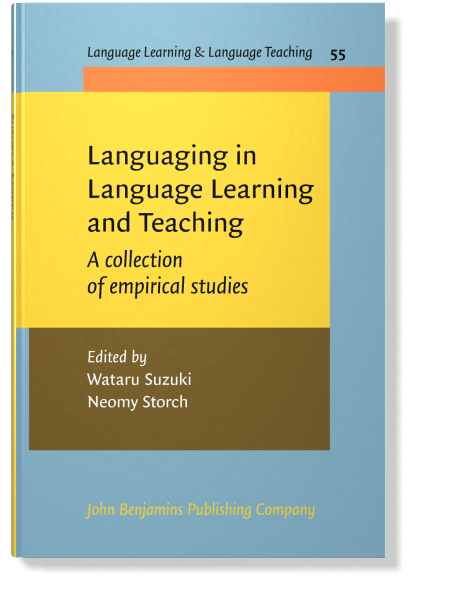
In:Languaging in Language Learning and Teaching: A collection of empirical studies
Edited by Wataru Suzuki and Neomy Storch
[Language Learning & Language Teaching 55] 2020
► pp. 1–16
Introduction
Published online: 14 August 2020
https://doi.org/10.1075/lllt.55.int
https://doi.org/10.1075/lllt.55.int
Article outline
- The theoretical underpinnings of languaging
- Languaging in L2 learning
- Collaborative dialogue
- Self-directed talk
- Written languaging
- The contributions of this volume
References

References (71)
Adams, R. (2003). L2
output, reformulation, and noticing: Implications for IL
development. Language Teaching
Research, 7(3), 347–376.
Ahmed, M. (1994). Speaking
as cognitive regulation: A Vygotskian perspective on dialogic
communication. In J. P. Lantolf & G. Appel (Eds.), Vygotskian
approaches to second language
research (pp. 157–172). Norwood, NJ: Ablex.
Ammar, A., & Hassan, R. M. (2018). Talking
it through: Collaborative dialogue and second language
learning. Language
Learning, 68(1), 46–82.
Antón, M., & DiCamilla, F. (1998). Socio-cognitive
functions of L1 collaborative interaction in the L2
classroom. Canadian Modern Language
Review, 54(3), 314–342.
Arievitch, I. M. (2003). A
potential for an integrated view of development and learning:
Galperin’s contribution to sociocultural
psychology. Mind, Culture, and
Activity, 10(4), 278–288.
Arievitch, I. M., & Haenen, J. P. (2005). Connecting
sociocultural theory and educational practice: Galperin’s
approach. Educational
Psychologists, 40(3), 155–165.
Basterrechea, M., & Leeser, M. J. (2019). Language-related episodes and learner proficiency during collaborative dialogue in CLIL. Language Awareness, 28(2), 97-113.
Berk, L. (1992). Children’s
private speech: An overview of theory and the status of
research. In R. Diaz, & L. Berk (Eds.), Private
speech: From social interaction to
self-regulation (pp. 17–43). Hillsdale, NJ: Lawrence Erlbaum Associates.
Borer, L. (2007). Depth
of processing in private and social speech: Its role in the
retention of word knowledge by adult EAP
learners. Canadian Modern Language
Review, 64(2), 269–295.
Centeno-Cortés, B. (2003). Private
speech in the second language classroom: Its role in internalization
and its link to social
production (Unpublished doctoral
dissertation). The Pennsylvania State University.
Centeno-Cortés, B., & Jiménez Jiménez, A. F. (2004). Problem-solving
tasks in a foreign language: The importance of the L1 in private
verbal thinking. International
Journal of Applied
Linguistics, 14(1), 7–35.
Chi, M. (2000). Self-explaining
expository texts: The dual processes of generating inferences and
repairing mental
models. In R. Glaser (Ed.), Advances
in instructional
psychology (pp. 161–238). Mahwah, NJ: Lawrence Erlbaum Associates.
Chi, M., Bassok, M., Lewis, M. W., Reimann, P., & Glaser, R. (1989). Self-explanations:
How students study and use examples in learning to solve
problems. Cognitive
Science, 13(2), 145–182.
Chi, M., de Leeuw, N., Chiu, M. H., & LaVancher, C. (1994). Eliciting
self-explanations improves
understanding. Cognitive
Science, 18, 439–477.
Diaz, R. M., & Berk, L. E. (Eds.). (1992). Private
speech: From social interaction to
self-regulation. Hillsdale, NJ: Lawrence Erlbaum Associates.
Diaz, R. M., Padilla, K. A. & Weathersby, E. K. (1991). The
effects of bilingualism on preschoolers’ private
speech. Early Childhood Research
Quarterly, 6(3), 377–393.
Dolitsky, M. (2000). Codeswitching
in a child’s monologues. Journal of
Pragmatics, 32(9), 1387–1403.
Frawley, W., & Lantolf, J. P. (1985). Second
language discourse: A Vygotskyan
perspective. Applied
Linguistics, 6(1), 19–44.
Fukuta, J. (2016). Effects
of task repetition on learners’ attention orientation in L2 oral
production. Language Teaching
Research, 20, 321–340.
Gal’perin, P. I. (1969). Stages
in the development of mental
acts. In M. Cole & I. Maltzman (Eds.), A
handbook of contemporary soviet
psychology (pp. 248–273). New York, NY: Basic Books.
(1992). Stage-by-stage
formation as a method of psychological
investigation. Journal of Russian and
East European
Psychology, 30(4), 60–80.
García Mayo, M. d. P. & Imaz Agirre, A. (2019). Task
modality and pair formation method: Their impact on interaction and
LREs among EFL primary school
children. System, 80, 165–175.
Guerrero, M. C. (2018). Going
covert: Inner and private speech in language
learning. Language
Teaching, 51(1), 1–35.
Imai, Y. (2010). Emotions
in SLA: New insights from collaborative learning in an EFL
classroom. Modern Language
Journal, 94(2), 278–292.
Ishikawa, M. (2013). Examining
the effect of written languaging: The role of metanotes as a
mediator of second language
learning. Language
Awareness, 22(3), 220–233.
Ishikwa, M. (2015). Metanotes
(written languaging) in a translation task: Do L2 proficiency and
task outcome matter? Innovation in
Language Learning and
Teaching, 9(2), 115–129.
Ishikawa, M., & Suzuki, W. (2016). The
effects of written languaging on learning the hyopothetical
conditional in
English. System, 58, 97–111.
Jiménez-Jiménez, A. (2015). Problem-solving
activities in bilingual
speakers. International Journal of
Bilingualism, 19(3), 259–281.
Kaivanpanah, S., & Miri, M. (2017). The
effects of task type on the quality of resolving language-related
episodes and vocabulary
learning. TESOL
Journal, 8(4), 920–942.
Lantolf, J. P. (2006). Sociocultural theory and L2: State of the art. Studies in Second Language Acquisition, 28(1), 67-109.
Lapkin, S., Swain, M., & Knouzi, I. (2008). French
as a second language university students learn the grammatical
concept of voice: Study design, materials development, and pilot
data. In J. P. Lantolf & M. Poehner (Eds.), Sociocultural
theory and the teaching of second
languages (pp. 228–255). London: Equinox.
Li, M., & Zhu, W. (2017). Explaining dynamic interactions in wiki-based collaborative writing. Language Learning & Technology, 21(1), 96–120. Retrieved from [URL]
Long, M. (1996). The
role of the linguistic environment in second language
acquisition. In R. William & T. Bhatia (Eds.), Handbook
of second language
acquisition (pp. 413–468). San Diego, CA: Academic Press.
Luria, A. (1961). The
role of speech in the regulation of normal and abnormal
behavior. (J. Tizard (Ed.)). New York, NY: Liveright.
Masuda, K., & Iwasaki, N. (2018). Pair-work
dynamics: Stronger learners’ languaging engagement and learning
outcomes for the Japanese polysemous particles
ni/de. Language and Sociocultural
Theory, 5(1), 46–71.
McCafferty, S. G. (1992). The
use of private speech by adult second language learners: A
cross-cultural study. The Modern
Language
Journal, 76(2), 179–189.
McCafferty, S. (1994). Adult
second language learners’ use of private speech: A review of
studies. Modern Language
Journal, 78(4), 421–436.
Negueruela, E. (2003). Systemic-theoretical
instruction and L2 development: A sociocultural approaching to
teaching-learning and researching L2
learning (Unpublished doctoral
dissertation). The Pennsylvania State University.
(2008). Revolutionary pedagogies: Learning that leads (to) second language development. In J. P. Lantolf & M. E. Poenher (Eds.), Sociocultural theory and the teaching of second languages (pp. 189-227). London: Equinox.
Ohta, A. S. (2001). Second
language acquisition processes in the classroom: Learning
Japanese. Mahwah, NJ: Lawrence Erlbaum Associates.
Pease-Alvarez, L., & Winsler, A. (1994). Cuando
el maestro no habla Español: Children’s bilingual language practices
in the classroom. TESOL
Quarterly, 28(3), 507–535.
Rouhshad, A., & Storch, N. (2016). A
focus on mode: Patterns of interaction in face-to-face and
computer-mediated
contexts. In M. Sato & S. Ballinger (Eds.), Peer
interaction and second language learning. Pedagogical potential and
research
agenda (pp. 267–289). Amsterdam: John Benjamins.
Shin, S-Y., Lidster, R., Sabraw, S., & Yeager, R. (2015). The effects of L2 proficiency differences in pairs on idea units in a collaborative text reconstruction task. Language Teaching Research, 20(3), 366-386.
Smith, H. J. (2007). The social and private worlds of speech: Speech for inter- and intramental activity. The Modern Language Journal, 91(3), 341-356.
Stafford, C. A. (2013). What’s
on your mind? How private speech mediates cognition during initial
non-primary language
learning. Applied
Linguistics, 34(2), 151–172.
Storch, N. (2008). Metatalk
in a pair work activity: Level of engagement and implications for
language development. Language
Awareness, 17(2), 95–114.
Storch, N., & Wigglesworth, G. (2007). Writing
tasks: The effects of
collaboration. In M. d. P. García Mayo (Ed.), Investigating
tasks in formal language
learning (pp. 157–177). Clevedon: Multilingual Matters.
Suzuki, W. (2012). Written
languaging, direct correction, and second language writing
revision. Language
Learning, 62(4), 1110–1133.
(2017). The
effect of quality of written languaging on second language
learning. Writing &
Pedagogy, 8(3), 461–482.
Swain, M. (2006). Languaging,
agency and collaboration in advanced language
proficiency. In H. Byrnes (Ed.), Advanced
language learning: The contribution of Halliday and
Vygotsky (pp. 95–108). London: Continuum.
(2010). Talking-it-through:
Languaging as a source of
learning. In R. Batstone (Ed.), Sociocognitive
perspectives on language use and language
learning (pp. 112–130). Oxford: Oxford University Press.
(2013). The
inseparability of cognition and emotion in second language
learning. Language
Teaching, 46(2), 195–207.
Swain, M., Brooks, L., & Tocalli-Beller, A. (2002). Peer-peer
dialogue as a means of second language
learning. Annual Review of Applied
Linguistics, 22, 171–185.
Swain, M., Kennear, P., & Steinnman, L. (2015). Sociocultural
theory in second language education: An introduction through
narratives. Clevedon: Multilingual Matters.
Swain, M., & Lapkin, S. (1995). Problems
in output and the cognitive processes they generate: A step towards
second language learning. Applied
Linguistics, 16(3), 371–391.
(1998). Interaction
and second language learning: Two adolescent French immersion
students working together. Modern
Language
Journal, 82(3), 320–337.
Swain, M., Lapkin, S., Knouzi, I., Suzuki, W., & Brooks, L. (2009). Languaging:
University students learn the grammatical concept of voice in
French. Modern Langauge
Journal, 93(1), 5–29.
Swain, M., & Watanabe, Y. (2020). Languaging:
Collaborative dialogue as a source of second language
learning. In C. A. Chapelle (Ed.), The
concise encyclopedia of applied
linguistics (pp. 667–674). Hoboken, NJ: John Wiley & Sons.
Villamil, O. S., & Guerrero, M. C. M. (2019). Sociocultural
theory: A framework for understanding the socio-cognitive dimensions
of peer
feedback. In K. Hyland & F. Hyland (Eds.), Feedback
in second language writing: Contexts and
issues (2nd
ed., pp. 23–44). Cambridge: Cambridge University Press.
Vygotsky, L. S. (1978). Mind
in society (M. Cole, V. John-Steiner, S. Scribner, & E. Souberman (Trans.)). Cambridge, MA: Harvard University Press.
(1997). The
collected works of L. S. Vygotsky. Vol. 4. The history of the
development of higher mental
functions (M. Hall (Trans.); R. W. Rieber (Ed.)). New York, NY: Plenum Press.
Vygotsky, L. S., & Luria, A. (1994). Tool
and symbol in child
development. In E. van der Veer, & J. Valsiner (Eds.), The
Vygotsky
reader (pp. 99–176). Oxford: Basil Blackwell.
Wang, L., & E. Hyun (2009). A
study of sociolinguistic characteristics of Taiwan children’s
peer-talk in a Mandarin-English-speaking
preschool. Journal of Early Childhood
Research, 7(1), 3–26.
Wells, G. (1998). Using
L1 to master L2: A response to Antón and DiCamilla’s socio-cognitive
functions of L1 collaborative interaction in the L2
classroom. Canadian Modern Language
Review, 54(3), 434–353.
Wigglesworth, G., & Storch, N. (2012). What
role for collaboration in writing and writing
feedback. Journal of Second Language
Writing, 21(4), 364–374.
Winsler, A. (2009). Still
talking to ourselves after all these years: A review of current
research on private
speech. In A. Winsler, C. Fernyhough, & I. Montero (Eds.), Private
speech, executive functioning, and the development of verbal
self-regulation (pp. 3–41). New York, NY: Cambridge University Press.
Cited by (7)
Cited by seven other publications
Bllaca, Nuhi & Christiane Dalton-Puffer
Carr, Nicholas
Suzuki, Wataru, Masako Ishikawa & Neomy Storch
2023. Verbally mediated data. In Research Methods in the Study of L2 Writing Processes [Research Methods in Applied Linguistics, 5], ► pp. 123 ff.
Kirchhoff, Natalie
Kirchhoff, Natalie
Sato, Masatoshi
Sato, Masatoshi
2023. Metacognitive approaches to collaborative writing. In L2 Collaborative Writing in Diverse Learning Contexts [Language Learning & Language Teaching, 59], ► pp. 32 ff.
This list is based on CrossRef data as of 26 november 2025. Please note that it may not be complete. Sources presented here have been supplied by the respective publishers. Any errors therein should be reported to them.