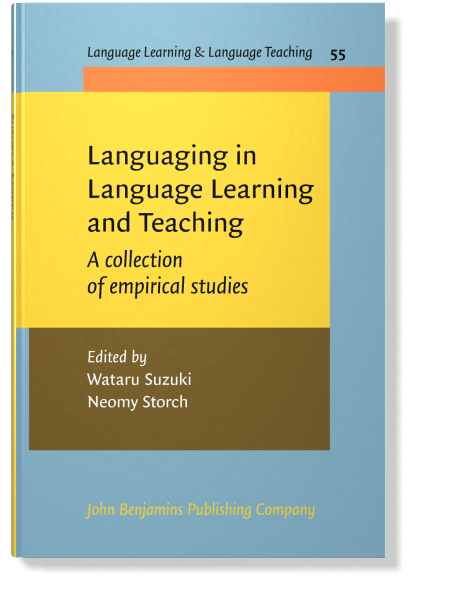
In:Languaging in Language Learning and Teaching: A collection of empirical studies
Edited by Wataru Suzuki and Neomy Storch
[Language Learning & Language Teaching 55] 2020
► pp. 267–286
Chapter 12Effects of written languaging in response to direct and
indirect corrective feedback on developing writing
accuracy
Published online: 14 August 2020
https://doi.org/10.1075/lllt.55.12mor
https://doi.org/10.1075/lllt.55.12mor
Abstract
This study examined effects of written
corrective feedback (WCF) followed by languaging on
grammatical accuracy in new writing tasks. Two homogeneous
EFL (English as a foreign language) classes were randomly
assigned to direct (n = 15) and indirect
(n = 15) feedback groups. After
receiving feedback, participants languaged about the reasons
for the errors in their writing. Their written explanations
were coded as written languaging episodes (WLEs). Results
revealed that the indirect group generated more unexplained
WLEs than the direct group. However, both groups made
significant gains in accuracy from the pre-test to the
post-test with no significant differences observed between
the two groups.
Article outline
- Introduction
- The conceptual framework of the study
- Oral languaging and private speech
- Written languaging
- Empirical research on oral and written languaging
- Method
- Participants
- Procedure
- Writing tasks
- Semi-structured interviews
- Data analysis
- Identification and resolution of WLEs
- Results
- Discussion
- Conclusion
References Appendix

References (34)
Bitchener, J., & Knoch, U. (2008). The
value of written corrective feedback for migrant and
international
students. Language
Teaching
Research, 12(3), 409–431.
Craik, F., & Lockhart, R. (1972). Level
of processing: A framework for memory
research. Journal of
Verbal Learning & Verbal
Behavior, 11(6), 671–684.
DiCamilla, F., & Lantolf, J. P. (1994). The
linguistic analysis of private
writing. Language
Science, 16(3), 347–369.
Ferris, D. (2002). Treatment
of error in second language student
writing. Ann Arbor, MI: University of Michigan Press.
(2006). Does
error feedback help student writers? New evidence on
the short- and long-term effects of written error
correction. In K. Hyland & F. Hyland (Eds.), Feedback
in second language writing: Contexts and
issues (pp. 81–104). Cambridge: Cambridge University Press.
Gug, I., & Kellogg, D. (2007). The
ZPD and whole class teaching: Teacher-led and
student-led interactional mediation of
tasks. Language
Teaching
Research, 11(3), 281–299.
Knouzi, I., Swain, M., Lapkin, S., & Brooks, L. (2010). Self-scaffolding
mediated by languaging: Microgenetic analysis of
high and low
performers. International
Journal of Applied
Linguistics, 20(1), 23–49.
Lantolf, J. P., & Thorne, S. L. (2006). Sociocultural
theory and the genesis of second language
development. Oxford: Oxford University Press.
Mackey, A., & Gass, S. M. (2005). Second
language research: Methodology and
design. Mahwah, NJ: Lawrence Erlbaum Associates.
Moradian, M. R., Miri, M., & Hossein Nasab, M. (2017). Contribution
of written languaging to enhancing the efficiency of
written corrective
feedback. International
Journal of Applied
Linguistics, 27(2), 406–426.
Negueruela, E. (2008). Revolutionary
pedagogies: Learning that leads (to) second language
development. In J. P. Lantolf & M. E. Poehner (Eds.), Sociocultural
theory and the teaching of second
languages (pp. 189–227). London: Equinox.
(2013). Internalization
in second language acquisition: Special
perspectives. In C. A. Chapelle (Ed.), The
encyclopedia of applied
linguistics (pp. 1–8). Malden, MA: Blackwell.
Ohta, A. S. (2001). Second
language acquisition processes in the classroom
learning
Japanese. Mahwah, NJ: Lawrence Erlbaum Associates.
Qi, D., & Lapkin, S. (2001). Exploring
the role of noticing in a three-stage second
language writing
task. Journal of
Second Language
Writing, 10(4), 277–303.
Schmidt, R. W. (1990). The
role of consciousness in second language
learning. Applied
Linguistics, 11(2), 129–158.
Schmidt, R. (2001). Attention. In P. Robinson (Ed.), Cognition
and second language
instruction (pp. 3–32). Cambridge: Cambridge University Press.
Storch, N. (2008). Metatalk
in a pair work activity: Level of engagement and
implications for language
development. Language
Awareness, 17(2), 95–114.
Suzuki, M. (2008). Japanese
learners’ self -revisions and peer revisions of
their written compositions in
English. TESOL
Quarterly, 42(2), 209–233.
Suzuki, W. (2009). Improving
Japanese university students’ second language
writing accuracy: Effects of
languaging. Annual
Review of English Language Education in
Japan, 20, 81–90.
(2012). Written
languaging, direct correction and second language
writing
revision. Language
Learning, 62(4), 1–24.
Swain, M. (2000). The
output hypothesis and beyond: Mediating acquisition
through collaborative
dialogue. In J. P. Lantolf (Ed.), Sociocultural
theory and second language
learning (pp. 97–114). Oxford: Oxford University Press.
(2006). Languaging,
agency and collaboration in advanced language
proficiency. In H. Byrnes (Ed.), Advanced
language learning: The contribution of Halliday and
Vygotsky (pp. 95–108). London: Continuum.
(2011). Cognitive
and effective enhancement among older adult: The
role of
languaging. Australian
Review of Applied
linguistics, 36(1), 4–19.
Swain, M., & Lapkin, S. (1998). Interaction
and second language learning: Two adolescent French
immersion students working
together. Modern
Language
Journal, 82(3), 320–337.
Swain, M., Lapkin, S., Knouzi, I., Suzuki, W., & Brooks, L. (2009). Languaging:
University students learn the grammatical concept of
voice in
French. Modern
Language
Journal, 93(1), 5–29.
Tocalli-Beller, A., & Swain, M. (2005). Reformulation:
The cognitive conflict and L2 learning it
generates. International
Journal of Applied
Linguistics, 15(1), 5–28.
Truscott, J. (1996). The
case against grammar correction in L2 writing
classes. Language
Learning, 46(2), 327–369.
Van Beuningen, C. G., De Jong, N. H., & Kuiken, F. (2008). The
effects of direct and indirect corrective feedback
on second language learners’ written
accuracy. International
Journal of Applied
Linguistic, 156(1), 279–296.
Van Beuningen, C. G., De Jong, N., & Kuiken, F. (2012). Evidence
on the effectiveness of comprehensive error
correction in second language
writing. Language
Learning, 62(1), 1–41.
Van Compernolle, R. A. (2010). Incidental
microgenetic development in second-language
teacher-learner
talk-in-interaction. Classroom
Discourse, 1(1), 66–81.
Cited by (3)
Cited by three other publications
Hsu, Hsiu-Chen
Coyle, Yvette, Florentina Nicolás-Conesa & Lourdes Cerezo
2023. Overview of methodological procedures in research on written corrective
feedback processing. In Research Methods in the Study of L2 Writing Processes [Research Methods in Applied Linguistics, 5], ► pp. 60 ff.
Suzuki, Wataru, Masako Ishikawa & Neomy Storch
2023. Verbally mediated data. In Research Methods in the Study of L2 Writing Processes [Research Methods in Applied Linguistics, 5], ► pp. 123 ff.
This list is based on CrossRef data as of 26 november 2025. Please note that it may not be complete. Sources presented here have been supplied by the respective publishers. Any errors therein should be reported to them.