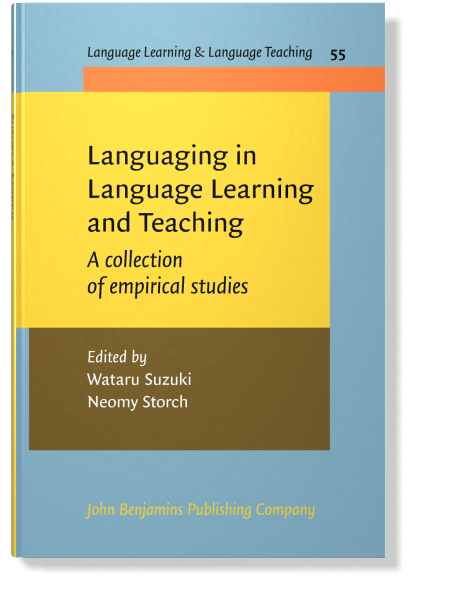
In:Languaging in Language Learning and Teaching: A collection of empirical studies
Edited by Wataru Suzuki and Neomy Storch
[Language Learning & Language Teaching 55] 2020
► pp. 241–266
Chapter 11L2 writers’ processing of written corrective
feedback
Depth of processing via written languaging
Published online: 14 August 2020
https://doi.org/10.1075/lllt.55.11man
https://doi.org/10.1075/lllt.55.11man
Abstract
In this study we investigated (i)
whether levels of depth of processing (DoP) are mediated by
writing conditions (individual vs. collaborative writing),
and (ii) the relationship between DoP and accuracy measures
in the texts produced before and after processing feedback.
Participants (118 intermediate EFL learners) were invited to
complete a picture-based problem-solving task in either
individual or collaborative writing conditions, in both
cases with and without the availability of feedback.
Findings show that access to feedback (rather than writing
conditions) was the key variable that mediated both DoP and
improvements in global accuracy. We discuss these findings
from various perspectives, including methodological
considerations for future languaging research.
Article outline
- Theoretical background
- DoP of WCF and language learning in individual and collaborative writing conditions
- Written languaging and WCF processing
- Research questions
- Method
- Design
- Context and participants
- Task, treatment, and data collection
procedures
- Task
- Treatment
- Data collection procedures
- Data coding and analysis
- Analysis of written texts
- Analysis of written languaging
- Statistical analyses
- Results
- Discussion
- Conclusions
References Appendix

References (39)
Bitchener, J. (2012). A
reflection on “the language learning potential” of
written CF. Journal
of Second Language
Writing, 21(4), 348–363.
(2016). To
what extent has the published written CF research
aided our understanding of its potential for L2
development? ITL:
International Journal of Applied
Linguistics, 167(2), 111–131.
(2017). Why
some L2 learners fail to benefit from written
corrective
feedback. In H. Nassaji & E. Kartchava (Eds.), Corrective
feedback in second language teaching and
learning (pp. 129–140). New York, NY: Routledge.
Bitchener, J., & Storch, N. (2016). Written
corrective feedback for L2
development. Bristol: Multilingual Matters.
Caras, A. (2019). Written
corrective feedback in compositions and the role of
depth of
processing. In R. Leow (Ed.), The
Routledge handbook of second language research in
classroom
learning (pp. 186–198). New York, NY: Routledge.
Cerezo, L., Manchón, R. M., & Nicolás-Conesa, F. (2019). What
do learners notice while processing written
corrective feedback? A look at depth of processing
via written
languaging. In R. Leow (Ed.), The
Routledge handbook of second language research in
classroom
learning (pp. 171–185). New York, NY: Routledge.
Evans, N., Hartshorn, J., & Allen, E. (2010). Written
corrective feedback: The Practitioners’
perspectives. International
Journal of English Studies
(IJES), 10(2), 47–77.
Ferris, D. (2002). Treatment
of error in second language student
writing. Ann Arbor, MI: University of Michigan Press.
Gilabert, R. (2007). Effects of manipulating task complexity on self-repairs during L2 oral production. International Journal of Applied Linguistics with International Review of Applied Linguistics in Language Teaching, 45 (3), 215–240.
Grosbois, M. (2016). Computer
supported collaborative writing and language
learning. In F. Farr & L. Murray (Eds.), The
Routledge handbook of language learning and
technology (pp. 269–280). New York, NY: Routledge.
Ishikawa, M. (2013). Examining
the effect of written languaging: The role of
metanotes as a mediator of second language
learning. Language
Awareness, 22(3), 220–233.
Ishikawa, M., & Suzuki, W. (2016). The
effect of written languaging on learning the
hypothetical condition in
English. System, 58, 97–111.
Knouzi, I., Swain, M., Lapkin, S., & Brooks, L. (2010). Self-scaffolding
mediated by languaging: Microgenetic analysis of
high and low
performers. International
Journal of Applied
Linguistics, 20(1), 23–49.
Leow, R. (2015). Explicit
learning in the classroom. A student-centered
perspective. London: Routledge.
(2019). Theoretical
underpinnings and cognitive processes in instructed
SLA. In R. Leow (Ed.), The
Routledge handbook of second language research in
classroom
learning (pp. 15–27). New York, NY: Routledge.
Liu, Q., & Brown, D. (2015). Methodological
synthesis of research on the effectiveness of
corrective feedback in L2
writing. Journal of
Second Language
Writing, 30, 66–81.
Lu, X. (2011). A corpus-based evaluation of syntactic complexity measures as indices of college-level ESL writers' language development. TESOL Quarterly, 45(1), 36–62.
Malvern, D., & Richards, B. (2002). Investigating accommodation in language proficiency interviews using a new measure of lexical diversity. Language Testing, 19(1), 85–104.
Manchón, R. M., & Vasylets, O. (2019). Language
learning through writing: Theoretical perspectives
and empirical
evidence. In J. W. Schwieter & A. Benati (Eds.), The
Cambridge handbook of language
learning (pp. 341–362). Cambridge: Cambridge University Press.
Polio, C. (2012). The
relevance of second language acquisition theory to
the written error correction
debate. Journal of
Second Language
Writing, 21(4), 375–389.
Qi, D., & Lapkin, S. (2001). Exploring
the role of noticing in a three-stage second
language writing
task. Journal of
Second Language
Writing, 10(4), 277–303.
Sachs, R., & Polio, C. (2007). Learners’
uses of two types of written corrective feedback on
a L2 writing revision
task. Studies in
Second Language
Acquisition, 29(1), 67–100.
Schmidt, R. W. (1990). The
role of consciousness in second language
learning. Applied
Linguistics, 11(2), 129–158.
(2001). Attention. In P. Robinson (Ed.), Cognition
and second language
learning (pp. 3–32). New York, NY: Cambridge University Press.
Storch, N. (2008). Metatalk
in pair work activity: Level of engagement and
implications for language
development. Language
Awareness, 17(2), 95–114.
(2011). Collaborative
writing in L2 contexts: Processes, outcomes, and
future
directions. Annual
Review of Applied
Linguistics, 31, 275–288.
(2016). Collaborative writing. In R. M. Manchón & P. K. Matsuda (Eds.), Handbook
of second and foreign language
writing (pp. 387–406). Berlin: De Gruyter Mouton.
(2018). Collaborative
writing. In J. Liontas (Ed.), The
TESOL encyclopedia of English language
teaching. New York, NY: John Wiley & Sons.
Storch, N. & Wigglesworth, G. (2010). Learners’
processing, uptake, and retention of corrective
feedback. Case
studies. Studies in
Second Language
Acquisition, 32(2), 303–334.
Suzuki, W. (2012). Written
languaging, direct correction, and second language
writing
revision. Language
Learning, 62(4), 1110–1133.
(2017). The
effect of quality of written languaging on second
language
learning. Writing
&
Pedagogy, 8(3), 461–482.
Suzuki, W., & Itagaki, N. (2007). Learner
metalinguistic reflections following output-oriented
and reflective
activities. Language
Awareness, 16(2), 131–146.
(2009). Languaging
in grammar exercises by Japanese EFL learners of
differing
proficiency. System, 37(2), 217–225.
Swain, M., & Lapkin, S. (2002). Talking
it through: Two French immersion learners’ response
to
reformulation. International
Journal of Educational
Research, 37(3–4), 285–304.
Swain, M., Lapkin, S., Knouzi, I., Suzuki, W., & Brooks, L. (2009). Languaging:
University students learn the grammatical concept of
voice in French. The
Modern Language
Journal, 93(1), 5–29.
Van Beuningen, C., De Jong, N., & Kuiken, F. (2012). Evidence
on the effectiveness of comprehensive error
correction in second language
writing. Language
Learning, 62(1), 1–41.
Cited by (19)
Cited by 19 other publications
Fujisawa, Yoko & Natsuko Shintani
Hsu, Hsiu-Chen
Lira-Gonzales, Maria-Lourdes, Hossein Nassaji & Kuok-Wa Chao Chao
Michaud, Gabriel, Kevin Papin & Mariane Parent
Milla, Ruth & María del Pilar García Mayo
Obanos-Gil, María Puy & Izaskun Villarreal
Carr, Nicholas
Cerezo, Lourdes & Florentina Nicolás-Conesa
Coyle, Yvette, Florentina Nicolás-Conesa & Lourdes Cerezo
2023. Overview of methodological procedures in research on written corrective
feedback processing. In Research Methods in the Study of L2 Writing Processes [Research Methods in Applied Linguistics, 5], ► pp. 60 ff.
Garcia, Valerie, Caitlyn Pineault & Lara Bryfonski
Manchón, Rosa M. & Julio Roca de Larios
2023. The study of L2 writing processes. In Research Methods in the Study of L2 Writing Processes [Research Methods in Applied Linguistics, 5], ► pp. 6 ff.
McBride, Sophie & Rosa M. Manchón
2023. Analysing L2 writers’ processing of written corrective feedback via
written languaging and think-aloud protocols. In Research Methods in the Study of L2 Writing Processes [Research Methods in Applied Linguistics, 5], ► pp. 337 ff.
Peng, Carrie Xin, Neomy Storch & Ute Knoch
Suzuki, Wataru, Masako Ishikawa & Neomy Storch
2023. Verbally mediated data. In Research Methods in the Study of L2 Writing Processes [Research Methods in Applied Linguistics, 5], ► pp. 123 ff.
Bowles , Melissa A. & Kacie Gastañaga
González-Cruz, Belén, Lourdes Cerezo & Florentina Nicolás-Conesa
Leow , Ronald P., Anne Thinglum & Stephanie A. Leow
Liu, Chunhong & Shulin Yu
Leow, Ronald P.
2020. L2 writing-to-learn. In Writing and Language Learning [Language Learning & Language Teaching, 56], ► pp. 95 ff.
This list is based on CrossRef data as of 26 november 2025. Please note that it may not be complete. Sources presented here have been supplied by the respective publishers. Any errors therein should be reported to them.