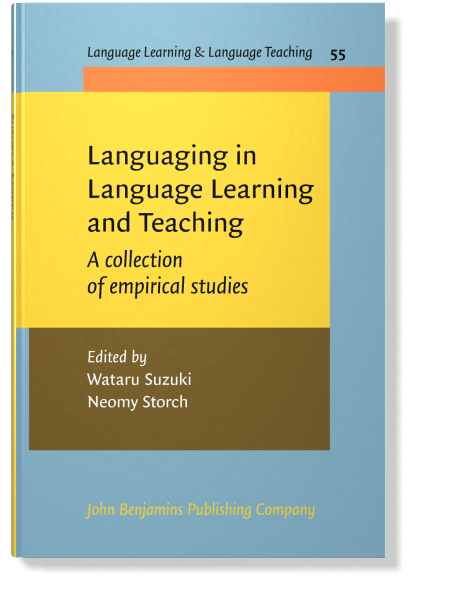
In:Languaging in Language Learning and Teaching: A collection of empirical studies
Edited by Wataru Suzuki and Neomy Storch
[Language Learning & Language Teaching 55] 2020
► pp. 149–170
Chapter 7Languaging in wiki-based collaborative writing:
Functions and mediating factors
Published online: 14 August 2020
https://doi.org/10.1075/lllt.55.07li
https://doi.org/10.1075/lllt.55.07li
Abstract
Despite the acknowledgement of the role of
languaging in collaborative writing, little research has examined
how L2 students use language to mediate the process of jointly
composing a text during asynchronous computer-mediated collaborative
writing. This chapter reports on a study that investigated the
languaging of three small groups of EFL students and the factors
mediating languaging when completing a collaborative wiki writing
task. The results revealed that languaging served multiple
functions: resolving various language problems, negotiating and
deciding about content and text organization, as well as mediating
social relationships. Learners’ perception of task goals, language
proficiency grouping, and patterns of interaction explained the ways
in which the three groups engaged in languaging.
Keywords: collaborative writing, languaging, LRE, mediating factor, Wiki
Article outline
- Introduction
- Literature review
- Languaging in collaborative writing
- Factors mediating languaging and LREs
- Research gap
- Methodology
- Participants
- Study procedure
- Patterns of interaction
- Data analysis
- Results
- Functions languaging serves
- Language-related episodes (LREs)
- Mediating factors
- Perception of task goals
- Language proficiency grouping
- Patterns of interaction
- Discussion and conclusion
Note References

References (45)
Anton, M., & DiCamilla, F. (1998). Socio-cognitive
functions of L1 collaborative interaction in the L2
classroom. The Canadian
Modern Language
Review, 54(3), 314–342.
Brooks, L., & Swain, M. (2009). Languaging
in collaborative writing: Creation and response to
expertise. In A. Mackey & C. Polio (Eds.), Multiple
perspectives on interaction in
SLA (pp. 58–89). Mahwah, NJ: Lawrence Erlbaum Associates.
Cho, H. (2017). Synchronous
web-based collaborative writing: Factors mediating
interaction among second-language
writers. Journal of Second
Language
Writing, 36, 37–51.
Denzin, N., & Lincoln, Y. (1994). The
Sage handbook of qualitative
research (3rd
ed.). Thousand Oaks, CA: Sage.
Donato, R. (1994). Collective
scaffolding in second language
learning. In J. P. Lantolf & G. Appel (Eds.), Vygotskian
approaches to second language
research (pp. 33–56). Norwood, NJ: Ablex.
Ede, L., & Lunsford, A. (1990). Singular
texts/plural
authors. Carbondale, IL: Southern Illinois University Press.
Elola, I., & Oskoz, A. (2010). Collaborative
writing: Fostering foreign language and writing conventions
development. Language
Learning and
Technology, 14(3), 51–71.
Fernández-Dobao, A. (2012). Collaborative
writing tasks in the L2 classroom: Comparing group, pair,
and individual work. Journal
of Second Language
Writing, 21(1), 40–58.
Imai, Y. (2010). Emotions
in SLA: New insights from collaborative learning for an EFL
classroom. The Modern Language
Journal, 94(2), 278–292.
Kessler, G. (2009). Student
initiated attention to form in wiki based collaborative
writing. Language Learning
&
Technology, 13(1), 79–95.
Kessler, G., & Bikowski, D. (2010). Developing
collaborative autonomous learning abilities in computer
mediated language learning: Attention to meaning among
students in wiki
space. Computer Assisted
Language
Learning, 23(1), 41–58.
Kim, Y., & McDonough, K. (2008). The
effect of interlocutor proficiency on the collaborative
dialogue between Korean as a second language
learners. Language Teaching
Research, 12(2), 211–234.
Kost, C. (2011). Investigating
writing strategies and revision behavior in collaborative
wiki projects. CALICO
Journal, 28(3), 606–620.
Lee, L. (2010). Exploring
wiki-mediated collaborative writing: A case study in an
elementary Spanish
course. CALICO
Journal, 27(2), 260–276.
Leeser, M. J. (2004). Learner
proficiency and focus on form during collaborative
dialogue. Language Teaching
Research, 8(1), 55–81.
Li, M. (2013). Individual
novices and collective experts: Collective scaffolding in
wiki-based small group
writing. System, 41(3), 752–769.
(2018). Computer-mediated
collaborative writing in L2 contexts: An analysis of
empirical research. Computer
Assisted Language
Learning, 31(8), 882–904.
Li, M. & Zhu, W. (2013). Patterns
of computer-mediated interaction in small writing groups
using wikis. Computer
Assisted Language
Learning, 26(1), 62–81.
Li, M., & Zhu, W. (2017). Explaining
dynamic interactions in wiki-based collaborative
writing. Language Learning
&
Technology, 21(2), 96–120.
Loewen, S., & Wolff, D. (2016). Peer
interaction in F2F and CMC
contexts. In M. Sato & S. Ballinger (Eds.), Peer
interaction and second language learning: Pedagogical
potential and research
agenda (pp. 267–289). Amsterdam: John Benjamins.
Piezon, S. L., & Donaldson, R. L. (2005). Online
groups and social loafing: Understanding student-group
interactions. Online Journal
of Distance Learning
Administration, 8(4), Retrieved
from <[URL]> (2 April,
2020).
Qi, D. S., & Lapkin, S. (2001). Exploring
the role of noticing in a three-stage second language
writing task. Journal of
Second Language
Writing, 10(4), 277–303.
Rouhshad, A., & Storch, N. (2016). A
focus on mode: Patterns of interaction in face-to-face and
computer-mediated
context. In M. Sato & S. Ballinger (Eds.), Peer
interaction and second language learning: Pedagogical
potential and research
agenda (pp. 267–289). Amsterdam: John Benjamins.
(2004). Using
activity theory to explain differences in patterns of dyadic
interactions in an ESL
class. The Canadian Modern
Language
Review, 60(4), 457–480.
(2008). Metatalk
in pair work activity: Level of engagement and implications
for language
development. Language
Awareness, 17(2), 95–114.
Storch, N., & Aldosari, A. (2013). Pairing
learners in pair work
activity. Language Teaching
Research, 17(1), 31–48.
Storch, N., & Wigglesworth, G. (2007). Writing
tasks: The effects of
collaboration. In M. P. Garcia Mayo (Ed.), Investigating
tasks in formal language
learning (pp. 157–177). Clevedon: Multilingual Matters.
(2010). Learners’
processing, uptake, and retention of corrective feedback on
writing: Case
studies. Studies in Second
Language
Acquisition, 32(2), 303–334.
Strauss, A. & Corbin, J. (1990). Basics
of qualitative research: Grounded theory procedures and
techniques. Newbury Park, CA: Sage.
Swain, M. (2000). The
output hypothesis and beyond: Mediating acquisition through
collaborative
dialogue. In J. P. Lantolf (Ed.), Sociocultural
theory and second language
learning (pp. 97–114). Oxford: Oxford University Press.
(2006). Languaging,
agency, and collaboration in advanced second language
proficiency. In H. Byrnes (Ed.), Advanced
language learning: The contribution of Halliday and
Vygotsky (pp. 95–108). London: Continuum.
(2010). Talking-it-through:
Language as a source of
learning. In R. Batstone (Ed.), Sociocognitive
perspectives on language use and language
learning (pp. 112–130). Oxford: Oxford University Press.
(2013). The
inseparability of cognition and emotion in second language
learning. Language
Teaching, 46(2), 195–207.
Swain, M., Brooks, L., & Tocalli-Beller, A. (2002). Peer-peer
dialogue as means of second language
learning. Annual Review of
Applied
Linguistics, 22, 171–185.
Swain, M., & Lapkin, S. (1998). Interaction
and second language learning: Two adolescent French
immersion students working
together. The Modern Language
Journal, 82(3), 320–337.
Swain, M., & Watanabe, Y. (2012). Languaging:
Collaborative dialogue as a source of second language
learning. In C. A. Chapell (Ed.), The
encyclopedia of applied
linguistics (pp. 3218-3225). Oxford: Blackwell.
Vygotsky, L. S. (1978). Mind
in society: The development of higher psychological
processes. Cambridge, MA: Harvard University Press.
Watanabe, Y. (2008). Peer-peer
interaction between L2 learners of different proficiency
levels: Their interactions and
reflections. The Canadian
Modern Language
Review, 64(4), 605–63.
(2019). The
role of languaging in collaborative and individual writing:
When pairs outperformed
individuals. In M. Haneda & H. Nassaji (Eds), Perspectives
on language as
action (pp. 63–79). Bristol: Multilingual Matters.
Cited by (7)
Cited by seven other publications
Cao, Zhenhao, Rachael Ruegg & Stephen Skalicky
Alqefari, Abdulrahman Nasser
Li, Mimi & Meixiu Zhang
2023. Introduction. In L2 Collaborative Writing in Diverse Learning Contexts [Language Learning & Language Teaching, 59], ► pp. 1 ff.
Cheung, Anisa
Liu, Pei-Lin, Anza Mei Gani Ginting, Chiu-Jung Chen & Hui-Chin Yeh
Rahimi, Masoud & Jalil Fathi
This list is based on CrossRef data as of 26 november 2025. Please note that it may not be complete. Sources presented here have been supplied by the respective publishers. Any errors therein should be reported to them.