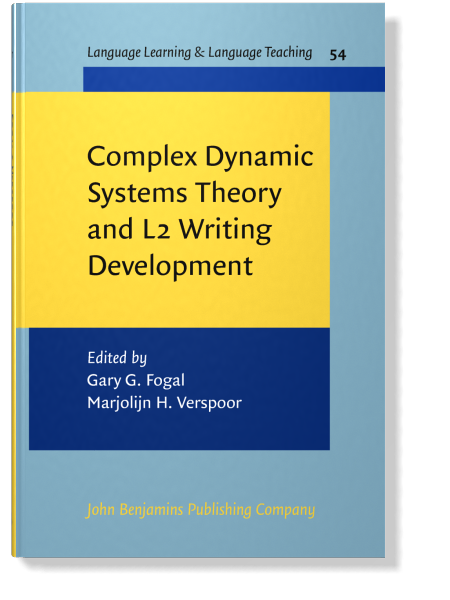
In:Complex Dynamic Systems Theory and L2 Writing Development
Edited by Gary G. Fogal and Marjolijn H. Verspoor
[Language Learning & Language Teaching 54] 2020
► pp. v–vi
Get fulltext
This article is available free of charge.
Published online: 4 June 2020
https://doi.org/10.1075/lllt.54.toc
https://doi.org/10.1075/lllt.54.toc
Table of contents
ForewordVII
Diane Larsen-Freeman
IntroductionIX
Gary G. Fogal
Marjolijn H. Verspoor
Part I.CAF perspectives
Chapter 1.Exploring dynamic developmental trajectories of writing fluency: Who benefited from the writing task?3
Kyoko Baba
Chapter 2.Coordination of linguistic subsystems as a sign of automatization?27
Junping Hou
Hanneke Loerts
Marjolijn H. Verspoor
Chapter 3.The dynamic co-development of linguistic and discourse-semantic complexity in
advanced L2 writing49
Yu Wang
Shoucun Tao
Part II.New constructs, approaches, and domains
Chapter 4.Adaptive imitation: Formulaicity and the words of others in L2 English academic
writing81
Susy Macqueen
Ute Knoch
Chapter 5.Profiling the dynamic changes of syntactic complexity in L2 academic
writing: A multilevel synchrony method109
R. Rosmawati
Chapter 6.Biographical retrodiction for investigating the evolution of learner agency
and L2 writing development through study abroad experiences133
Ryo Nitta
Part III.Methodological perspectives
Chapter 7.The elusive phase shift: Capturing changes in L2 writing development and interaction between the
cognitive and social ecosystems161
Elizabeth Hepford
Chapter 8.Investigating complexity in L2 writing with mixed methods approaches183
Alex Gilmore
Gabriela Adela Gánem-Gutiérrez
Chapter 9.A critical appraisal of the CDST approach to investigating linguistic
complexity in L2 writing development207
Bram Bulté
Alex Housen
Part IV.Curricular perspectives
Chapter 10.Envisioning L2 writing development in CDST under a curricular optic: A proposal241
Heidi Byrnes
Chapter 11.Unpacking ‘simplex systems’: Curricular thinking for L2 writing development271
Gary G. Fogal
List of contributors295
Index299
