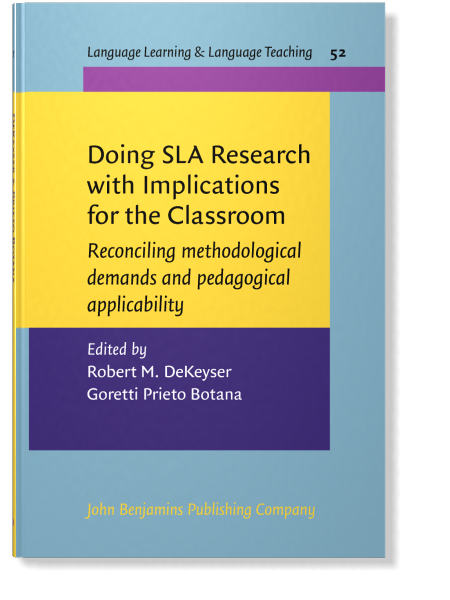
In:Doing SLA Research with Implications for the Classroom: Reconciling methodological demands and pedagogical applicability
Edited by Robert M. DeKeyser and Goretti Prieto Botana
[Language Learning & Language Teaching 52] 2019
► pp. 179–200
Chapter 9Lexical development in the writing of intensive English program students
Published online: 7 March 2019
https://doi.org/10.1075/lllt.52.09juf
https://doi.org/10.1075/lllt.52.09juf
Abstract
This paper focuses on vocabulary development in intensive English program (IEP) students, comparing free writing data from an IEP to previous research in more controlled contexts. These free writing data derive from writing assignments collected from students with three language backgrounds: Arabic (n = 22), Chinese (n = 20) and Korean (n = 19), who studied at the intermediate and subsequently the advanced levels of an IEP in the USA. The main finding was that a purely text-based measure of diversity, vocD, did not capture gains in lexical development, whereas a measure of lexical sophistication, Advanced Guiraud (AG), did show measureable improvement. Discussion focuses on a more theoretically complex conceptualization of lexical development, how experimental methods compare with ‘messy’ classroom corpus data, and the problem of text length. Specific pedagogical recommendations include more focus more on lexical quality (Perfetti & Hart, 2002) and words at lower frequency bands (3000–9000).
Article outline
- Introduction
- Method
- Participants
- Materials and procedure
- Results
- Discussion
- General discussion
- Pedagogical and methodological implications
- Conclusion
Notes References

References (45)
Bachman, L. F. (1990). Fundamental considerations in language testing. Oxford: Oxford University Press.
Booth, P. (2013). Vocabulary knowledge in relation to memory and analysis: An approximate replication of Milton’s (2007) study on lexical profiles and learning style. Language Teaching, 46(3), 335–354.
Brown, D. (2013). Types of words identified as unknown by L2 learners when reading. System, 41, 1043–1055.
Brown, J. D. (1988). Understanding research in second language learning. Cambridge: Cambridge University Press.
Bulté, B., & Housen, A. (2014). Conceptualizing and measuring short-term changes in L2 writing complexity. Journal of Second Language Writing, 26, 42–65.
Crossley, S. A., Salsbury, T., McNamara, D. S., & Jarvis, S. (2011). Predicting lexical proficiency in language learner texts using computational indices. Language Testing, 28(4), 561–580.
Daller, H., Van Hout, R., & Treffers‐Daller, J. (2003). Lexical richness in the spontaneous speech of bilinguals. Applied linguistics, 24(2), 197–222.
Daller, M., Turlik, J., & Weir, I. (2013). Vocabulary acquisition and the learning curve. In S. Jarvis & M. Daller (Eds.), Vocabulary knowledge: Human ratings and automated measures (pp. 185–218). Amsterdam: John Benjamins.
Duràn, P., Malvern, D., Richards, B., & Chipere, N. (2004). Developmental Trends in Lexical Diversity. Applied Linguistics, 25(2), 220–242. .
deBoer, F. (2014). Evaluating the comparability of two measures of lexical diversity. System, 47, 139–145.
DeKeyser, R. M. (2005). What makes learning second‐language grammar difficult? A review of issues. Language learning, 55(S1), 1–25.
Duràn, P., Malvern, D., Richards, B., & Chipere, N. (2004). Developmental trends in lexical diversity. Applied Linguistics, 25(2), 220–242.
Ellis, N. C., & Simpson-Vlach, R. (2009). Formulaic language in native speakers: Triangulating psycholinguistics, corpus linguistics, and education. Corpus Linguistics and Linguistic Theory, 5(1), 61–78.
Friedline, B. E. (2011). Challenges in the second language acquisition of derivational morphology: From theory to practice (Unpublished PhD dissertation), University of Pittsburgh, PA. <[URL]>
Hamp-Lyons, L. (2007). The impact of testing practices on teaching: ideologies and alternatives. In J. Cummins & C. Davison (Eds.), International handbook of English language teaching (pp. 487–504). New York, NY: Springer.
Horst, M. (2005). Learning L2 vocabulary through extensive reading: A measurement study. Canadian Modern Language Review, 61(3), 355–382.
Hulstijn, J., & Laufer, B. (2001). Some empirical evidence for the involvement load hypothesis in vocabulary acquisition. Language Learning, 51, 539–558.
Hsu, W. (2014). The most frequent opaque formulaic sequences in English-medium college textbooks. System, 47, 146–161.
Jarvis, S. (2013). Defining and measuring lexical diversity. In S. Jarvis & M. Daller (Eds.), Vocabulary knowledge: Human ratings and automated measures (pp. 13–44). Amsterdam: John Benjamins.
Jarvis, S., & Daller, M. (Eds.). (2013). Vocabulary knowledge. Human ratings and automated measures. Amsterdam: John Benjamins.
Juffs, A. (1998). The acquisition of semantics-syntax correspondences and verb frequencies in ESL materials. Language Teaching Research, 2, 93–123.
Lam, R. (2016). Taking stock of portfolio assessment scholarship: From research to practice. Assessing Writing.
Laufer, B., & Nation, P. (1995). Vocabulary size and use: Lexical richness in L2 written production. Applied linguistics, 16(3), 307–322.
McCarthy, P. M., & Jarvis, S. (2007). vocd: A theoretical and empirical evaluation. Language Testing, 24(4), 459–488.
MacWhinney, B. (2000). The CHILDES project: Tools for analyzing talk (3rd ed.). Mahwah, NJ: Lawrence Erlbaum Associates.
Malvern, D., Richards, B., Chipere, N., & Duràn, P. (2004). Lexical diversity and language development: Quantification and assessment. Paulgrave: Palgrave MacMillan.
McCarthy, P. M., & Jarvis, S. (2010). MTLD, vocd-D, and HD-D: A validation study of sophisticated approaches to lexical diversity assessment. Behavior Research Methods, 42(2), 381–392.
Murakami, A., & Alexopoulou, T. (2016). L1 influence on the acquisition order of English grammatical morphemes. Studies in Second Language Acquisition, 38(3), 365–401.
Nation, I. S. P. (2001). Learning vocabulary in another language. Cambridge: Cambridge University Press.
(2007). Fundamental issues in modelling and assessing vocabulary knowledge. Modelling and assessing vocabulary knowledge, 35–43.
Norouzian, R., & Plonsky, L. (2018). Eta- and partial eta-squared in L2 research: A cautionary review and guide to more appropriate usage. Second Language Research, 34(2), 257–271.
Penno, J. F., Wilkinson, I. A. G., & Moore, D. W. (2002). Vocabulary acquisition from teacher explanation and repeated listening to stories: do they overcome the Matthew effect. Journal of Educational Psychology, 94(1), 23–33.
Perfetti, C. A., & Hart, L. (2002). The lexical quality hypothesis. In L. Verhoeven, C. Elbro, & P. Reitsma (Eds.), Precursors of functional literacy (pp. 189–214). Amsterdam: John Benjamins.
Schmitt, N., & Schmitt, D. (2014). A reassessment of frequency and vocabulary size in L2 vocabulary profiles and learning style. Language Teaching, 46(3), 335–354.
(2014). A reassessment of frequency and vocabulary size in L2 vocabulary teaching. Language Teaching, 47(4), 484–503. .
Sisková, Z. (2012). Lexical richness in EFL students’ narratives. Language Studies Working Papers. University of Reading, 4, 26–36.
Stanovich, K. E. (1986). Matthew effects in reading: some consequences of individual differences in the acquisition of literacy. Reading Research Quarterly, 21(4), 360–407.
Todd, R. W. (2017). An opaque engineering word list: which words should a teacher focus on? English for Specific Purposes, 45, 31–39.
van Hout, R., & Vermeer, A. (2007). Comparing measures of lexical richness. In H. Daller, J. Milton, & J. Treffers-Daller (Eds.), Modelling and assessing vocabulary knowledge (pp. 93–115). Cambridge: Cambridge University Press.
West, M. (1953). A general service list of English words: With semantic frequencies and a supplementary word list for the writing of popular science and technology. London: Addison-Wesley Longman.
Cited by (2)
Cited by two other publications
Naismith, Ben & Alan Juffs
Naismith, Ben, Alan Juffs, Na-Rae Han & Daniel Zheng
This list is based on CrossRef data as of 26 november 2025. Please note that it may not be complete. Sources presented here have been supplied by the respective publishers. Any errors therein should be reported to them.