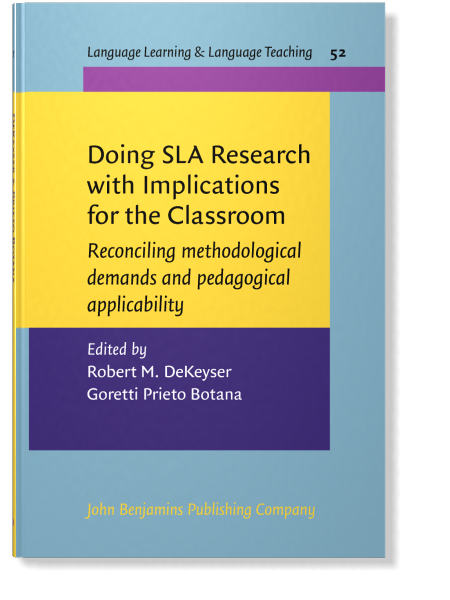
In:Doing SLA Research with Implications for the Classroom: Reconciling methodological demands and pedagogical applicability
Edited by Robert M. DeKeyser and Goretti Prieto Botana
[Language Learning & Language Teaching 52] 2019
► pp. 55–82
Chapter 4Integrating instructed second language research, pragmatics, and corpus-based instruction
Published online: 7 March 2019
https://doi.org/10.1075/lllt.52.04bar
https://doi.org/10.1075/lllt.52.04bar
Abstract
This paper discusses the issues raised by implementing instruction in language classrooms for the purpose of researching the effects of instruction on second language acquisition. We examine the process of developing and implementing novel corpus-based instruction for the teaching of pragmatic routines in a study that compared the use of teacher-developed corpus-based materials to guided, hands-on corpus searches by learners (Bardovi-Harlig, Mossman, & Su, 2017). We use this study as the impetus for reflection on the experimenters’ role in materials and activities development and the difference between experimental instruction and classroom teaching. We further discuss the role of learner proficiency levels and grammatical and lexical development in response to instruction, teacher collaboration, and generalizability to other contexts.
Article outline
- Introduction
- Background
- Authentic materials in pragmatics
- Research – teaching trajectory
- The study: Comparing corpus materials and corpus searches
- Instruction
- Pretest-posttest
- Questionnaire
- Participants
- Analysis
- Results
- Production data
- Independent searches
- Discussion
- CS and CM comparisons revisited
- Learning, teaching, and testing clarifications
- Self-clarification
- Other-clarification
- Syntax and lexicon as variables in pragmatic development
- Integrating research and teaching
- Experimentalizing instruction
- Materials and activities development
- Participant availability
- Experimental control
- Teacher collaboration
- Generalizability to other contexts
- Concluding reflections
Acknowledgments Notes References

References (39)
Bardovi-Harlig, K. (2006). On the role of formulas in the acquisition of L2 pragmatics. In K. Bardovi-Harlig, C. Félix-Brasdefer, A. S. Omar (Eds.), Pragmatics and language learning, (Vol. 11, pp. 1–28). Honolulu, HI: University of Hawai‘i, National Foreign Language Resource Center.
(2009). Conventional expressions as a pragmalinguistic resource: Recognition and production of conventional expressions in L2 pragmatics. Language Learning, 59, 755–795.
(2010). Recognition of conventional expressions in L2 pragmatics. In G. Kasper, H. t. Nguyen, D. R. Yoshimi, & J. K. Yoshioka (Eds.), Pragmatics and language learning (Vol. 12, pp. 141–162). Honolulu, HI: University of Hawai‘i, National Foreign Language Resource Center.
(2018). Pragmatic awareness in second language acquisition. In P. Garret & J. Maria Cots (Eds.), Routledge handbook of language awareness. (pp. 323–338). UK: Taylor & Francis.
Bardovi-Harlig, K., & Bastos, M.-T. (2011). Proficiency, length of stay, and intensity of interaction and the acquisition of conventional expressions in L2 pragmatics. Intercultural Pragmatics 8, 347–384.
Bardovi-Harlig, K., Bastos, M.-T., Burghardt, B., Chappetto, E., Nickels, E., & Rose, M. (2010). The use of conventional expressions and utterance length in L2 pragmatics. In G. Kasper, H. t. Nguyen, D. R. Yoshimi, & J. K. Yoshioka (Eds.), Pragmatics and language learning (Vol. 12, pp. 163–186). Honolulu, HI: University of Hawai‘i, National Foreign Language Resource Center.
Bardovi-Harlig, K., Hartford, B. A. S., Mahan-Taylor, R., Morgan, M. J., & Reynolds, D. W. (1991). Developing pragmatic awareness: Closing the conversation. ELT Journal, 45, 4–15.
Bardovi-Harlig, K., & Mossman, S. (2016). Corpus-based materials development for teaching and learning pragmatic routines. In B. Tomlinson (Ed.) SLA research and materials development for language learning (pp. 250–267). New York, NY: Taylor and Francis.
Bardovi-Harlig, K., Mossman, S., Rothgerber, J., & Su, Y., & Swanson, K. (in press). Revisiting clarifications: Self- and other-clarifications in corpus-based pragmatics instruction. In M. Sato & S. Loewen (Eds.), Evidence-based second language pedagogy: A collection of instructed second language acquisition studies. New York: Routledge.
Bardovi-Harlig, K., Mossman, S., & Su, Y. (2017). The effect of corpus-based instruction on pragmatic routines. Language Learning & Technology, 21, 76–103.
Bardovi-Harlig, K., Mossman, S., & Vellenga, H. E. (2015a). Developing corpus-based materials to teach pragmatic routines. TESOL Journal, 6, 499–526.
(2015b). The effect of instruction on pragmatic routines in academic discussion. Language Teaching Research, 19, 324–350.
Bardovi-Harlig, K., & Salsbury, T. (2004). The organization of turns in the disagreements of L2 learners: A longitudinal perspective. In D. Boxer & A. D. Cohen (Eds.), Studying speaking to inform second language learning (pp. 199–227). Clevedon: Multilingual Matters.
Bardovi-Harlig, K., & Vellenga, H. E. (2012). The effect of instruction on conventional expressions in L2 pragmatics. System, 40, 77–89.
Biber, D., Conrad, S., & Cortes, V. (2004). If you look at …: Lexical bundles in university teaching and textbooks. Applied Linguistics, 25, 371–405.
Biber, D., Johansson, S., Leech, G., Conrad, S., & Finegan, E. (1999). Longman grammar of spoken and written English. London: Longman.
Boulton, A. (2010). Data-driven learning: Taking the computer out of the equation. Language Learning, 60, 534–572.
Boxer, D., & Pickering, L. (1995). Problems in the presentation of speech acts in ELT materials: The case of complaints. ELT Journal, 49, 44–58.
Cheng, W., & Cheng, P. (2010). Correcting others and self-correcting in business and professional discourse and textbooks. In A. Trosborg (Ed.), Pragmatics across languages and cultures (Vol. 7 of Handbooks of pragmatics, pp. 443–466). Berlin: Mouton de Gruyter.
Clennell, C. (1999). Promoting pragmatic awareness and spoken discourse skills with EAP classes. ELT Journal, 53, 83–91.
Cohen, A. D., & Ishihara, N. (2013). Pragmatics. In B. Tomlinson (Ed.), Applied linguistics and materials development (pp. 113–126). London: Bloomsbury Academic.
Félix-Brasdefer, J. C., & Cohen, A. D. (2012). Teaching pragmatics in the foreign language classroom: Grammar as a communicative resource. Hispania, 95, 650–669.
Furniss, E. A. (2016). Teaching the pragmatics of Russian conversation using a corpus-referred website. Language Learning & Technology, 20(2), 38–60.
Hulstijn, J., & Laufer, B. (2001). Some empirical evidence for the involvement load hypothesis in vocabulary acquisition. Language Learning, 51, 539–558.
Ishihara, N., & Cohen, A. D. (2010). Teaching and learning pragmatics: Where language and culture meet. London: Longman.
LoCastro, V. (1997). Pedagogical intervention and pragmatic competence development. Applied Language Learning, 8, 75–109.
Pomerantz, A. (1984). Agreeing and disagreeing with assessments: Some features of preferred/dispreferred turn shapes. In J. M. Atkinson & J. Heritage (Eds.), Structures of social action: Studies in conversation analysis (pp. 57–101). Cambridge: Cambridge University Press.
Ren, W., & Han, Z. (2016). The representation of pragmatic knowledge in recent ELT textbooks. ELT J, 70, 424–434.
Simpson, R. C., Briggs, S. L., Ovens, J., & Swales, J. M. (2002). The Michigan Corpus of Academic Spoken English. Ann Arbor, MI: The Regents of the University of Michigan. <[URL]>
Taguchi, N. (2007). Development of speed and accuracy in pragmatic comprehension in English as a foreign language. TESOL Quarterly, 41, 313–338.
Taguchi, N., Kaufer, D., Gómez-Laich, M. P., & Zhao, H. (2016). A corpus linguistics analysis of on-line peer commentary. In K. Bardovi-Harlig, & J. C. Félix-Brasdefer (Eds.), Pragmatics and Language Learning (Vol. 14, pp. 357–370). Honolulu, HI: University of Hawai‘i, National Foreign Language Resource Center.
Vercellotti, M. L., & Packer, J. (2016). Shifting structural complexity: The production of clause types in speeches given by English for academic purposes students. Journal of English for Academic Purposes, 22, 179–190.
Cited by (1)
Cited by one other publication
Bardovi-Harlig, Kathleen
This list is based on CrossRef data as of 26 november 2025. Please note that it may not be complete. Sources presented here have been supplied by the respective publishers. Any errors therein should be reported to them.