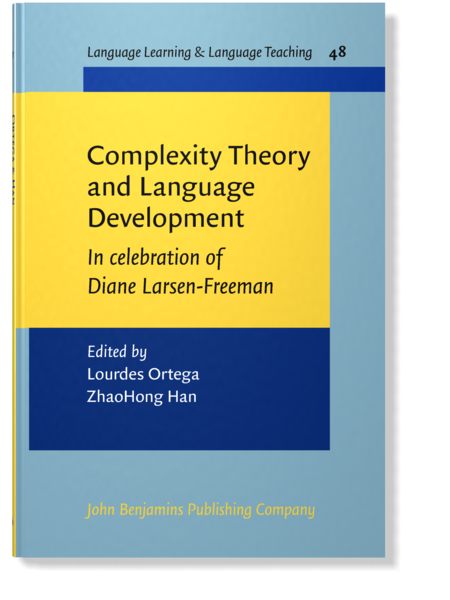
In:Complexity Theory and Language Development: In celebration of Diane Larsen-Freeman
Edited by Lourdes Ortega and ZhaoHong Han
[Language Learning & Language Teaching 48] 2017
► pp. v–vi
Get fulltext
This article is available free of charge.
Published online: 1 November 2017
https://doi.org/10.1075/lllt.48.toc
https://doi.org/10.1075/lllt.48.toc
Table of contents
List of contributors
VII
List of tables
XI
List of figures
XIII
Acknowledgements
XV
Introduction
1
Lourdes Ortega
ZhaoHong Han
Chapter 1.Complexity Theory: The lessons continue
11
Diane Larsen-Freeman
Chapter 2.Complexity Theory and Dynamic Systems Theory: Same or different?
51
Kees de Bot
Chapter 3.Neural complexity meets lexical complexity: An issue both in language and in neuroscience
59
John H. Schumann
Chapter 4.Conceptualizing L2 learner characteristics in a complex, dynamic world
79
Zoltán Dörnyei
Chapter 5.The emerging need for methods appropriate to study dynamic systems: Individual differences in motivational dynamics
97
Peter D. MacIntyre
Emily MacKay
Jessica Ross
Esther Abel
Chapter 6.Lost in state space? Methodological considerations in Complex Dynamic Theory approaches to second language development research
123
Wander Lowie
Chapter 7.Complex Dynamic Systems Theory and L2 pedagogy: Lessons to be learned
143
Marjolijn Verspoor
Chapter 8.Language destabilization and (re-)learning in Complexity Theory perspective: Timescales and patterns across four studies
163
Conny Opitz
Chapter 9.A neuropsycholinguistic approach to complexity: Bi/multilingual attrition and aphasia as destabilization
191
Barbara Köpke
Chapter 10.Energy conservation in SLA: The simplicity of a complex adaptive system
209
ZhaoHong Han
Gang Bao
Paul J. Wiita
Index
233
