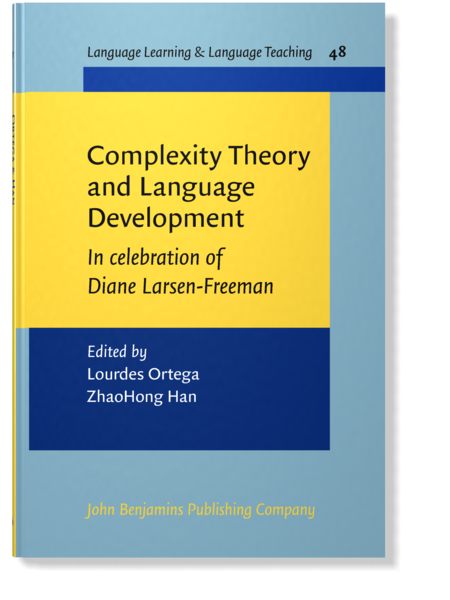
In:Complexity Theory and Language Development: In celebration of Diane Larsen-Freeman
Edited by Lourdes Ortega and ZhaoHong Han
[Language Learning & Language Teaching 48] 2017
► pp. 79–96
Chapter 4Conceptualizing learner characteristics in a complex, dynamic world
Published online: 1 November 2017
https://doi.org/10.1075/lllt.48.05dor
https://doi.org/10.1075/lllt.48.05dor
Abstract
The complex dynamic systems turn in second language acquisition has raised several fundamental challenges to studying learner characteristics, because a systemic perception of mental functioning that is characterized by nonlinear relations undermines the traditional theoretical basis of individual differences as distinct and stable learner attributes. This being the case, how can we account for the widely observed learner differences? Based on McAdams and Pals’ (2006) personality construct, this chapter outlines a new, multi-layered model of learner characteristics which consists of a three-tiered framework: dispositional traits, characteristic adaptations, and integrative life narratives. The three levels of the construct treat learner variation in rather different ways, which is consistent with the intuitive belief that certain personality aspects are more entrenched than others. After describing the proposed framework, the chapter draws on anxiety research to illustrate the three types of system components and how they are compatible with the principles of Complexity Theory.
Article outline
- Introduction
- The traditional conception of individual differences
- Challenges to the “individual difference myth”
- The dawn of a new era
- McAdams’s model of personality: The New Big Five
- Dörnyei and Ryan’s adaptation of McAdams’s model to SLA
- Narrative identity
- Understanding language learner characteristics within the system
- Conclusion: Learner characteristics in a complex, dynamic world
Acknowledgements References

References (39)
Ackerman, P. L. (2005). Personality, trait complexes and adult intelligence. In A. Eliasz, S. E. Hampson, & B. De Raad (Eds.), Advances in personality psychology (pp. 91–112). Hove, East Sussex: Psychology Press.
Ackerman, P. L., & Heggestad, E. D. (1997). Intelligence, personality, and interests: Evidence for overlapping traits. Psychological Bulletin, 121(2), 219–245.
Ackerman, P. L., & Kanfer, R. (2004). Cognitive, affective, and conative aspects of adult intellect within a typical and maximal performance framework. In D. Y. Dai & R. J. Sternberg (Eds.), Motivation, emotion, and cognition: Integrative perspectives on intellectual functioning and development (pp. 119–141). Mahwah, NJ: Lawrence Erlbaum Associates.
Ackerman, P. L., Chamorro-Premuzic, T., & Furnham, A. (2011). Trait complexes and academic achievement: Old and new ways of examining personality in educational contexts. British Journal of Educational Psychology, 81, 27–40.
Barkhuizen, G. (Ed.). (2013). Narrative research in applied linguistics. Cambridge, UK: Cambridge University Press.
Barkhuizen, G., Benson, P., & Chik, A. (2014). Narrative inquiry in language teaching and learning research. New York, NY: Routledge.
Bell, J. S. (2002). Narrative research in TESOL. Narrative inquiry: More than just telling stories. TESOL Quarterly, 36(2), 207–213.
Benson, P., & Nunan, D. (Eds.). (2004). Learners’ stories: Difference and diversity in language learning. Cambridge, UK: Cambridge University Press.
Carver, C. S., & Scheier, M. F. (1999). Themes and issues in the self-regulation of behaviour. In R. S. J. Wyer (Ed.), Perspectives on behavioral self-regulation (pp. 1–105). Mahwah, NJ: Lawrence Erlbaum Associates.
Costa, P. T. Jr., & McCrae, R. R. (1985). The NEO personality inventory manual. Odessa, FL: Psychological Assessment Resources.
(2008). The revised NEO Personality Inventory (NEO-PI-R). In G. Boyle, G. Matthews, & D. Saklofske (Eds.), The SAGE handbook of personality theory and assessment, Volume 2, Personality measurement and testing (pp. 179–199). London: Sage.
Dörnyei, Z. (2000). Motivation in action: Towards a process-oriented conceptualisation of student motivation. British Journal of Educational Psychology, 70, 519–538.
(2009a). Individual differences: Interplay of learner characteristics and learning environment. In N. C. Ellis & D. Larsen-Freeman (Eds.), Language as a complex adaptive system (pp. 230–248). Malden, MA: Wiley Blackwell.
(2014). Researching complex dynamic systems: ‘Retrodictive qualitative modelling’ in the language classroom. Language Teaching, 47(1), 80–91.
Dörnyei, Z., & Ryan, S. (2015). The psychology of the language learner revisited. New York, NY: Routledge.
Dörnyei, Z., MacIntyre, P. D., & Henry, A. (2015). Introduction: Applying complex dynamic systems principles to empirical research on L2 motivation. In Z. Dörnyei, P. D. MacIntyre & A. Henry (Eds.) Motivational dynamics in language learning (pp. 1–7). Bristol, UK: Multilingual Matters.
Ellis, N. C., & Larsen-Freeman, D. (2006). Language emergence: Implications for applied linguistics – Introduction to the special issue. Applied Linguistics, 27(4), 558–589.
Goldberg, L. R. (1992). The development of markers for the Big-Five factor structure. Psychological Assessment, 4(1), 26–42.
Kalaja, P., Menezes, V., & Barcelos, M. F. (Eds.). (2008). Narratives of learning and teaching EFL. Houndmills, UK: Palgrave Macmillan.
Kenyon, G. M., & Randall, W. L. (1997). Restorying our lives: Personal growth through autobiographical reflection. Westport, CT: Praeger.
Kluckhohn, C., & Murray, H. A. (1948). Personality formation: The determinants. In C. Kluckhohn & H. A. Murray (Eds.), Personality in nature, society, and culture (pp. 35–48). London: Jonathan Cape.
Larsen-Freeman, D., & Cameron, L. (2008). Complex systems and applied linguistics. Oxford, UK: Oxford University Press.
Larsen-Freeman, D. (2012). Complex, dynamic systems: A new transdisciplinary theme for applied linguistics? Language Teaching, 45(2), 202–214.
Lewontin, R. (2000). The triple helix: Gene, organism, and environment. Cambridge, MA: Harvard University Press.
(2012). Exploring psychological themes through life-narrative accounts. In J. A. Holstein, & J. F. Gubrium (Eds.), Varieties of narrative analysis (pp. 15–32). Thousand Oaks, CA: Sage.
McAdams, D. P., & Adler, J. M. (2010). Autobiographical memory and the construction of a narrative identity: Theory, research, and clinical implications. In J. E. Maddux, & J. Tangney (Eds.), Social psychological foundations of clinical psychology (pp. 36–50). New York, NY: Guilford Press.
McAdams, D. P., & Bowman, P. J. (2001). Narrating life’s turning points: Redemption and contamination. In D. P. McAdams, R. Josselson, & A. Lieblich (Eds.), Turns in the road: Narrative studies of lives in transition (pp. 3–34). Washington, DC: American Psychological Association.
McAdams, D. P., & McLean, K. C. (2013). Narrative identity. Current Directions in Psychological Science, 22(3), 233–238.
McAdams, D. P., & Pals, J. L. (2006). A new Big Five: Fundamental principles for an integrative science of personality. American Psychologist, 61, 204–217.
Mercer, S. (2013). Working with language learner histories from three perspectives: Teachers, learners and researchers. Studies in Second Language Learning and Teaching, 3(2), 161–185.
Cited by (24)
Cited by 24 other publications
Baba, Kyoko & Ryo Nitta
2025. Two stories on applying novel methods. In Research Methods in CDST Approaches to SLD [Research Methods in Applied Linguistics, 14], ► pp. 57 ff.
Jackson, Daniel O. & Chika Takahashi
Tabari, Mahmoud Abdi & Mahsa Farahanynia
2025. The predictive role of motivational orientations in L2 writing task performance across proficiency
levels. Journal of Second Language Studies
van Dijk, Marijn, Wander Lowie, Nienke Smit, Marjolijn Verspoor & Paul van Geert
Zheng, Yongyan, Lourdes Ortega, Simona Pekarek Doehler, Miyuki Sasaki, Søren Wind Eskildsen & Xuesong (Andy) Gao
Li, Mingyu
Alzaanin, Eman
Freeborn, Lani, Sible Andringa, Gabriela Lunansky & Judith Rispens
Machin, Elizabeth
Machin, Elizabeth, Jennifer Ament & Carmen Pérez-Vidal
Mardian, Fatemeh & Musa Nushi
Pallotti, Gabriele
Pérez-Vidal, Carmen
Al-Hoorie, Ali H., Phil Hiver, Tae-Young Kim & Peter I. De Costa
Irshad, Mufeeda
Melo-Pfeifer, Sílvia
Mills, Nicole, Matthew Courtney, Christopher Dede, Arnaud Dressen & Rus Gant
PAPI, MOSTAFA & PHIL HIVER
Véliz-Campos, Mauricio, Mical Polanco-Soto & Adriana Biedroń
Wang, Wei & Ju Zhan
Dörnyei, Zoltán
Hiver, Phil & Mostafa Papi
Jackson, Daniel O.
This list is based on CrossRef data as of 26 november 2025. Please note that it may not be complete. Sources presented here have been supplied by the respective publishers. Any errors therein should be reported to them.