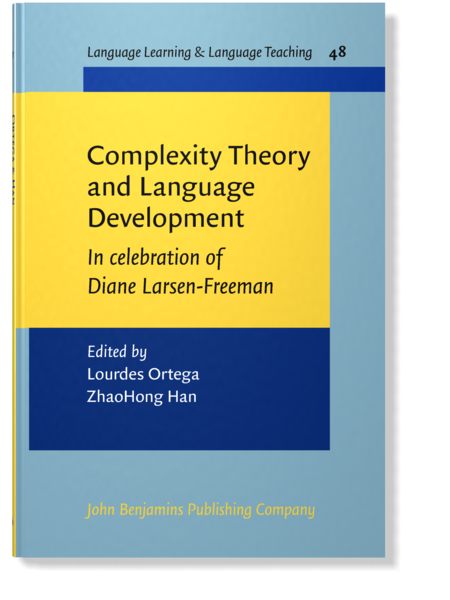
In:Complexity Theory and Language Development: In celebration of Diane Larsen-Freeman
Edited by Lourdes Ortega and ZhaoHong Han
[Language Learning & Language Teaching 48] 2017
► pp. 11–50
Chapter 1Complexity Theory
The lessons continue
Published online: 1 November 2017
https://doi.org/10.1075/lllt.48.02lar
https://doi.org/10.1075/lllt.48.02lar
Abstract
Interest in Complexity Theory (CT) is growing. This is not surprising, considering the state of the modern world – its dynamism, interconnectivity, mobile populations, changing climate, pattern of unintentional consequences, space-time compression, and technological innovation. These qualities make the non-reductionist, ecological, dynamic systems view that CT affords appropriate for our post-structural times. This is not to say that CT is without antecedents in history, some of which are mentioned in the chapter. I also relate how I have come to see CT as a metatheory. A metatheory has wide, transdisciplinary implications. Nevertheless, a metatheory still warrants object theories: in the case of second language development, a theory of language and a theory of learning. These are discussed here as thirty aphorisms. Also taken up are additional lessons afforded by the theory, specifically, overcoming dualities, the need to distinguish a focal system from its environment for the purposes of investigation, and how generalizability can be achieved.
Article outline
- Introduction
- Complexity Theory: What is it?
- My connection
- What paradigm is CT attempting to shift?
- Taking stock
- The lessons continue
- Lesson 1.CT invites us to “interrogate dichotomies” (Morin, 2007). How can we do this and what can we learn from doing so?
- Lesson 2.If everything is connected to everything else, how can you distinguish a system from its environment?
- Lesson 3.If we reject simple linear causality, do we have to give up on generalizability?
- Conclusion
Acknowledgements Notes References

References (225)
Al-Hoorie, A. H. (2015). Human agency: Does the beach ball have free will? In Z. Dörnyei, P. D. MacIntyre, & A. Henry (Eds.), Motivational dynamics in language learning (pp. 55–72). Bristol, UK: Multilingual Matters.
Andriani, P., & McKelvey, B. (2007). Beyond Gaussian averages: Redirecting international business and management research toward extreme events and power laws. Journal of International Business Studies, 38, 1212–1230.
Atkinson, D. (Ed.). (2011). Alternative approaches to second language acquisition. London: Routledge.
Atkinson, D., Churchill, E., Nishino, T., & Okada, H. (2007). Alignment and interaction in a sociocognitive approach to second language acquisition. Modern Language Journal, 91, 169–188.
Baba, K., & Nitta, R. (2014). Phase transitions in development of writing fluency from a complex dynamic systems perspective. Language Learning, 64, 1–35.
Baird, R., Baker, W., & Kitazawa, M. (2014). The complexity of ELF. Journal of English as a Lingua Franca, 3(1), 171–196.
Barlow, M., & Kemmer, S. (Eds.). (2000). Usage based models of language. Chicago, IL: University of Chicago Press.
Bastardas-Boada, A. (2013). Language policy and planning as an interdisciplinary field: Towards a complexity approach. Current Issues in Language Planning, 14(3–4), 363–381.
(2014). Towards a complex-figurational socio-linguistics: Some contributions from physics, ecology and the sciences of complexity. History of the Human Sciences, 27(3), 55–75.
Bates, E., & MacWhinney, B. (1987). Competition, variation, and language learning. In B. MacWhinney (Ed.), Mechanisms of language acquisition (pp. 157–193). Hillsdale, NJ: Lawrence Erlbaum Associates.
Bisson, M. J., van Heuven, W. J. B., Conklin, K., & Tunney, R. J. (2014). The role of repeated exposure to multimodal input in incidental acquisition of foreign language vocabulary. Language Learning, 64(4), 855–877.
Blommaert, J. (2014). From mobility to complexity in sociolinguistic theory and method. Tilburg Papers in Culture Studies, paper 103.
Blythe, R. A., & Scott-Phillips, T. C. (2014). Simulating the real origins of communication. PLoS ONE, 9(11): e113636.
Burns, A., & Knox, J. A. (2011). Classrooms as complex adaptive systems: A relational model. TESL EJ, 15(1), 1–25.
Bybee, J. (2006). From usage to grammar: The mind’s response to repetition. Language 82(4), 711–733.
Byrge, L., Sporns, O., & Smith, L. (2014). Developmental process emerges from extended brain-body-behavior networks. Trends in Cognitive Science, 18(8), 395–403.
Byrne, D. (2013). Evaluating complex social interventions in a complex world. Evaluation, 19(3), 217–228.
Byrne, D., & Callaghan, G. (2014). Complexity theory and the social sciences. The state of the art. Oxon: Routledge.
Byrnes, H. (2014). Theorizing language development at the intersection of ‘task’ and L2 writing: Reconsidering complexity. In H. Byrnes & R. M. Manchόn (Eds), Task-based language learning: Insights from and for L2 writing (pp. 79–103). Amsterdam: John Benjamins.
Chan, H. -P. (2014). A dynamic approach to the development of lexicon and syntax in a second language. Unpublished doctoral dissertation, University of Groningen.
Christiansen, M. H., & Chater, N. (2008). Language as shaped by the brain. Behavioral and Brain Sciences, 31, 449–558.
Cilliers, P. (2001). Boundaries, hierarchies and networks in complex systems. International Journal of Innovation Management, 5(2), 135–147.
Cilliers, P., & Preiser, R. (Eds.). (2010). Complexity, difference and identity: An ethical perspective. Dordrecht: Springer.
Clark, A. (1997). Being there: Putting brain, body, and world together again. Cambridge, MA: The MIT Press.
Clarke, M. A., & QuinnWilliams, J. (forthcoming). Changing schools: Identity, transformation, and educational innovation. Ann Arbor, MI: University of Michigan Press.
Cobb, P., Confrey, J., diSessa, A., Lehrer, R., & Schauble, L. (2003). Design experiments in educational research. Educational Researcher, 32(1), 9–13.
Cochran-Smith, M., Ell, F., Ludlow, L., Grudnoff, L., & Aitken, G. (2014). The challenge and promise of complexity theory for teacher education research. Teachers College Record, 116(5), 1–38.
Cooper, D. (1999). Linguistic attractors: The cognitive dynamics of language acquisition and change. Amsterdam: John Benjamins.
Cowley, S. J. (Ed.). (2011). Distributed language. Amsterdam: John Benjamins.
Davis, B., & Sumara, D. (2012). Fitting teacher education in/to/for an increasingly complex world. Complicity: An International Journal of Complexity and Education, 9(1), 30–40.
de Bot, K. (2008). Introduction: Second language development as a dynamic process. Modern Language Journal, 92, 166–178.
(2015). Rates of change: Timescales in second language development. In Z. Dörnyei, P. D. MacIntyre, & A. Henry (Eds.), Motivational dynamics in language learning (pp. 29–37). Bristol, UK: Multilingual Matters.
de Bot, K., Verspoor, M., & Lowie, W. (2007). A dynamic systems theory approach to second language acquisition. Bilingualism: Language and Cognition, 10(1), 7–21.
De Costa, P., & Bolton, K. (forthcoming). World Englishes and second language acquisition. World Englishes, Special Issue.
De Jesus, P. (2016). Autopoietic enactivism, phenomenology and the deep continuity between life and mind. Phenomenology and the Cognitive Sciences, 15, 265–289.
Derrida, J. (1978). Writing and difference. Alan Bass, translator. Chicago, IL: University of Chicago Press.
Doll, W. E., Jr. (Ed.). (2005). Chaos, complexity, curriculum and culture: A conversation. New York, NY: Peter Lang.
Dörnyei, Z. (2009). Individual differences: Interplay of learner characteristics and learning environment. Language Learning, 59, 230–248.
Dörnyei, Z., MacIntyre, P. D., & Henry, A. (Eds.). (2015). Motivational dynamics in language learning. Bristol, UK: Multilingual Matters.
Dörnyei, Z., & Ushioda, E. (2013). Teaching and researching motivation (2nd ed.). London: Routledge.
Doughty, C. J., & Long, M. H. (2003). The scope of inquiry and goals of SLA. In C. J. Doughty & M. H. Long (Eds.), Handbook of second language acquisition (pp. 3–16). Malden, MA: Blackwell.
Duff, P. (2006). Beyond generalizability: Contextualization, complexity and credibility in applied linguistics research. In M. M. Chalhoub-Deville, C. Chapelle, & P. Duff (Eds.), Inference and generalizability in applied linguistics: Multiple research perspectives (pp. 65–95). Amsterdam: John Benjamins.
Ellis, N. C., & Larsen-Freeman, D. (2006). Language emergence: Implications for applied linguistics – Introduction to the special issue. Applied Linguistics, 27(4), 558–589.
Evans, J. (2007). The emergence of language: A dynamical systems account. In E. Hoff & M. Shatz (Eds.), Blackwell handbook of language development, (pp. 128–148). Malden, MA: Blackwell.
Friere, M. M. (2013). Complex educational design: A course design model based on complexity. Campus-Wide Information Systems, 30(3), 174–185.
Gass, S., & Valmori, L. (2015). Replication in interaction and working memory research: Révész (2012) and Goo (2012). Language Teaching, 48(4), 545–555.
Gershkoff-Stowe, L., & Thelen, E. (2004). U-shaped changes in behavior: A dynamic systems perspective. Journal of Cognition and Development, 5, 11–36.
Gibbs, R. W., & Cameron, L. (2008). The social cognitive dynamics of metaphor performance. Cognitive Systems Research, 9(1–2), 64–75.
Goldberg, A. (2006). Constructions at work: The nature of generalization in language. Oxford, UK: Oxford University Press.
Gregersen, T., MacIntyre, P., & Meza, M. (2014). The motion of emotion: Idiodynamic case studies of learners’ foreign language anxiety. Modern Language Journal, 98(2), 574–588.
Gruchalla, R. S., & Sampson, H. A. (2015). Preventing peanut allergy through early consumption – ready for prime time? [Editorial]. The New England Journal of Medicine, 372, 875–877.
Gurzynski-Weiss, L., & Baralt, M. (2014). Exploring learner perception and use of task-based interactional feedback in face-to-face and computer-mediated modes. Studies in Second Language Acquisition, 36(1), 1–37.
Halliday, M., & Burns, A. (2006). Applied linguistics: Thematic pursuits or disciplinary moorings? Journal of Applied Linguistics, 3(1), 113–128.
Han, Z-H. (2004). Fossilization in adult second language acquisition. Clevedon: Multilingual Matters.
Han, Z-H., & Tarone, E. (Eds.). (2014). Interlanguage. Forty years later. Amsterdam: John Benjamins.
Hayles, N. K. (1990). Chaos bound: Orderly disorder in contemporary literature and science. Ithaca, NY: Cornell University Press.
(Ed.) (1991). Chaos and order: Complex dynamics in literature and science. Chicago, IL: The University of Chicago Press.
Heisenberg, W. (1927). Über den anschaulichen Inhalt der quantentheoretischen Kinematik und Mechanik. Zeitschrift für Physik, 43(3–4), 172–198.
Herdina, P., & Jessner, U. (2002). A dynamic model of multilingualism. Clevedon: Multilingual Matters.
Herdina, P. (2017). Entrenchment, embeddedness, and entanglement: A dynamic complexity view. In H. J. Schmid (Ed.), Entrenchment, memory and automaticity. The psychology of linguistic knowledge and language learning (pp. 387–407). American Psychological Association and Walter de Gruyter.
Herdina, P., & Larsen-Freeman, D. (In preparation). Complexity theory and language.
Hiver, P. (2015). Attractor states. In Z. Dörnyei, P. D. MacIntyre, & A. Henry (Eds.), Motivational dynamics in language learning (pp. 20–28). Bristol, UK: Multilingual Matters.
Hiver, P., & Al-Hoorie, A. H. (2016). Putting complexity into practice. A dynamic ensemble for second language research. Modern Language Journal, 100(4), 741–756.
Hogan-Brun, G., & Hogan, J. (2013). Language planning and complexity: A conversation. Current Issues in Language Planning, 14(3–4), 490–496.
Hopper, P. (1998). Emergent grammar. In M. Tomasello (Ed.), The new psychology of language (pp. 155–175). Mahwah, NJ: Lawrence Erlbaum Associates.
Horn, J. (2008). Human research and complexity theory. Educational Philosophy and Theory, 40(1), 130–143.
Hornberger, N. (2013). Negotiating methodological rich points in the ethnography of language policy. International Journal of the Sociology of Language, 219, 101–122.
Human, O., & Cilliers, P. (2013). Towards an economy of complexity: Derrida, Morin and Bataille. Theory, Culture & Society, 30(5) 24–44.
Hult, F. M. (2010a). Analysis of language policy discourses across the scales of space and time. International Journal of the Sociology of Language, 202, 7–24.
(2010b). The complexity turn in educational linguistics. Language, Culture and Curriculum, 23(3), 173–177.
Ioannidis, J. P. A. (2005). Why most published research findings are false. PLoS Medicine, 2(8), e124.
Jessner, U. (2003). A dynamic approach to language attrition in multilingual systems. In V. Cook (Ed.), Effects of the second language on the first (pp. 234–246). Clevedon: Multilingual Matters.
Jessner, U., Allgäuer-Hackl, E., & Hofer, B. (2016). Emerging multilingual awareness in educational contexts: From theory to practice. The Canadian Modern Language Review/La Revue canadienne des langues vivantes, 72(2), 157–182.
Joaquin, A. D. L., & Schumann, J. H. (Eds.). (2013). Exploring the interactional instinct. New York, NY: Oxford University Press.
Johnson, M. (1987). The body and the mind: The bodily basis of meaning, imagination, and reason. Chicago, IL: University of Chicago Press.
Juarrero, A. (2000). Dynamics in action: Intentional behavior as a complex system. Emergence, 2(2), 24–57.
(2009). Top-down causation and autonomy in complex systems. In N. Murphy, G. F. R. Ellis, & T. O’Connor (Eds.), Downward causation and the neurobiology of free will (pp. 83–102). Berlin: Springer.
Ke, J., & Holland, J. H. (2006). Language origin from an emergentist perspective. Applied Linguistics, 27(4), 691–716.
Keller, R. (1985). Towards a theory of linguistic change. In T. Ballmer (Ed.) Linguistic dynamics: Discourses, procedures and evolution (pp. 212–237). Berlin: Mouton de Gruyter.
Kelso, J. A. S., & Tognoli, E. (2009). Toward a complementary neuroscience: Metastable coordination dynamics of the brain. In N. Murphy, G. F. R. Ellis, & T. O’Connor (Eds.), Downward causation and the neurobiology of free will (pp.103–124). Berlin: Springer.
Kirby, S., & Hurford, J. R. (2002). The emergence of linguistic structure: An overview of the iterated learning model. In A. Cangelosi & D. Parisi (Eds.), Simulating the evolution of language. (pp. 121–148). London: Springer.
Kozaki, Y., & Ross, S. J. (2011). Contextual dynamics in foreign language learning motivation. Language Learning, 61(4), 1328–1354.
Kramsch, C. (2009). Third culture and language education. In V. Cook & L. Wei (Eds.), Contemporary applied linguistics (pp. 233–254). London: Continuum.
(2012). Why is everybody so excited about complexity theory in applied linguistics? Mélanges CRAPEL n° 33 (numéro spécial : Didactique des langues et complexité: En hommage à Richard Duda).
Kramsch, C., & Whiteside, A. (2008). Language ecology in multilingual settings: Towards a theory of symbolic competence. Applied Linguistics, 29(4), 645–671.
Kramsch, C. & Whiteside, A. (2016). Annotated bibliography on symbolic competence. A presentation at the University of Arizona, February 26.
Langacker, R. (1988). A usage-based model. In B. Rutzka-Ostyn (Ed.), Topics in cognitive linguistics (pp. 127–161). Amsterdam: John Benjamins.
Larsen-Freeman, D. (1997). Chaos/complexity science and second language acquisition. Applied Linguistics, 18, 141–165.
(2006). The emergence of complexity, fluency, and accuracy in the oral and written production of five Chinese learners of English. Applied Linguistics, 27, 590–619.
(2007). Reflecting on the cognitive-social debate in second language acquisition. Modern Language Journal, 91 (focus volume), 773–787.
(2010a). The dynamic co-adaption of cognitive and social views: A chaos/complexity theory perspective. In R. Batstone (Ed.), Sociocognitive perspectives on second language use/learning (pp. 40–53). Oxford, UK: Oxford University Press.
(2010b). Having and doing: Learning from a complexity theory perspective. In P. Seedhouse, S. Walsh, & C. Jenks (Eds.), Conceptualising learning in applied linguistics (pp. 52–68). Houndmills: Palgrave Macmillan.
(2011). A complexity theory approach to second language acquisition/development. In D. Atkinson (Ed.), Alternative approaches to second language acquisition (pp. 48–72). Oxford, UK: Oxford University Press.
(2012a). Complex, dynamic systems: A new transdisciplinary theme for applied linguistics? Language Teaching, 45(2), 202–214.
(2012b). On the roles of repetition in language teaching and learning. Applied Linguistics Review, 3(2), 195–210.
(2014). Another step to be taken – Rethinking the end point of the interlanguage continuum. In Z-H. Han & E. Tarone (Eds.), Interlanguage. Forty years later (pp. 203–220). Amsterdam: John Benjamins.
(2015a). Saying what we mean: Making a case for ‘language acquisition’ to become ‘language development.’ A plenary address delivered at the 16th AILA World Congress, Beijing, August 2011. Language Teaching, 48(4), 491–505.
(2015b). Complexity theory. In B. VanPatten & J. Williams (Eds.), Theories in second language acquisition: An introduction (2nd ed., pp. 227–244). New York, NY: Routledge.
(2016a). A successful union: Linking ELF with CAS. In L. Lopriore & E. Grazzi (Eds.), Intercultural communication: New perspectives from ELF (pp. 15–29). Rome: Roma Tres Press.
(2016b). The psychology of language learning and “the science of the individual.” A paper presented at the Individual in Context. Psychology of Language Learning 2 conference. University of Jyväskylä, Finland.
(forthcoming). Resonances: Second language development and language planning and policy from a complexity theory perspective. In F. Hult, T. Kupisch, & M. Siiner (Eds.), Bridging language acquisition and language policy. Dordrecht: Springer.
(2017a). Shifting metaphors: From computer input to ecological affordances to adaptation. In T. Pattison (Ed.), Proceedings from the IATEFL 50th Anniversary Conference, Birmingham, pp. 10–19. Kent, England: IATEFL..
(2017b). The fractal shape of language. Paper presented at AILA, Rio de Janeiro.
Larsen-Freeman, D. & Cameron, L. (2008a). Complex systems and applied linguistics. Oxford, UK: Oxford University Press.
Larsen-Freeman, D., & Cameron, L. (2008b). Research methodology on language development from a complex systems perspective. Modern Language Journal, 92, 200–213.
Larsen-Freeman, D., & Freeman, D. (2008). Language moves: The place of “foreign” language-in classroom teaching and learning. Review of Research in Education 32(1), 147–186. Washington, DC: American Educational Research Association.
Larsen-Freeman, D., & Tedick, D. J. (2016). Teaching world languages: Thinking differently. In D. Gitomer & C. Bell (Eds.), Handbook of research on teaching (5th ed., pp. 1335–1388). Washington DC: American Educational Research Association.
Lee, N., Mikesell, L., Joaquin, A. D. L., Mates, A. W., & Schumann, J. H. (2009). The interactional instinct: The evolution and acquisition of language. Oxford, UK: Oxford University Press.
Lemke, J. L., & Sabelli, N. H. (2008). Complex systems and educational change: Towards a new research agenda. Educational Philosophy and Theory, 40(1), 118–129.
Lerner, R. M., & Benson, J. B. (2013). Introduction: Embodiment and epigenesis: A view of the issues. Advances in Child Development and Behavior, 44, 1–19.
Lewontin, R. (1998). The evolution of cognition: Questions we will never answer. In D. Scarborough & S. Sternberg (Eds.), An invitation to cognitive science, Volume 4: Methods, models and conceptual issues (pp. 107–132). Cambridge, MA: The MIT Press.
Long, M. (2003). Stabilization and fossilization in interlanguage development. In C. J. Doughty & M. H. Long (Eds.), Handbook of second language acquisition (pp. 487–536). Malden, MA: Blackwell.
Lowie, W., & Verspoor, M. (2015). Variability and variation in second language acquisition orders. A dynamic reevaluation. Language Learning, 65(1), 63–88.
MacIntyre, P. D. (2012). The idiodynamic method: A closer look at the dynamics of communication traits. Communication Research Reports, 29(4), 361–367.
Macintyre, P. D. & Legatto, J. J. (2011). A dynamic system approach to willingness to communicate: Developing an idiodynamic method to capture rapidly changing affect. Applied Linguistics, 32(2), 149–171.
Macqueen, S. (2012). The emergence of patterns in second language writing: A sociocognitive exploration of lexical trails. Bern: Peter Lang.
Mahmoodzadeh, M., & Gkonou, C. (2015). A complex dynamic systems perspective on foreign language anxiety. Konin Language Studies, 3(1), 89–108.
Menezes, V. (Ed.). (2013). Complexity Studies in Applied Linguistics. Special issue of Revista Brasilileira de Linguistica Applicada, 13(2).
Mercer, S. (2011). Understanding learner agency as a complex dynamic system. System, 39(4), 427–436.
(2012). The complexity of learner agency. Apples – Journal of Applied Language Studies, 6(2), 41–59.
(2013). Towards a complexity-informed pedagogy for language learning. Revista Brasilileira de Linguistica Applicada, 13(2), 375–309.
(2016). Complexity, language learning and the language classroom. In G. Hall (Ed.), The Routledge handbook of English language teaching (pp. 473–485). Abingdon: Routledge.
Merleau-Ponty, M. (1968). The visible and the invisible (Ed. C. Lefort and trans. A. Lingis). Evanston, IL: Northwestern University Press.
Miller, J. H., & Page, S. E. (2007). Complex adaptive systems: An introduction to computational models of social life. Princeton, NJ: Princeton University Press.
Mitchell, S. D. (2003). Biological complexity and integrative pluralism. Cambridge, UK: Cambridge University Press.
Molenaar, P. C. M., & Nesselroade, J. R. (2015). Systems methods for developmental research. In W. F. Overton & P. C. M. Molenaar (Eds.), Handbook of child psychology and developmental science, Volume 1, Theory and method (7th ed., pp. 652–682). Hoboken, NJ: Wiley.
Morin, E. (2005). Introducao ao pensamento complexo (Introduction to Complex Thinking). Lisboa: Editora Sulina.
Moss, P., & Haertel, E. (2016). Engaging methodological pluralism. In D. Gitomer & C. Bell (Eds.), Handbook of research on teaching (5th ed., pp. 127–248). Washington DC: American Educational Research Association.
Mufwene, S. S., Coupé, C., & Pellegrino, F. (2017). Complexity in language: A multifaceted phenomenon. In S. S. Mufwene, C. Coupé, & F. Pellegrino (Eds.), Complexity in language: Developmental and evolutionary perspectives (pp. 1–29). Cambridge, UK: Cambridge University Press.
Nelson, R. (2013). Expanding the role of connectionism in SLA theory. Language Learning, 63(1), 1–33.
Open Science Collaborative. (2015). Estimating the reproducibility of psychological science. Science, 349(6251), 943–952.
Opfer, V. D., & Pedder, D. (2011). Conceptualizing teacher professional learning. Review of Educational Research, 81(3), 376–407.
Opitz, C. (2011). First language attrition and second language acquisition in a second language environment. Unpublished doctoral dissertation, Trinity College Dublin.
(2014). Trying out theories on interlanguage. In Z-H. Han & E. Tarone (Eds.), Interlanguage. Forty years later (pp. 173–202). Amsterdam: John Benjamins.
Osberg, D. (2008). The logic of emergence: An alternative conceptual space for theorizing critical education. Journal of the Canadian Association for Curriculum Studies, 6(1), 133–161.
Osberg, D., & Biesta, G. (Eds.). (2010). Complexity theory and the politics of education. Rotterdam: Sense Publishers.
Overton, W. F. (2006). Developmental psychology: Philosophy, concepts, and methodology. In R. M. Lerner (Ed.), Handbook of child psychology, Volume 1, Theoretical models of human development (pp. 18–88). New York, NY: Wiley.
(2007). A coherent metatheory for dynamic systems: Relational organicism-contextualism. Human Development, 50, 154–159.
(2013). A new paradigm for developmental science: Relationism and relational-developmental systems. Applied Developmental Science, 17(2), 94–107.
(2014). Relational developmental systems and developmental science. A focus on methodology. In P. C. M. Molenaar, R. M. Lerner, & K. Newell (Eds.), Handbook of developmental systems: Theory and methodology (pp. 19–65). New York, NY: The Guilford Press.
Price, B. (1997). The myth of postmodern science. In R. A. Eve, S. Horsfall, & M. E. Lee (Eds.), Chaos, complexity, and sociology; Myths, model, and theories (pp. 3–14). Thousand Oaks, CA: Sage.
Ricca, B. (2012). Beyond teaching methods: A complexity approach. Complicity: An International Journal of Complexity and Education, 9(2), 31–51.
Rose, L. T., Rouhani, P., & Fischer, K. W. (2013). The science of the individual. Mind, Brain, and Education, 7(3), 152–158.
Schmid, M. S., Köpke, B., & de Bot, K. (2013). Language attrition as complex, non-linear development. International Journal of Bilingualism, 17(6), 675–683.
Schmidt, R. (1983). Interaction, acculturation, and the acquisition of communicative competence. In N. Wolfson & E. Judd (Eds.), Sociolinguistics and language acquisition (pp. 137–174). Rowley, MA: Newbury House.
Schneider, E. W. (1997). Chaos theory as a model for dialect variability and change? In A. R. Thomas (Ed.), Issues and methods in dialectology (pp. 22–36). Bangor: Department of Linguistics, University of Wales.
Schoenemann, P. T. (2009). Evolution of brain and language. In N. C. Ellis & D. Larsen-Freeman (Eds.), Language as a complex adaptive system. Language Learning, Special issue, 162–186.
(2017). A complex-adaptive-systems approach to the evolution of language and the brain. In S. Mufwene, C. Coupé, & F. Pellegrino (Eds.), Complexity in language: Developmental and evolutionary perspectives (pp. 67–100). Cambridge, UK: Cambridge University Press.
Schulze, M., & Scholz, K. (2016). CALL theory: Complex adaptive systems. In C. Caws & M-J. Hamel (Eds.), Learner-computer interactions: New insights on CALL theories and applications (pp. 65–87). Amsterdam: John Benjamins.
Schumann, J. (2015). Foreword. In Z. Dörnyei, P. D. MacIntyre, & A. Henry (Eds.), Motivational dynamics in language learning (pp. xv–xix). Bristol, UK: Multilingual Matters.
Schumann, J. H., Crowell, S. E., Jones, N. E., Lee, N., Schuchert, S. A., & Woods, L. A. (Eds.). (2004). The neurobiology of language. Perspectives from second language acquisition. Mahwah, NJ: Lawrence Erlbaum Associates.
Seedhouse, P. (2010). Locusts, snowflakes, and recasts: Complexity theory and spoken interaction. Classroom Discourse, 1, 4–24.
Spencer, J. P., Perone, S., & Buss, A. T. (2011). Twenty years and going strong: A dynamic systems revolution in motor and cognitive development. Child Development Perspectives, 5(4), 260–266.
Steels, L. (2011). Modeling the cultural evolution of language. Physics of Life Reviews, 8, 339–356.
Steffensen, S. V. (2011). Beyond mind: An extended psychology of languaging. In S. J. Cowley (Ed.), Distributed language (pp. 185–209). Amsterdam: John Benjamins.
Strogatz, S. (2003). Sync. How order emerges from chaos in the universe, nature and daily life. New York, NY: Hyperion.
Svalberg, A. M.-L. (2012). Language awareness in language learning and teaching: A research agenda. Language Teaching, 45(3), 376–388.
Tasker (2013). The dynamics of Chinese learning journeys: A longitudinal study of adult learners of Mandarin in Australia. Unpublished doctoral dissertation, University of New England.
Taylor, M. C. (2001). The moment of complexity: Emerging network culture. Chicago, IL: University of Chicago Press.
The Douglas Fir Group (2016). A transdisciplinary framework for SLA in a multilingual world. Modern Language Journal, 100-S, 19–47.
Thelen, E., & Smith, L. B. (1994). A dynamic systems approach to the development of cognition and action. Cambridge, MA: The MIT Press.
(2007). Dynamic systems theories. Theoretical models of human development. In E. Thelen & Linda B. Smith (Eds.), Handbook of child psychology 1 (pp. 258–312). Hoboken, NJ: Wiley.
Thibault, P. J. (2011). First order languaging dynamics and second-order language: The distributed language view. Ecological Psychology, 23(3), 210–245.
Thompson, P. (2012). Both dialogic and dialectic. Translation at the crossroads. Learning, Culture, and Social Interaction, 1, 90–101.
Thorne, S. L., Fischer, I., & Lu, X. (2012). The semiotic ecology and linguistic complexity of an online game world. ReCALL, null, 279–301.
Todeva, E. (2009). Multilingualism as a kaleidoscopic experience: The mini-universes within. In E. Todeva & J. Cenoz (Eds.), The multiple realities of multilingualism (pp. 53–74). Berlin: Mouton de Gruyter.
Toit, G. D., Roberts, G., Sayre, P. H., Bahnson, H. T., Radulovic, S., Santos, A. F., et al. (2015). Randomized trial of peanut consumption in infants at risk for peanut allergy. The New England Journal of Medicine, 372, 803–813.
Tomasello, M. (2003). Constructing a language: A usage-based theory of language acquisition. Cambridge, MA: Harvard University Press.
Urrestarazu, H. (2011). Autopoietic systems. A generalized explanatory approach. Constructivist Foundations, Vienna. <[URL]>
Vallacher, R. R., van Geert, P., & Nowak, A. (2015). The intrinsic dynamics of psychological process. Current Directions in Psychological Science, 24(1), 58–64.
van Geert, P. (2003). Dynamic systems approaches and modeling of developmental processes. In J. Valsiner & K. J. Connolly (Eds.), Handbook of developmental psychology (pp. 640–672). London: Sage.
(2008). The dynamic systems approach in the study of L1 and L2 acquisition: An introduction. Modern Language Journal, 92(2), 179–199.
(2011). The contribution of complex dynamic systems to development. Child Development Perspectives, 5(4), 273–278.
van Geert, P., & Fischer, K. W. (2009). Dynamic systems and the quest for individual-based models of change and development. In J. P. Spencer, M. S. C. Thomas, & J. L. McClelland (Eds.), Toward a unified theory of development (pp. 313–336). Oxford, UK: Oxford University Press.
van Geert, P., & Steenbeek, H. (2014). The good, the bad, and the ugly? The dynamic interplay between educational practice, policy, and research. Complicity: An International Journal of Complexity and Education, 11(2), 22–39.
van Lier, L. (2000). From input to affordance: Social-interactive learning from an ecological perspective. In J. Lantolf (Ed.), Sociocultural theory and second language learning (pp. 245–259). Oxford, UK: Oxford University Press.
(2006). The ecology and semiotics of language learning: A sociocultural perspective. Dordrecht: Kluwer.
Varela, F. (1995). The emergent self. In J. Brockman (Ed.), The third culture: Beyond the scientific revolution (pp. 209–222). New York, NY: Simon & Schuster.
Verspoor, M., de Bot, K., & Lowie, W. (Eds.). (2011). A dynamic approach to second language development: Methods and techniques. Amsterdam: John Benjamins.
Verspoor, M., Lowie, W., & van Dijk, M. (2008). Variability in L2 development from a dynamic systems perspective. Modern Language Journal, 92(2), 214–231.
Verspoor, M., Schmid, M. S., & Xu, X. (2012). A dynamic usage based perspective on L2 writing. Journal of Second Language Writing, 21(3), 239–263.
Walby, S. (2007). Complexity theory, systems theory and multiple intersecting social inequalities. Philosophy of the Social Sciences, 37(4), 449–470.
Waring, H. Z. (2012). “Any questions?”: Investigating the nature of understanding-checks in the language classroom. TESOL Quarterly, 46(4), 722–755.
Weber, K., Christiansen, M. H., Petersson, K. M., Indefrey, P., & Hagoort, P. (2016). fMRI syntactic and lexical repetition effects reveal the initial stages of learning a new language. The Journal of Neuroscience, 36(26), 6872–6880.
Wegerif, R. B. (2008). Dialogic or dialectic? The significance of ontological assumptions in research on educational dialogue. British Educational Research Journal, 34(3), 347–361.
Witherington, D. C. (2007). The dynamic systems approach as metatheory for developmental psychology. Human Development, 50, 127–153.
(2011). Taking emergence seriously: The centrality of circular causality for dynamic systems approaches to development. Human Development, 54, 66–92.
Cited by (148)
Cited by 148 other publications
Ahmed Ali Sulaiman, Moosa, Mohamad Ahmad Saleem Khasawneh & Goodarz Shakibaei
Block, Josianne
Chen, Zhaoyu
Dikilitaş, Kenan, Muhammet Yaşar Yüzlü, Ali Öztüfekçi & Simon Mumford
Dikilitaş, Kenan, Muhammet Yaşar Yüzlü, Ali Öztüfekçi & Simon Mumford
Dong, Jihua, Ye Liu & Louisa Buckingham
Durmaz, Zekeriya & Semiha Gürsoy
Hampel, Regine & Helen Lee
Hiver, Phil, Ali H. Al‐Hoorie & Akira Murakami
Hua, Zhu, Elin Arfon & Ann-Marie Hunter
Joan Casademont, Anna, Carme Bach & Èric Viladrich Castellanas
2025. Examining coherence and cohesion errors in writing Catalan as an additional language. In Applying Corpora in Teaching and Learning Romance Languages [Studies in Corpus Linguistics, 122], ► pp. 352 ff.
Karjagdi Çolak, Miranda, Kenia Puig I Planella & Athina Vrettou
Liu, Yuanyuan & Xiaoli Li
Ma, Yanhong
Mohamed, Salwa
Mroz, Aurore P.
Oki, Yukiko & Masatoshi Sato
2025. Applying retrodictive qualitative modeling to activity theory. In Research Methods in CDST Approaches to SLD [Research Methods in Applied Linguistics, 14], ► pp. 121 ff.
Pinner, Richard
R. Cooper, Christopher
R. Cooper, Christopher
van Dijk, Marijn, Wander Lowie, Nienke Smit, Marjolijn Verspoor & Paul van Geert
Xu, Quan & Lu Wang
Alves, Ubiratã Kickhöfel
Gruba, Paul
Hiver, Phil & Charlie Nagle
Hofer, Barbara
Kibler, Amanda K., Martha Sandstead, Sara Wiger & Jane Weiss
Mendes de Oliveira, Milene
Mroz, Aurore & Julia Gorham
Pienemann, Manfred, Anke Lenzing & Howard Nicholas
Piniel, Katalin
Piniel, Katalin
Ramadhan, Abdulmawlay, Kolawole Iyiola & Ahmad Bassam Alzubi
Ramón, Noelia & Rosa Rabadán
2024. The Spanish subjunctive mood and its English correspondences. Languages in Contrast 24:1 ► pp. 33 ff.
Rautio, Samu & Mika Broms
Schmor, Rebecca & Encrica Piccardo
Yang, Lei & Yang Lin
王, 思轶
Alzaanin, Eman
Chorão, Graça, Célia Tavares & Pedro Duarte
Costa Cruz, Marion & Ubiratã Kickhöfel Alves
Dyson, Bronwen
Fraschini, Nicola
Han, ZhaoHong, Eun Young Kang & Sarah Sok
Kibler, Amanda K.
Letica Krevelj, Stela & Nives Kovačić
Liu, Di, Hyangeun Ji & Dominique Kliger
Phakiti, Aek
Phakiti, Aek
Piccardo, Enrica
Soyoof, Ali, Barry Lee Reynolds, Boris Vazquez-Calvo & Katherine McLay
Zhou, Qianqian
Zhou, Shiyao Ashlee, Phil Hiver & Yongyan Zheng
Alves, Ubiratã Kickhöfel & Felipe Guedes Moreira Vieira
Guarín, Daniel
Han, Yiting & Jonathon Reinhardt
Hiver, Phil & Ali H. Al-Hoorie
Hiver, Phil & Ali H. Al-Hoorie
HIVER, PHIL & ALI H. AL‐HOORIE
Hiver, Phil, Ali H. Al-Hoorie & Reid Evans
Hiver, Phil, Ali H. Al-Hoorie & Diane Larsen-Freeman
Huang, Ting, Rasmus Steinkrauss & Marjolijn Verspoor
Matsumoto, Yumi, Jay Jo Lee & Eunhee Kim
Michońska-Stadnik, Anna
Mroz, Aurore P. & Tricia Thrasher
Pallotti, Gabriele
Peng, Zhiyang & Aek Phakiti
Perozzo, Reiner Vinicius & Felipe Flores Kupske
Piccardo, Enrica, Marina Antony-Newman, Rebecca Schmor, Geoff Lawrence, Angelica Galante, Aline Germain-Rutherford & Andre Scholze
Piccardo, Enrica & Coralie Payre-Ficout
Seba, Adson Luan Duarte Vilasboas & Valdir Silva
Yezdani, Omer, Louis Sanzogni & Luke Houghton
Zhang, Chao
Abendroth-Timmer, Dagmar & David Gerlach
Al-Hoorie, Ali H., Phil Hiver, Tae-Young Kim & Peter I. De Costa
Bouchard, Jérémie
Bouchard, Jérémie
Bouchard, Jérémie
Bülow, Lars & Simone E. Pfenninger
Chang, Pengyun & Lawrence Jun Zhang
Gao, Yang & Yafang Zhou
Hartmann, Stefan
Hiver, Phil, Zach Whiteside, Ana C. Sánchez Solarte & Claudia J. Kim
Liu, Di
2021. Prosody transfer failure despite cross-language similarities. Journal of Second Language Pronunciation 7:1 ► pp. 38 ff.
Liu, Di & Marnie Reed
McGregor, Alison
Melo-Pfeifer, Sílvia
Melo-Pfeifer, Sílvia
Morales-López, Esperanza
2021. Form-function dialectics in the analysis of irony in political discourse. Revista Española de Lingüística Aplicada/Spanish Journal of Applied Linguistics 34:2 ► pp. 527 ff.
Pfenninger, Simone E.
Pfenninger, Simone E.
Weng, Zhenjie & Mark A. McGuire
Xiao, Hao-Zhang, Chen-Yu Dai & Li-Zheng Dong
2021. The development of interlanguage pragmatic markers in alignment with role relationships. Pragmatics. Quarterly Publication of the International Pragmatics Association (IPrA) 31:4 ► pp. 617 ff.
Yang, Jianbo
Zhang, Chao & Gengxin Sun
Evans, D. Reid & Diane Larsen-Freeman
Fogal, Gary G
Fogal, Gary G.
Fogal, Gary G.
Fogal, Gary G.
Gurzynski-Weiss, Laura
2020. Introducing cross-theoretical explorations of interlocutors and their individual differences. In Cross-theoretical Explorations of Interlocutors and Their Individual Differences [Language Learning & Language Teaching, 53], ► pp. 3 ff.
PAPI, MOSTAFA & PHIL HIVER
Rosmawati, R.
2020. Profiling the dynamic changes of syntactic complexity in L2 academic
writing. In Complex Dynamic Systems Theory and L2 Writing Development [Language Learning & Language Teaching, 54], ► pp. 109 ff.
Rostami, Farzad & Mohammad Hosssein Yousefi
ZHENG, YONGYAN, XIUCHUAN LU & WEI REN
Alves, Ubiratã Kickhöfel , Luciene Bassols Brisolara, Leonardo Cláudio Da Rosa & Ana Carolina Signor Buske
Belletti, Thais de Freitas Mondini
Bülow, Lars, Hannes Scheutz & Dominik Wallner
2019. Variation and change of plural verbs in Salzburg’s base dialects. In Morphological Variation [Studies in Language Companion Series, 207], ► pp. 95 ff.
Fogal, Gary G. & Richard S. Pinner
Kostoulas, Achilleas
Kubanyiova, Magdalena
MACINTYRE, PETER D., TAMMY GREGERSEN & SARAH MERCER
MATSUMOTO, YUMI
MATSUMOTO, YUMI
Michaelson, Valerie, William Pickett & Colleen Davison
Pfenninger, Simone E. & David Singleton
Taniguchi, Kazumi
Byrnes, Heidi
Byrnes, Heidi
Byrnes, Heidi
2020. Envisioning L2 writing development in CDST under a curricular
optic. In Complex Dynamic Systems Theory and L2 Writing Development [Language Learning & Language Teaching, 54], ► pp. 241 ff.
Byrnes, Heidi
2020. Toward an agenda for researching L2 writing and language learning. In Writing and Language Learning [Language Learning & Language Teaching, 56], ► pp. 73 ff.
Byrnes, Heidi
2021. Review of Webster & Cloran (2019): Describing language: Form and function, volume 5 in the collected works of Ruqaiya Hasan. Language, Context and Text. The Social Semiotics Forum 3:1 ► pp. 174 ff.
Cuéllar, Lourdes & Rebecca L. Oxford
Han, ZhaoHong
Han, ZhaoHong
Larsen-Freeman, Diane
2018. Task repetition or task iteration?. In Learning Language through Task Repetition [Task-Based Language Teaching, 11], ► pp. 311 ff.
Larsen-Freeman, Diane
Larsen-Freeman, Diane
2020. Complexity Theory. In Cross-theoretical Explorations of Interlocutors and Their Individual Differences [Language Learning & Language Teaching, 53], ► pp. 189 ff.
Larsen-Freeman, Diane
Larsen‐Freeman, Diane
Larsen‐Freeman, Diane
Larsen‐Freeman, Diane
LARSEN–FREEMAN, DIANE
Ortega, Lourdes
ORTEGA, LOURDES
Sridhar, S.N. & Kamal K. Sridhar
Ishikawa, Tomokazu
Ishikawa, Tomokazu
Ishikawa, Tomokazu
[no author supplied]
This list is based on CrossRef data as of 26 november 2025. Please note that it may not be complete. Sources presented here have been supplied by the respective publishers. Any errors therein should be reported to them.