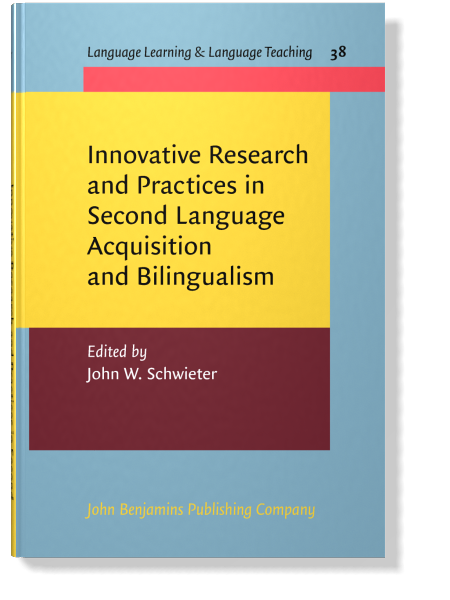
In:Innovative Research and Practices in Second Language Acquisition and Bilingualism
Edited by John W. Schwieter
[Language Learning & Language Teaching 38] 2013
► pp. 85–106
Chapter 5. Why theory and research are important for the practice of teaching
The case of mood choice in Spanish relative clauses
Published online: 22 August 2013
https://doi.org/10.1075/lllt.38.08gar
https://doi.org/10.1075/lllt.38.08gar
Theoretical approaches to second language research suggest that the interaction between different linguistic modules may be at the root of many difficulties faced by learners. The choice of mood in relative clauses in Spanish illustrates the problem given that, in order to be proficient in this area, speakers must know what the two moods, indicative and subjunctive, bring to the meaning of the sentences (semantics) and what the contribution of the context is (pragmatics). Based on results of research carried out by generative linguists on the acquisition of mood selection in relative clauses, this paper argues that the results of theoretically based research that looks at questions such as these has an important contribution to make to language teaching, bridging the gap between generative linguistic approaches to SLA and pedagogy.

Cited by (4)
Cited by four other publications
Leal, Tania & Roumyana Slabakova
Marsden, Heather
2018. Generative second language acquisition and language teaching. In Meaning and Structure in Second Language Acquisition [Studies in Bilingualism, 55], ► pp. 283 ff.
Rastelli, Stefano & Kook-Hee Gil
González Alonso, Jorge & Jason Rothman
2017. From theory to practice in multilingualism. In L3 syntactic transfer [Bilingual Processing and Acquisition, 5], ► pp. 277 ff.
This list is based on CrossRef data as of 26 november 2025. Please note that it may not be complete. Sources presented here have been supplied by the respective publishers. Any errors therein should be reported to them.