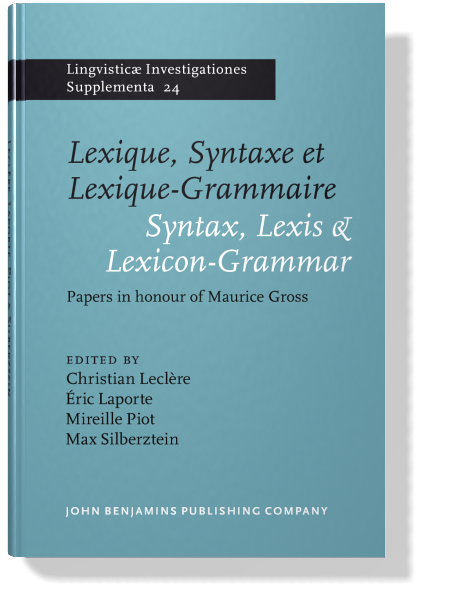
In:Lexique, Syntaxe et Lexique-Grammaire / Syntax, Lexis & Lexicon-Grammar: Papers in honour of Maurice Gross
Edited by Christian Leclère, Éric Laporte, Mireille Piot and Max Silberztein
[Lingvisticæ Investigationes Supplementa 24] 2004
► pp. 343–371
La structure de la phrase en français de Belgique
Article language: French
Published online: 29 July 2004
https://doi.org/10.1075/lis.24.29lam
https://doi.org/10.1075/lis.24.29lam
The paper aims at analyzing about 500 verbs that typically belong to Belgian French, according to the principles of the lexicon-grammar set forth by Maurice Gross. Four categories are distinguished, viz. verbs that are totally unknown in France, e.g. loanwords from Dutch (20 %), verbs that sound archaic in France (2 %), verbs that are common in France but with a different meaning, the so-called "faux amis" (8 %) and verbs that are used in France but with a different syntactic construction (70 %). Each Belgian verb is ascribed to a syntactic class, based on the (in)transitive character of the verb, the absence/ presence of a prepositional complement, etc. The Belgian verbs are thus classified in 33 different classes, the largest of which correspond to transitive structures with two arguments, viz. subject and direct object. Two major findings of the paper are that Belgian French differs more from the French spoken in France than is usually assumed, and that the differences not only concern lexical matters, but, maybe more importantly, syntactic differences.

Cited by (1)
Cited by one other publication
This list is based on CrossRef data as of 26 november 2025. Please note that it may not be complete. Sources presented here have been supplied by the respective publishers. Any errors therein should be reported to them.