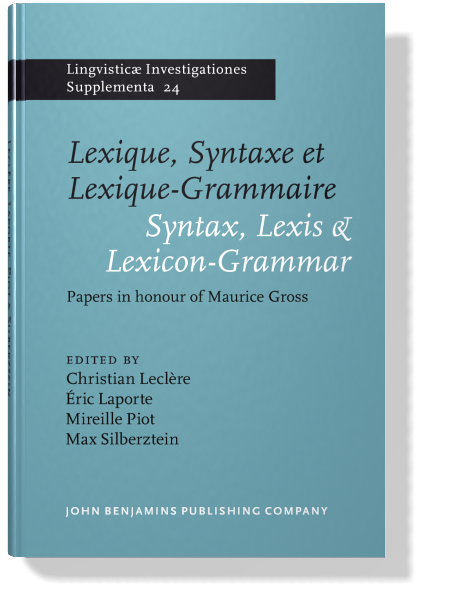
In:Lexique, Syntaxe et Lexique-Grammaire / Syntax, Lexis & Lexicon-Grammar: Papers in honour of Maurice Gross
Edited by Christian Leclère, Éric Laporte, Mireille Piot and Max Silberztein
[Lingvisticæ Investigationes Supplementa 24] 2004
► pp. 231–238
Classes sémantiques et description des langues
Article language: French
Published online: 29 July 2004
https://doi.org/10.1075/lis.24.21gro
https://doi.org/10.1075/lis.24.21gro
The purpose of this article is to demonstrate the importance of semantic classes in the description of language. We know that most predicates are polysemous, and that each sense correlates with a particular set of arguments. We can group these arguments into semantic classes ("classes d'objets" (object classes)), so that the meaning of a predicate can be recognized automatically in context. The same can be done for predicates: the establishment of classes (or sub-classes) of "actions", "states" and "events" allows the grouping of verbs, adjectives or nominal predicates which share the same defining properties. To illustrate this, we shall describe the semantic class of "behaviour towards others".

Cited by (3)
Cited by three other publications
Prandi, Michele
This list is based on CrossRef data as of 26 november 2025. Please note that it may not be complete. Sources presented here have been supplied by the respective publishers. Any errors therein should be reported to them.