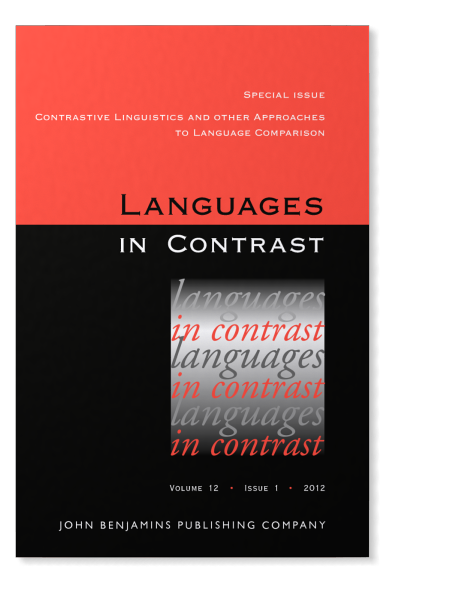
Review published In: Contrastive Linguistics and other Approaches to Language Comparison
Edited by Matthias Hüning and Barbara Schlücker
[Languages in Contrast 12:1] 2012
► pp. 112–119
Book review
. Contrastive Pragmatics. Amsterdam: John Benjamins, 2011. 182 pp. ISBN 978 90 272 2260 2 . [Benjamins Current Topics, 30].
Published online: 12 January 2012
https://doi.org/10.1075/lic.12.1.10ang
https://doi.org/10.1075/lic.12.1.10ang

References (27)
Aijmer, K. and A. -M. Simon-Vandenbergen. 2003. “The Discourse Particle well and its Equivalents in Swedish and Dutch”. Linguistics 41 (6): 1123–1161.
Béal, C. 1993. “Les Stratégies Conversationnelles en Français et en Anglais. Conventions ou reflets de divergences culturelles profondes?” (Conversational Strategies in French and English. Conventions or a reflection of profound cultural differences?) Langue Française 981: 79–106.
Bull, P. E., J. Elliott, D. Palmer and L. Walker. 1996. “Why politicians are three-faced: The face model of political interviews”. British Journal of Social Psychology, 351: 267–284.
Djerf-Pierre, M. 2000. “Squaring the Circle: Public Service and Commercial News on Swedish Television 1956–99”. Journalism Studies 1 (2): 239–260.
Fischer, O. 1989. “The Origin and Spread of the Accusative and Infinitive Construction in English”. Folia Linguistica Historica 81: 143–217.
1992. “Syntactic Change and Borrowing: The Case of the Accusative and Infinitive Construction in English”. In Internal and External Factors in Syntactic Change, eds. M. Gerritsen and D. Stein. 17–88. Berlin: Mouton de Gruyter.
Goldberg, J. 1990. “Interrupting the Discourse on Interruptions: An Analysis in Terms of Relationally Neutral, Power- and Rapport-oriented Acts”. Journal of Pragmatics 141: 883–903.
Haspelmath, M. 2007. “Pre-established Categories don’t Exist: Consequences for Language Description and Typology”. Linguistic Typology 11 (1): 119–132.
House, J. 1996. “Contrastive Discourse Analysis and Misunderstanding: The Case of German and English.” In Contrastive Sociolinguistics, eds. M. Hellinger and H. Ammon. 345–361. Berlin, New York: Mouton de Gruyter.
2005. “Politeness in Germany: Politeness in GERMANY?”. In Politeness in Europe, eds, L. Hickey and M. Stewart. 13–28. Clevedon, United Kingdom: Multilingual Matters.
2005. “Politeness in France: How to Buy Bread Politely”. In Politeness in Europe, eds. Hickey, L. and Stewart, M. 29–44. Clevedon, United Kingdom: Multilingual Matters.
Linke, A. 2000. “Informalisierung? Ent-Distanzierung? Familiarisierung? Sprach(gebrauchs) wandel als Indikator soziokultureller Entwicklungen”. Der Deutschunterricht 31: 66–77.
Martin, J. R., and P. R. R. White. 2005. The Language of Evaluation: Appraisal in English. New York: Palgrave Macmillan.
Moissinac, L. and M. Bamberg. 2004. “‘It’s weird, I was so mad’: Developing Discursive Identity Defenses in Conversational ‘Small’ Stories of Adolescent Boys”. Texas Speech Communication Journal Special Issue, “Narratives We Live By”. Available online at [URL] [last accessed 30th January 2012].
Nøjgaard, M. 1993. Les adverbes français: Essai de description fonctionnelle. Copenhagen: Munksgaard.c
Rossari, C., A. Beaulieu-Masson, C. Cojocariu and A. Razgouliaeva. 2004. Autour des connecteurs. Réflexions sur lénonciation et la portée. Bern: Peter Lang.
Searle, J. 1969. Speech Acts: An Essay in the Philosophy of Language. Cambridge: Cambridge University Press.
Simon-Vandenbergen, A. -M. 1996. “A functional approach to modality”. In Anglistentag 1995, eds. Greifswald, J. K. and D. Vanderbeke. 149–167. (Proceedings of the Anglistentag, XVII1). Tübingen: Max Niemeyer Verlag.
Tottie, G. 1991. Negation in English Speech and Writing: A Study in Variation. San Diego: Academic Press.
Traugott, E. C. and R. Dasher. 2002. Regularity in semantic change. Cambridge: Cambridge University Press.
Visconti, J. 2004. “Conditionals and Subjectification: Implications for a Theory of Semantic Change”. Typological Studies in Language 591: 169–192.