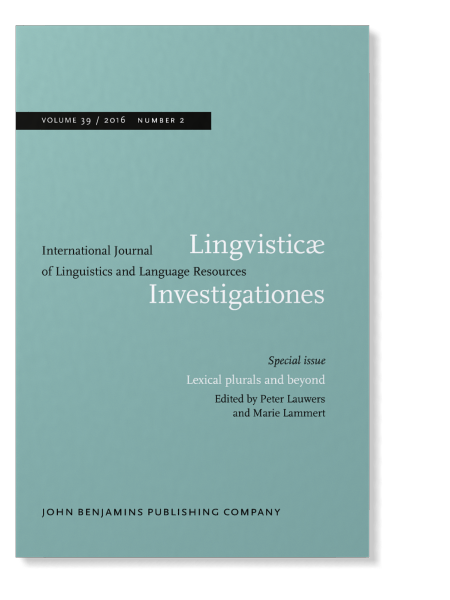
Article published In: Lexical plurals and beyond
Edited by Peter Lauwers and Marie Lammert
[Lingvisticæ Investigationes 39:2] 2016
► pp. 272–288
Les pluriels lexicaux dits « massifs » face au conditionneur universel
Article language: French
Published online: 30 March 2017
https://doi.org/10.1075/li.39.2.04lau
https://doi.org/10.1075/li.39.2.04lau
Cette contribution s’intéresse aux pluriels lexicaux en français. Elle montre que les pluriels lexicaux sont toujours dans la portée de dérivations ultérieures qui restaurent le statut [+ comptable], comme cela ressort notamment de la présence de déterminants indéfinis fortement individualisants. Ces transferts s’avèrent reproduire certains transferts classiques entre massif et comptable comme le trieur et le conditionneur universels. Ce dernier donne lieu à différents effets de sens d’après la nature du nom qui sert d’input : délimitation dans l’espace tridimensionnel, délimitation temporelle, délimitation globale d’événements et d’objets complexes et conditionnement qualitatif. Dans certains cas, le transfert aboutit à la réfection du singulier au sein d’une nouvelle opposition grammaticale. Des opérations « au-delà » du pluriel massif confirment à la fois la pertinence structurelle de la classe des pluriels massifs et leur statut proprement massif (massif étant conçu ici à la fois comme ‘dense’ et ‘compact’).
This paper deals with lexical plurals in French. It shows that lexical plurals are still within the scope of derivations that restore a [+ count] status, as witnessed by the presence of strongly individuating indefinite determiners. These shifts appear to line up with two canonical mass>count transfers, viz. the universal sorter and the universal packager. The latter comes in various subtypes according to the nature of the input-noun: packaging in three-dimensional space, temporal bounding, spatio-temporal bounding of complex activities and objects and, finally, “qualitative” packaging. In some cases, even a novel singular count form shows up (Une rillette, s’il vous plaît!), restoring the canonical grammatical opposition. These operations beyond “plural mass” confirm both the structural relevance of mass plurals as a lexical class and their genuine ‘mass’ status (mass being conceived both as ‘dense’ and ‘compact’).
Article outline
- Introduction
- 1.Pluriel lexical, pluriel non/moins dénombrable
- 2.Effets divers du conditionneur appliqué aux Npl
- 2.1Le conditionneur comme « délimitateur » dans l’espace tridimensionnel
- 2.1.1Rillettes, pâtes, frites
- 2.1.2Fèces, selles, urines
- 2.2Le conditionneur comme « délimitateur » temporel
- 2.3Délimitation globale d’événements et d’objets complexes
- 2.4Le conditionneur qualitatif : bornage qualitatif externe de l’occurrence du N à structure interne compacte
- 2.1Le conditionneur comme « délimitateur » dans l’espace tridimensionnel
- 3.Deux mises en garde
- 4.Conclusions
Oeuvres citées Sitographie

References (33)
Boone, A. (1989). La distinction massif/comptable et les noms de maladies. In J. David et G. Kleiber (Eds.), Termes massifs et termes comptables (pp. 109–123). Metz et Paris : Université de Metz et Klincksieck.
Bunt, H. C. (1985). Mass terms and model theoretic semantics. Cambridge: Cambridge University Press.
Copestake, A., et Briscoe, T. (1995). Semi-productive polysemy and sense extension. Journal of Semantics, 121, 15–67.
De Belder, M. (2011). A morphosyntactic decomposition of countability in Germanic. The Journal of comparative Germanic Linguistics, 14(3), 173–202.
Desagulier, G. (2012).
C'est de la bombe! : Qualitative count-to-mass conversion in French copular subject-predicate constructions. In M. Bouveret et D. Legallois (Eds.), Constructions in French (pp. 201–231). Amsterdam: John Benjamins.
Galmiche, M. (1989). Massif / comptable : de l'un à l'autre et inversement. In J. David et G. Kleiber (Eds.), Termes massifs et termes comptables (pp. 63–77). Paris : Klincksieck.
Hilgert, E. (2014). Un révélateur de massivité: l'énigmatique un peu de. Langue française, 1831, 101–116.
Kerleroux, F. (1996). La coupure invisible. Etudes de syntaxe et de morphologie. Villeneuve d’Ascq : Presses Universitaires du Septentrion.
Kilgarriff, A., Baisa, V., Bušta, J., Jakubíček, M., Kovář, V., Michelfeit, J., Rychlý, P., & Suchomel, V. (2014). The sketch engine: Ten years on. Lexicography, 11, 1–30.
Kleiber, G. (1999). Problèmes de sémantique. La polysémie en questions. Villeneuve d'Ascq : Presses universitaires du Septentrion.
. (2003). Indéfini, partitif et adjectif: du nouveau. La lecture individualisante. Langages, 1511, 9–28.
Knittel, M.-L. (2016). Les noms déverbaux: des pluriels lexicaux à la pluriactionnalité. In P. Lauwers & M. Lammert (Eds.), Lingvisticae investigationes, 39(2), Lexical Plurals and beyond, special issue. Amsterdam: John Benjamins.
Landman, F. (2011). Count nouns - mass nouns - neat nouns - mess nouns. In B. H. Partee, M. Glanzberg, et J. Skilters (Eds.), Formal semantics and pragmatics: Discourse, context, and models. The Baltic international yearbook of cognition, logic and communication (Vol. 61, pp. 1–67). Manhattan, KS: New Prairie Press.
Lauwers, P. (2014). Les pluriels 'lexicaux' : typologie quantifiée des déficits de dénombrabilité. Langue française, 1831, 117–132.
McCawley, J. D. (1975). Lexicography and the count-mass distinction. In In C. Cogen, et al.. (Eds.), Proceedings of the first Berkeley linguistic society conference (pp. 314–321).
Paykin, K. (2003). Noms et verbes météorologiques: des matières aux événements. Université Lille 3. Thèse de doctorat.
Salles, M. (2004). Adjectif et adjectivité ou comment un substantif peut être plus adjectif qu'un adjectif. L'Information grammaticale, 1031, 7–12.
Van de Velde, D. (1995). Le spectre nominal. Des noms de matière aux noms d'abstraction. Louvain: Peeters.
. (2000). Quelques variétés de pluriels de noms abstraits: Référence (pro-) nominale plurielle: aspects linguistiques et psycholinguistiques. Verbum, 41, 379–395.
Vermote, T. (2014). L'opposition massif-comptable: flexibilité et modélisation. Etudes de corpus, enquêtes d'acceptabilité et expérience d'amorçage en français et en néerlandais. Thèse de doctorat (PhD)., Universiteit Gent.
Wierzbicka, A. (1988). The semantics of grammar. Amsterdam: John Benjamins.
Frantext :[URL]
Le Trésor de la Langue Française informatisé (= TLFi): [URL]
Sketch Engine, French Ten Ten Corpus (= 1010) : [URL]
Cited by (3)
Cited by three other publications
Kleineberg, Désirée & Wiltrud Mihatsch
2025. Diachronic evidence for Spanish object mass nouns as a peripheral category. In The Diachrony of Word Class Peripheries [Studies in Language Companion Series, 238], ► pp. 17 ff.
Corbett, Greville G.
Lammert, Marie
2016. Lexical plurals through meronymy and hyperonymy. Lingvisticae Investigationes 39:2 ► pp. 335 ff.
This list is based on CrossRef data as of 25 november 2025. Please note that it may not be complete. Sources presented here have been supplied by the respective publishers. Any errors therein should be reported to them.