In:New Frontiers and Connections in Second Language Acquisition: Selected Proceedings of the 17th Generative Approaches to Second Language Acquisition (GASLA-17) Conference
Edited by Tania Ionin and Silvina Montrul
[Language Acquisition and Language Disorders 71] 2026
► pp. 1–6
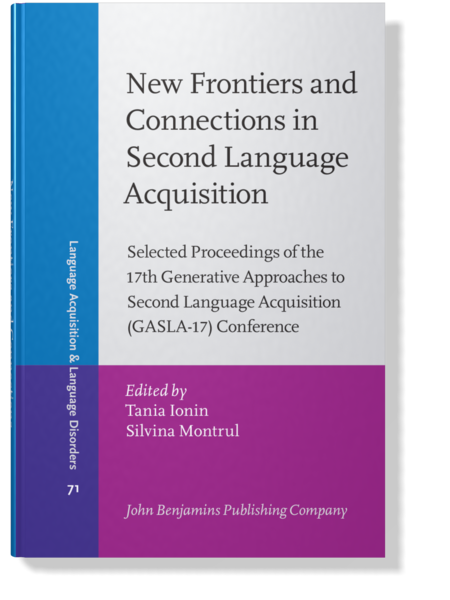
New frontiers and connections in second language acquisition
Introduction
This content is being prepared for publication; it may be subject to changes.

References (11)
Crain, S. (1991). Language
acquisition in the absence of
experience. Behavioral and Brain
Sciences, 14, 597–650.
De Villiers, J., & Roeper, T. (Eds.). (2011). Handbook
of generative approaches to language
acquisition. Springer.
Mitrofanova, N., Leivada, E., & Westergaard, M. (2023). Crosslinguistic
influence in L3 acquisition: Evidence from artificial language
learning. Linguistic Approaches to
Bilingualism, 135, 717–742.
Reiss, J., Sprenger, J., & Zalta, E. N. (2014). The
Stanford encyclopedia of philosophy. [URL]
Schwartz, B. D., & Sprouse, R. A. (2000). When
syntactic theories evolve: Consequences for L2 acquisition
research. In J. Archibald (Ed.), Second
language acquisition and linguistic
theory (pp. 156–186). Blackwell.
(2013). Generative
approaches and the poverty of the
stimulus. In J. Herschensohn & M. Young-Scholten (Eds.), The
Cambridge handbook of second language
acquisition (pp. 137–158). Cambridge University Press.
Slabakova, R., Leal, T., & Domínguez, L. (2024). Research
methods in generative second language
acquisition. Routledge.
Slabakova, R., Leal, T., Dudley, A., & Stack, M. (2020). Generative
second language
acquisition. Cambridge University Press.
White, L. (1989). Universal
grammar and second language
acquisition. John Benjamins.