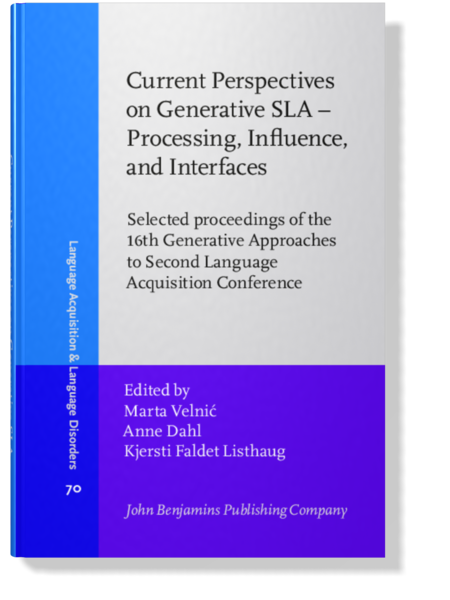
In:Current Perspectives on Generative SLA - Processing, Influence, and Interfaces: Selected proceedings of the 16th Generative Approaches to Second Language Acquisition Conference
Edited by Marta Velnić, Anne Dahl and Kjersti Faldet Listhaug
[Language Acquisition and Language Disorders 70] 2024
► pp. 1–8

References (20)
Bylund, E., Khafif, Z., & Berghoff, R. (2023). Linguistic
and geographic diversity in research on second language acquisition and multilingualism: An analysis of selected
journals. Applied
Linguistics, 1–26.
Clahsen, H., & Felser, C. (2006). Continuity
and shallow structures in language processing. Applied
Psycholinguistics, 27(1), 107–126.
Cunnings, I. (2017). Parsing
and working memory in bilingual sentence processing. Bilingualism: Language and
Cognition, 20(4), 659–678.
Di Domenico, E. (2021). Bilingualism
and (outward) over-explicitness in the choice of subject anaphoric devices. Quaderni di Linguistica e Studi
Orientali, 7, 51–73.
Ferreira, F., Bailey, K. G. D., & Ferraro, V. (2002). Good-enough
representations in language comprehension. Current Directions in Psychological
Science, 11(1), 11–15.
Hahne, A. (2001). What’s
different in second-language processing? Evidence from event-related brain
potentials. Journal of Psycholinguistic
Research, 30, 251–266.
Hopp, H. (2016). The
timing of lexical and syntactic processes in second language sentence
comprehension. Applied
Psycholinguistics, 37(5), 1253–1280.
Ionin, T., & Rispoli, M. (2019). Three
streams of generative language acquisition research: Selected papers from the 7th Meeting of Generative Approaches to
Language Acquisition – North America, University of Illinois at Urbana-Champaign. John Benjamins.
Jacob, G., & Felser, C. (2016). Reanalysis
and semantic persistence in native and non-native garden-path recovery. Quarterly
Journal of Experimental
Psychology, 69(5), 907–925.
Jiang, N., Novokshanova, E., Masuda, K., & Wang, X. (2011). Morphological
congruency and the acquisition of L2 morphemes. Language
Learning, 61(3), 940–967.
Lardiere, D. (2009). Some
thoughts on the contrastive analysis of features in second language acquisition. Second
Language
Research, 25(2), 173–227.
Marsden, H., & Slabakova, R. (2019). Grammatical
meaning and the second language classroom: Introduction. Language Teaching
Research, 23(2), 147–157.
Miyagawa, S. (2009). Why
Agree? Why Move? Unifying agreement-based and discourse-configurational languages. The MIT Press.
Roberts, L., & Felser, C. (2011). Plausibility
and recovery from garden paths in second language sentence processing. Applied
Psycholinguistics, 32(2), 299–331.
Rothman, J., & Slabakova, R. (2018). The
generative approach to SLA and its place in modern second language studies. Studies in
Second Language
Acquisition, 40(2), 417–442.
Slabakova, R. (2013). What
is easy and what is hard to acquire in a second
language. In M. d. P. García Mayo, M. J. Gutiérrez Mangado, & M. Martínez-Adrián (Eds.), Contemporary
approaches to second language
acquisition (pp. 5–8). John Benjamins.
Sorace, A. (2011). Pinning
down the concept of “interface” in bilingualism. Linguistic Approaches to
Bilingualism, 1(1), 1–33.