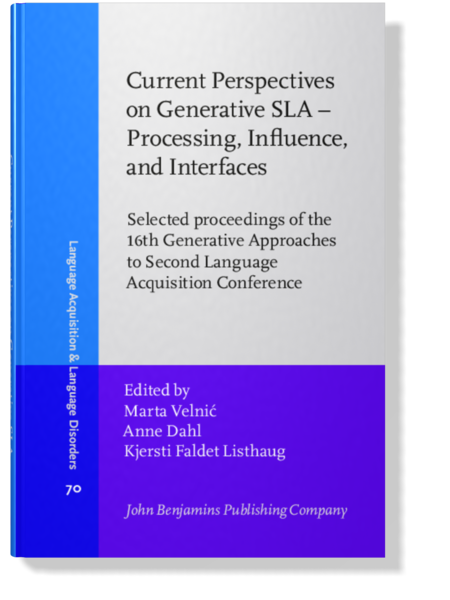
In:Current Perspectives on Generative SLA - Processing, Influence, and Interfaces: Selected proceedings of the 16th Generative Approaches to Second Language Acquisition Conference
Edited by Marta Velnić, Anne Dahl and Kjersti Faldet Listhaug
[Language Acquisition and Language Disorders 70] 2024
► pp. 316–348
Chapter 13UG-as-Guide in selection and reassembly of an uninterpretable feature in L2 acquisition
of wh-questions
Evidence from islands and scope
Published online: 17 October 2024
https://doi.org/10.1075/lald.70.13kim
https://doi.org/10.1075/lald.70.13kim
Abstract
This study explores Universal Grammar (UG) in second language (L2) acquisition, focusing on
uninterpretable features. We present the UG-as-Guide (UGG) model, which contends
that UG plays a pivotal role in eliminating UG-incompatible properties. We investigated L2 English wh-questions in
Chinese-speaking and Japanese-speaking learners through an acceptability judgment task and an elicited production
task. The data revealed that lower-intermediate learners transfer optional movement operations from their native
languages, and apply these operations obligatorily, contrary to UG principles, while upper-intermediate learners
display a shift towards the relevant syntactic knowledge of native speakers. This supports the UGG model, indicating
that initially adopted UG-incompatible operations are subsequently adjusted to align with UG principles, underscoring
the interplay between UG and interlanguage in L2 acquisition.
Keywords: uninterpretable features, wh-questions, UG-as-Guide, interlanguage
Article outline
- 1.Introduction
- 2.Theoretical background
- 2.1Empirical facts about wh-questions
- 2.1.1English
- 2.1.2Chinese
- 2.1.3Japanese
- 2.1.4Summary
- 2.2Theoretical analyses
- 2.2.1English
- 2.2.2Chinese
- 2.2.3Japanese
- 2.3Interim summary
- 2.1Empirical facts about wh-questions
- 3.Wh-questions in L2 grammars
- 3.1Accessibility to UG
- 3.2Acquirability of uninterpretable features and problems with feature reassembly
- 3.3A new proposal on the role of UG
- 4.Experiments
- 4.1Participants
- 4.2AJT
- 4.2.1Aim and predictions
- 4.2.2Design
- 4.3EPT
- 4.3.1Aim and predictions
- 4.3.2Design
- 4.4Results and examination of hypotheses
- 4.4.1AJT
- 4.4.2EPT
- 4.4.3EPT
- 5.Discussion
- 6.Conclusion
Acknowledgements Notes References

References (57)
Aoun, J., & Li, Y. A. (1993). On
some differences between Chinese and Japanese wh-elements. Linguistic
Inquiry, 24, 365–372.
Bates, D., Maechler, M., Bolker, B., Walker, S., Christensen, R., Singmann, H., Dai, B., Scheipl, F., Grothendieck, G., & Green, P. (2020). Package
‘lme4’ (Version 1.1–26).
Belikova, A., & White, L. (2009). Evidence
for the fundamental difference hypothesis or not? Island constraints
revisited. Studies in Second Language
Acquisition, 31, 199–223.
Bley-Vroman, R. W., Felix, S. W., & Ioup, G. L. (1988). The
accessibility of universal grammar in adult language learning. Second Language
Research, 4, 1–32.
Cable, S. (2010). The
grammar of Q: Q-particles, wh-movement, and pied-piping. Oxford University Press.
Cheung, C.-H. C. (2014). Wh-fronting
and the left periphery in Mandarin. Journal of East Asian
Linguistics, 23, 393–431.
(2000). Minimalist
inquiries: The framework. In R. Martin, D. Michaels, & J. Uriagereka (Eds.), Step
by step: Essays on minimalism in honor of Howard
Lasnik (pp. 89–155). The MIT Press.
(2001). Derivation
by phase. In M. Kenstowicz (Ed.), Ken
Hale: A life in
language (pp. 1–52). The MIT Press.
Felser, C. (2001). Wh-expletives
and secondary predication: German partial wh-movement reconsidered. Journal of
Germanic
Linguistics, 13, 5–38.
Goto, N. (2017). Eliminating
the strong/weak parameter on T. In M. Y. Erlewine (Ed.), Proceedings
of GLOW in Asia XI, (Vol.
2, pp. 57–71. MITWPL.
Hagstrom, P. (1998). Decomposing
questions (Unpublished doctoral
dissertation). MIT.
Hawkins, R., & Chan, C. Y-H. (1997). The
partial availability of Universal Grammar in second language acquisition: The ‘failed functional feature
hypothesis’. Second Language
Research, 13, 187–226.
Hawkins, R., & Hattori, H. (2006). Interpretation
of English multiple wh-question by Japanese speakers: A missing uninterpretable feature
account. Second Language
Research, 22, 269–301.
Huang, C.-T. J. (1982). Logical
relations in Chinese and the theory of grammar (Unpublished doctoral
dissertation). MIT.
Johnson, J., & Newport, E. (1991). Critical
period effects on universal properties of language: The status of subjacency in the acquisition of a second
language. Cognition, 39, 215–258.
Kimura, T. (2022a). Feature
selection, feature reassembly, and the role of Universal Grammar: The acquisition of wh-questions by Japanese
and Chinese learners of English (Unpublished doctoral
dissertation). Chuo University.
(2022b). Reassembly
of uninterpretable features in L2 acquisition: Evidence from
wh-questions. In Y. Gong & F. Kpogo (Eds.), Proceedings
of the 46th annual Boston University Conference on Language
Development (pp. 378–389. Cascadilla Press.
Kuznetsova, A, Brockhoff, P. B., & Christensen, R. H. B. (2017). lmerTest
package: Tests in linear mixed effects models. Journal of Statistical
Software, 82.
Lardiere, D. (2008). Feature
assembly in second language acquisition. In J. Liceras, H. Zobl, & H. Goodluck (Eds.), The
role of formal features in second language
acquisition (pp. 106–140). Lawrence Erlbaum Associates.
Law, P. (2010). Scrambling
of wh-phrases in Japanese. In R. Otoguro, K. Ishikawa, H. Umemoto, K. Yoshimoto, & Y. Harada (Eds.), Proceedings
of the 24th Pacific Asia Conference on Language, Information and Computation (pp. 463–470). Waseda University, Tohoku University.
Liu, Y. (2019). Explicating
wh-fronting in Mandarin: A scrambling
approach. In A. G. Grognet (Ed.), Proceedings
of Linguistics Society of America (Vol.
43, pp. 1–12). LSA.
Martohardjono, G. (1993). Wh-movement
in the acquisition of a second language: A cross-linguistic study of three languages with and without
movement (Unpublished doctoral
dissertation). Cornell University.
Miyamoto, Y., & Iijima, Y. (2003). On
the existence of scrambling in the grammar of Japanese elementary EFL
learners. In S. Foster-Cohen & S. P. Doehler (Eds.) Eurosla
Yearbook 3, (pp. 7–27). John Benjamins.
Nishigauchi, T. (1986). Quantification
in syntax (Unpublished doctoral
dissertation). University of
Massachusetts, Amherst.
Reinhart, T. (1981). A
second COMP position. In A. Belletti, L. Brandi, & L. Rizzi (Eds.), Theory
of markedness in generative
grammar (pp. 517–557). Scuola Normale Superiore di Pisa.
Rizzi, L. (2004). Locality
and left periphery. In A. Beletti (Ed.) Structures
and beyond: The cartography of syntactic structures (Vol.
3, pp. 223–251). Oxford University Press.
Ross, J. (1967). Constraints
on variables in syntax (Unpublished doctoral
dissertation) MIT.
Saito, M. (1992). Long
distance scrambling in Japanese. Journal of East Asian
Linguistics, 1, 69–118.
(2016). (A)
Case for labeling: Labeling in languages without ϕ-feature agreement. The
Linguistic
Review, 33, 129–175.
(2017). Japanese
wh-phrases as operators with unspecified quantificational force. Language and
Linguistics, 18, 1–25.
Sauerland, U., & Elbourne, P. (2002). Total
reconstruction, PF movement and derivational order. Linguistic
Inquiry, 33, 283–319.
Schachter, J. (1989). Testing
a proposed universal. In S. Gass & J. Schachter (Eds.), Linguistic
perspectives on second language
acquisition (pp. 73–88). Cambridge University Press.
Schwartz, B. D., & Sprouse, R. A. (1996). L2
cognitive states and the Full Transfer/Full Access model. Second Language
Research, 12, 40–72.
Sharwood-Smith, M. (1988). On
the role of linguistic theory in explanations of second language developmental
grammars. In S. Flynn & W. O’Neil (Eds.), Linguistic
theory in second language
acquisition (pp. 173–198). Kluwer.
Shimoyama, J. (2006). Indeterminate
phrase quantification in Japanese. Natural Language
Semantics, 14, 139–173.
Starke, M. (2001). Move
dissolves into Merge: A theory of locality (Unpublished doctoral
dissertation). University of Geneva.
Szabolcsi, A., & Zwarts, F. (1993). Weak
islands and an algebraic semantics of scope taking. Natural Language
Semantics, 1, 235–284.
Tsimpli, I. M. (2003). Clitics
and determiners in L2 Greek. In J. M. Liceras, H. Zobl, & H. Goodluck (Eds.), Proceedings
of the 6th Generative Approaches to Second Language Acquisition Conference (GASLA
2002) (pp. 331–339). Cascadilla Press.
Tsimpli, I. M., & Dimitrakopoulou, M. (2007). The
Interpretability Hypothesis: Evidence from wh-interrogatives in second language
acquisition. Second Language
Research, 23, 215–242.
Tsimpli, I. M., & Roussou, A. (1991). Parameter-resetting
in L2? UCL Working Papers in
Linguistics, 3, 149–70.
University of Cambridge Local
Examinations Syndicate. (2001). Quick Placement
Test. Oxford University Press.
Uriagereka, J. (1999). Multiple
spell-out. In S. Epstein & N. Hornstein (Eds.), Working
minimalism (pp. 251–282). The MIT Press.
Wakabayashi, S. (1997). The
acquisition of functional categories by learners of English (Unpublished
doctoral dissertation). University of
Cambridge.
(2002). The
acquisition of non-null subjects in English: A minimalist account. Second
Language
Research, 18, 28–71.
Wakabayashi, S., & Okawara, I. (2003). Japanese
learners’ errors on long distance
wh-questions. In S. Wakabayashi (Ed.), Generative
approaches to the acquisition of English by native speakers of
Japanese (pp. 215–46). Mouton de Gruyter.
Watanabe, A. (1992). Subjacency
and S-structure movement of wh-in-situ. Journal of East Asian
Linguistics, 1, 255–292.
White, L. (1992). Subjacency
violations and empty categories in L2
acquisition. In H. Goodluck & M. Rochemont (Eds.), Island
constraints (pp. 445–464). Kluwer.
Wu, J. (1999). Syntax
and semantics of quantification in Chinese (Unpublished doctoral
dissertation). University of Maryland.
Cited by (2)
Cited by two other publications
Kimura, Takayuki
Kimura, Takayuki & Takaaki Hirokawa
2025. More evidence on the unergative–unaccusative distinction in second language grammars. Linguistic Approaches to Bilingualism 15:3 ► pp. 404 ff.
This list is based on CrossRef data as of 25 november 2025. Please note that it may not be complete. Sources presented here have been supplied by the respective publishers. Any errors therein should be reported to them.