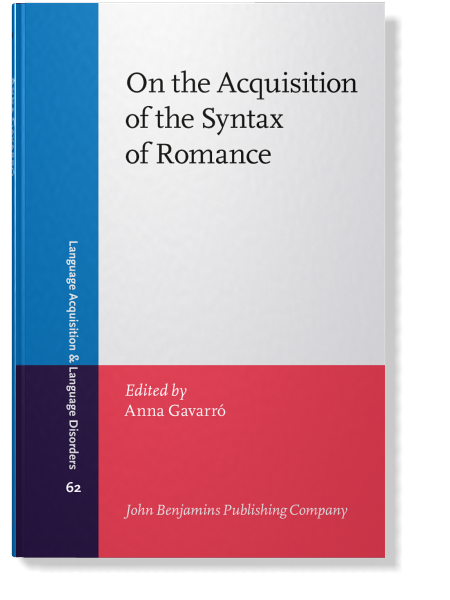
In:On the Acquisition of the Syntax of Romance:
Edited by Anna Gavarró
[Language Acquisition and Language Disorders 62] 2018
► pp. 187–214
Subject position in Spanish as a heritage language in the Netherlands: External and internal interface factors
Published online: 12 December 2018
https://doi.org/10.1075/lald.62.09osc
https://doi.org/10.1075/lald.62.09osc
This study investigates Spanish heritage speakers in the Netherlands concerning their knowledge of three factors influencing subject position in Spanish: verb type, focus and definiteness. The results of a scalar acceptability judgment task show that heritage speakers have monolingual-like knowledge of the effects of verb type and focus, but not of the effect of definiteness of the subject. We interpret the vulnerability of the definiteness factor as partial support for the second version of the Interface Hypothesis, which predicts the syntax-discourse/pragmatics interface to be particularly vulnerable compared to the syntax-semantics interface. The heritage speakers moreover overgeneralize postverbal subjects, a finding that we tentatively attribute to cross-linguistic influence from Dutch.
Article outline
- 1.Introduction
- 2.The Interface Hypothesis
- 3.Subject position in Spanish
- 4.Previous research on word order patterns in monolingual and heritage Spanish
- 5.Research questions and hypotheses
- 6.Method
- Participants
- Task and procedure
- Items
- 7.Results
- Monolingual controls
- Heritage speakers
- Individual differences
- Item effects
- 8.Discussion
- 9.Conclusion
Acknowledgments Notes References

References (58)
Alba, O. (2004). Cómo hablamos los dominicanos: Un enfoque sociolingüístico. Santo Domingo: Grupo León Jimenes.
Bates, D., & Sarkar, D. (2006). Lme4: Linear mixed-effects models using S4 classes. R package version 0.99875-8. < [URL] >
(2001). Inversion as focalization. In A. Hulk & J. Y. Pollock (Eds.), Subject inversion in Romance and the theory of Universal Grammar (pp. 60–90). Oxford: OUP.
Belletti, A., Bennati, E., & Sorace, A. (2007). Theoretical and developmental issues in the syntax of subjects: Evidence from near-native Italian. Natural Language and Linguistic Theory, 25, 657–689.
Cuza, A. (2012). Crosslinguistic influence at the syntax proper: Crosslinguistic influence at the syntax proper: Interrogative subject–verb inversion in heritage Spanish. International Journal of Bilingualism, 17(1), 71–96.
De Miguel Aparicio, E. (1993). Construcciones ergativas e inversión en la lengua y la interlengua española. In J. M. Liceras (Ed.), La lingüística y el análisis de los sistemas no nativos (pp. 178–195). Ottawa: Dovehouse Editions.
De Prada Pérez, A. (2010). Variation in subject expression in Western Romance. In S. Colina, A. Olarrea, & A. M. Carvalho (Eds.), Selected papers from the 39th Linguistics Symposium of Romance Languages (LSRL) (pp. 267–284). Amsterdam: John Benjamins.
De Prada Pérez, A., & Pascual y Cabo, D. (2012). Interface heritage speech across proficiencies: Unaccusativity, focus, and subject position in Spanish. In K. Geeslin & M. Díaz-Campos (Eds.), Selected proceedings of the 14th Hispanic Linguistics Symposium (pp. 308–318). Somerville, MA: Cascadilla Proceedings Project.
Domínguez, L., (2007). The L2 acquisition of Spanish focus: A case of incomplete and divergent grammars. In S. Baauw, J. van Kampen, & M. Pinto (Eds.), The acquisition of Romance languages: Selected papers from The Romance Turn II (pp. 45–57). Utrecht: LOT.
Domínguez, L. & Arche, M. J., (2008). Optionality in L2 grammars: the acquisition of SV/VS contrast in Spanish. In H. Chan, H. Jacob, & E. Kapia (Eds.), Proceedings of the 32nd annual Boston University Conference on Language Development (BUCLD 32) (pp. 96–107). Somerville: Cascadilla Press.
Domínguez, L., & Arche, M. J. (2014). Subject inversion in non-native Spanish. Lingua, 145(1), 243–265.
Fernández Soriano, O. (1993). Sobre el orden de palabras en español. Dicenda: Cuadernos de Filología Hispánica, 11, 113–152.
Gabriel, C. (2010). On focus, prosody, and word order in Argentinean Spanish: A minimalist OT account. ReVEL, 4, 183–222.
Halekoh, U., & Højsgaard, S. (2014). A kenward-roger approximation and parametric bootstrap methods for tests in linear mixed models–the R package pbkrtest. Journal of Statistical Software, 59(9), 1–30.
Hertel, T. J. (2003). Lexical and discourse factors in the second language acquisition of Spanish word order. Second Language Research, 19(4), 273–304.
Hinch Nava, E. (2007). Word order in bilingual Spanish: Convergence and intonation strategy. In J. Holmquist, A. Lorenzino & L. Sayahi (Eds.), Selected proceedings of the Third Workshop on Spanish Sociolinguistics (pp. 129–139). Somerville, MA: Cascadilla Proceedings Project.
Hoot, B. (2012). Presentational focus in heritage and monolingual Spanish. (Doctoral dissertation). Chicago: University of Illinois at Chicago.
Hopp, H. (2009). The syntax–discourse interface in near-native L2 acquisition: off-line and on-line performance. Bilingualism: Language and Cognition, 12, 463–483.
Hulk, A. & Müller, N. (2000). Bilingual first language acquisition at the interface between syntax and pragmatics. Bilingualism: Language and Cognition, 3(3), 227–244.
Ivanov, I. (2012). L2 acquisition of Bulgarian clitic-doubling: A test case for the Interface Hypothesis. Second Language Research, 28(3). 345–368.
Iverson, M., Kempchinsky, P., & Rothman, J. (2008). Interface vulnerability and knowledge of the subjunctive/indicative distinction with negated epistemic predicates in L2 Spanish. Eurosla Yearbook, 8(1), 135–163.
Kahane, H. & Kahane, R. (1950). The position of the actor expression in colloquial Mexican Spanish. Language, 26(2), 236–263.
Laleko, O., & Polinsky, M. (2016). Between syntax and discourse. Linguistic Approaches to Bilingualism, 6(4), 396–439.
López Meirama, B. (1997). La posición del sujeto en la cláusula monoactancial en español (Unpublished doctoral dissertation). Universidade de Santiago de Compostela.
Lozano, C. (2006). Focus and split-intransitivity: The acquisition of word order alternations in non-native Spanish. Second Language Research, 22(2), 145–187.
Montrul, S. (2005). Second language acquisition and first language loss in adult early bilinguals: Exploring some differences and similarities. Second Language Research, 21(3), 199–249.
(2006). On the bilingual competence of Spanish heritage speakers: Syntax, lexical-semantics and processing. International Journal of Bilingualism, 10(1), 37–69.
(2008). Incomplete acquisition in Spanish heritage speakers: chronological age or interfaces vulnerability. In H. Chan, H. Jacob, & E. Kapia (eds), BUCLD 32: Proceedings of the 32nd annual Boston University Conference on Language Development (pp. 299–310). Somerville, MA: Cascadilla.
Muntendam, A. (2009). Linguistic transfer in Andean Spanish: Syntax or pragmatics? (Unpublished doctoral dissertation). University of Illinois at Urbana-Champaign.
Ordóñez, F. (1997). Word order and clause structure in Spanish and other Romance languages (Unpublished doctoral dissertation). The City University of New York Graduate Center.
Ordóñez, F., & Olarrea, A. (2006). Microvariation in Caribbean/non Caribbean Spanish interrogatives. Probus, 18, 59–96.
Osch van, B., & Sleeman, P. (2016). Spanish heritage speakers in the Netherlands: Linguistic patterns in the judgment and production of mood. International Journal of Bilingualism. :
Osch van, B.. Hulk, A., Sleeman, P., & Aalberse, S. (2017). Mood distinctions by Spanish heritage speakers in the Netherlands: a question of interfaces or variability? In K. Bellamy, M. Child, P. González, A. Muntendam, & M.C. Parafita Couto (Eds.), Multidisciplinary approaches to bilingualism in the Hispanic and Lusophone world (pp. 67–94). Amsterdam: John Benjamins.
Parafita Couto, M. C. P., Gathercole, V. C. M., & Stadthagen-González, H. (2015). Interface strategies in monolingual and end-state L2 Spanish grammars are not that different. Frontiers in Psychology, 5, 1525, 1–17.
Perlmutter, D. M. (1978). Impersonal passives and the unaccusative hypothesis. Annual meeting of the Berkeley Linguistics Society, 4, 157–190.
R Development Core Team (2017). R: A Language and Environment for Statistical Computing. Vienna: R Foundation for Statistical Computing. <[URL]>
Rivas, J. (2008). La posición del sujeto en las construcciones monoactanciales del español: Una aproximación funcional. Hispania, 91(4), 897–912.
Roggia, A. B. (2011). Unaccusativity and word order in Mexican Spanish: An examination of syntactic interfaces and the split intransitivity hierarchy (Unpublished doctoral dissertation). The Pennsylvania State University.
Rosen, C. (1984) The interface between semantic roles and initial grammatical relations. In D. Perlmutter & C. Rosen (Eds.) Studies in relational grammar 2 (pp. 38–77). Chicago, IL: University of Chicago Press.
Rothman, J. (2008). How pragmatically odd! Interface delays and pronominal subject distribution in L2 Spanish. Studies in Hispanic and Lusophone Linguistics, 1(2), 317–340.
Sánchez-Alvarado, C. (2016). Subject position in L2 Spanish. Poster session presented at Linguistic Symposium on Romance Languages (LSRL) 46, Stony Brook University (SUNY).
Serratrice, L., Sorace, A., & Paoli, S. (2004). Crosslinguistic influence at the syntax– pragmatics interface, subjects and objects in English–Italian bilingual and monolingual acquisition. Bilingualism, Language and Cognition, 7, 183–206.
Silva-Corvalán, C. (2001). Sociolingüística y pragmática del español. Washington, DC: Georgetown University Press.
Slabakova, R., Rothman, J. & Kempchinsky, P. (2012). Clitic-doubled left dislocation and focus fronting in L2 Spanish: A case of successful acquisition at the syntax–discourse interface. Second Language Research, 28(3), 319–343.
(2004). Gradience at the lexicon-syntax interface: evidence from auxiliary selection and implications for unaccusativity. In A. Alexiadou, E. Anagnostopoulou, & M. Everaert (Eds.), The unaccusativity puzzle: Explorations of the syntax-lexicon interface (pp. 243–268) Oxford: OUP.
(2011). Pinning down the concept of ‘interface’ in bilingualism. Linguistic Approaches to Bilingualism, 1(1), 1–33. :
Sorace, A., & Filiaci, F. (2006). Anaphora resolution in near-native speakers of Italian. Second Language Research, 22, 339–368.
Sorace, A., & Serratrice, L. (2009). Internal and external interfaces in bilingual language development: Beyond structural overlap. International Journal of Bilingualism, 13(2), 195–210.
Tsimpli, I. M., & Sorace, A. (2006). Differentiating interfaces: L2 performance in syntax–semantics and syntax–discourse phenomena. In D. Bamman, T. Magnitskaia, & C. Zaller (Eds.), BUCLD 30: Proceedings of the 30th annual Boston University Conference on Language Development (pp. 653–664). Somerville, MA: Cascadilla Press.
Tsimpli, I., Sorace, A., Heycock, C., & Filiaci, F. (2004). First language attrition and syntactic subjects: A study of Greek and Italian near-native speakers of English. International Journal of Bilingualism, 8(3), 257–277.
Villa-García, J. & Suárez-Palma, I. (2016). Early null and overt subjects in the Spanish of simultaneous English-Spanish bilinguals and crosslinguistic influence. Revista Española de Lingüística Aplicada/Spanish Journal of Applied Linguistics (RESLA/SJAL) 29(2), 350–395.
Cited by (7)
Cited by seven other publications
Giannakou, Aretousa & Georgios P. Georgiou
Hoot, Bradley
Rinke, Esther, Cristina Flores, Priscila Oliveira & Liliana Correia
Hoot, Bradley & Tania Leal
Laleko, Oksana
Laleko, Oksana
This list is based on CrossRef data as of 25 november 2025. Please note that it may not be complete. Sources presented here have been supplied by the respective publishers. Any errors therein should be reported to them.