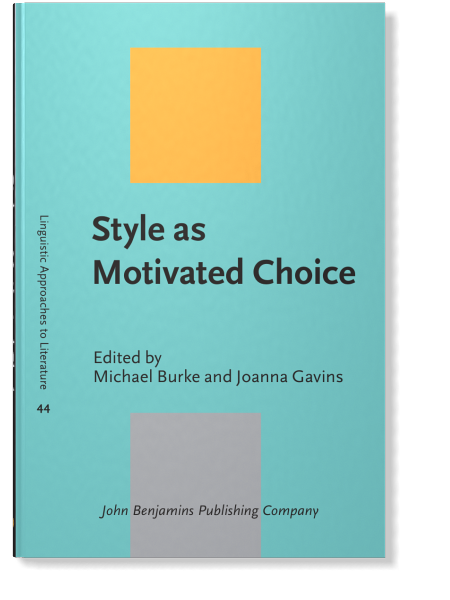
In:Style as Motivated Choice: In memory of Peter Verdonk (1934–2021)
Edited by Michael Burke and Joanna Gavins
[Linguistic Approaches to Literature 44] 2025
► pp. 130–147
Chapter 8Cognition and the creative interplay of word and image in Apollinaire’s “Il Pleut”
Published online: 8 May 2025
https://doi.org/10.1075/lal.44.08gav
https://doi.org/10.1075/lal.44.08gav
Abstract
This chapter honours two of Peter Verdonk’s long-standing scholarly interests: first, the relationship between word
and image in poetry; and second, the cognition of literary style. In his article, “Painting, poetry, parallelism: ekphrasis,
stylistics and cognitive poetics”, Verdonk states that human beings have “a prevailing desire for some sort of productive
interaction between word and image” (2005: 235), before going on to present a
characteristically exhaustive, contextually grounded and cognitively informed analysis of the style of William Carlos
Williams’ poem, “The Dance”. While Verdonk’s analysis focuses on an ekphrastic text which, as he explains, “is expected to
call the image to mind, to conjure it up, as it were” (2005: 235), he also notes
that other poetic forms, including shape poetry and concrete poetry, similarly seem to satisfy our preoccupation with vision
and language. My own chapter examines one such poem, while aiming to follow the analytical principles of context-sensitivity,
rigour, and theoretical experimentation which underpinned Peter’s entire scholarly career. In the analysis of Apollinaire’s
famous text, “Il Pleut”, which follows, I bring traditional stylistic and literary-critical approaches into
dialogue with more recent cognitive accounts of the experience of reading poetry, specifically looking at the cognition of
iconicity in poetry at the very beginnings of what would become the concrete movement in the early twentieth century.
Keywords: Apollinaire, calligrams, cognition, concrete poetry, iconicity, “Il Pleut”, stylistics
Article outline
- Approaching “Il Pleut”
- Visuo-verbal simultaneity
- Experiencing “Il Pleut”
- Concluding remarks
Acknowledgement References

References (37)
Adamson, W. L. 1999. Apollinaire’s
politics: Modernism, Nationalism, and the public sphere in avant-garde
Paris. Modernism/Modernity 6(3): 33–56.
1966 [1902]. Letter
to Karl Boès. In Oeuvres complètes de Guillaume Apollinaire:
Volume 4, M. Décaudin (ed.). Paris: André Balland & Jacques Lecat.
1980. Calligrammes:
Poems of War and Peace (1939–1916) [trans. A. H. Greet]. Berkeley, CA: University of California Press.
1991. Simultanisme-librettisme. In Oeuvres
en prose completes, M. Décaudin & P. Caizergues (eds). Paris: Gallimard.
Clark, A. 2008. Supersizing
the Mind: Embodiment, Action, and Cognitive
Extension. Oxford: Oxford University Press.
Fauconnier, G. & Turner, M. 2003. The
Way We Think: Conceptual Blending and the Mind’s Hidden Complexities. New York, NY: Basic Books.
Foucault, M. 1983. [1973] This
is Not a Pipe [trans. J. Harkness]. Berkeley, CA: University of California Press.
Freeman, M. H. 2020. The
Poem as Icon: A Study in Aesthetic
Cognition. Oxford: Oxford University Press.
2020. Poetry
in the Mind: The Cognition of Contemporary Poetic
Style. Edinburgh: Edinburgh University Press.
Harvey, P. 2024. Remembering
Atwood: Text World Theory and Memories of Narrative Fiction. PhD
dissertation, University of Sheffield.
Herman, D. 2002. Story
Logic: Problems and Possibilities of Narrative. Lincoln, NE: University of Nebraska Press.
Kennedy, A. 2000. Attention
allocation in reading: sequential or parallel? In Reading as
a Perceptual Process, A. Kennedy, R. Radach, D. Heller & J. Pynte (eds), 193–220. Oxford: Elsevier.
Kennedy, A., Brooks, R., Flynn, L.-A. & Prophet, C. 2003. The
reader’s spatial code. In The Mind’s Eye: Cognitive and
Applied Aspects of Eye Movement Research, J. Hyönä, R. Radach & H. Deubel (eds), 193–212. Amsterdam: Elsevier Science.
Kennedy, A. & Murray, W. S. 1985. Spatial
coordinates and reading: comments on Monk (1985). Quarterly Journal of Experimental
Psychology 39: 649–56.
Lahey, E. 2019. World-building
as cognitive feedback loop. In Experiencing Fictional
Worlds, B. Neurohr & E. Stewart-Shaw (eds), 53–72. Amsterdam: John Benjamins.
Langacker, R. W. 1986. Abstract
motion. In Proceedings of the Twelfth Annual Meeting of the
Berkeley Linguistics Society, V. Nikiforidou, M. VanClay, M. Niepokuj, & D. Feder (eds), 455–471. Berkeley, CA: University of California, Berkeley Linguistics Society.
1987. Foundations
of Cognitive Grammar, Volume 1: Theoretical Prerequisites. Stanford, CA: Stanford University Press.
1991. Foundations
of Cognitive Grammar, Volume 2: Descriptive Application. Stanford, CA: Stanford University Press.
Lockerbie, S. I. 1980. Introduction. In Calligrammes:
Poems of Peace and War (1913–1916) [trans. A. H. Greet], 1–20. Berkeley, CA: University of California Press.
Nänny, M. & Fischer, O. 1999. Form
Miming Meaning: Iconicity in Language and
Literature 1. Amsterdam: John Benjamins.
2001. The
Motivated Sign. Amsterdam: John Benjamins.
Navon, D. 1977. Forest
before trees: the precedence of global features in visual perception. Cognitive
Psychology 9: 353–83.
Shingler, K. 2011. Perceiving
text and image in Apollinaire’s
calligrammes. Paragraph, 34(1): 66–85.
Stockwell, P. 2009. The
cognitive poetics of literary resonance. Language and
Cognition, 1(1): 25–44.
Talmy, L. 1983. How
language structures space. In Spatial Orientation: Theory,
Research, and Application, H. L. Pick, Jr. & L. P. Acredolo (eds), 225–282. New York: Plenum.
1996. Fictive
motion in language and “ception”. In Language and
Space, P. Bloom, M. A. Peterson, L. Nadel, & M. F. Garrett (eds), 211–276. Cambridge, MA: MIT Press.
2000. Toward
a Cognitive Semantics: Vol. I. Conceptual Structuring Systems. Cambridge, MA: MIT Press.