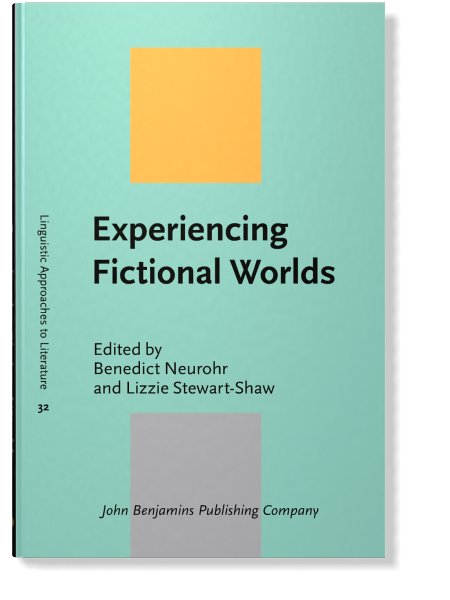
In:Experiencing Fictional Worlds:
Edited by Benedict Neurohr and Lizzie Stewart-Shaw
[Linguistic Approaches to Literature 32] 2019
► pp. v–vi
Get fulltext
This article is available free of charge.
Published online: 21 February 2019
https://doi.org/10.1075/lal.32.toc
https://doi.org/10.1075/lal.32.toc
Table of contents
Acknowledgments
List of contributors
Preface
Chapter 1.Introduction
Benedict Neurohr
Lizzie Stewart-Shaw
Part 1.Foundations of fictional worlds
Chapter 2.Immersion and emergence in children’s literature
Peter Stockwell
Chapter 3.A Predictive Coding approach to Text World Theory
Benedict Neurohr
Chapter 4.World-building as cognitive feedback loop
Ernestine Lahey
Part 2.Forming fictional worlds
Chapter 5.Building horrible worlds
Lizzie Stewart-Shaw
Chapter 6.Framing the narrative: The “fictive publisher” as a bridge builder between intra- and extratextual world
Natalia Igl
Chapter 7.Constructing inferiority through comic characterisation: Self-deprecating humour and cringe comedy in High Fidelity and Bridget Jones’s Diary
Agnes Marszalek
Chapter 8.Cognitive grammar and reconstrual: Re-experiencing Margaret Atwood’s “The Freeze-Dried Groom”
Chloe Harrison
Louise Nuttall
Part 3.Fictional worlds in context
Chapter 9.Immersive reading and the unnatural text-worlds of “Dead Fish”
Jessica Norledge
Chapter 10.Experiencing literature in the poetry classroom
Marcello Giovanelli
Chapter 11.Sharing fiction: A text-world approach to storytime
Sarah Jackson
Chapter 12.Afterword
Joanna Gavins
Index
