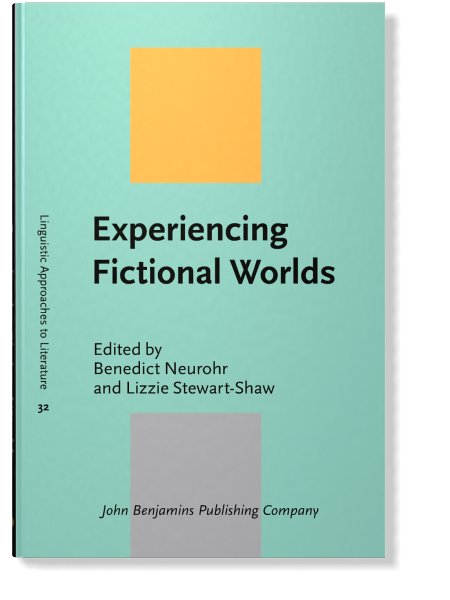
In:Experiencing Fictional Worlds:
Edited by Benedict Neurohr and Lizzie Stewart-Shaw
[Linguistic Approaches to Literature 32] 2019
► pp. 53–72
Chapter 4World-building as cognitive feedback loop
Published online: 21 February 2019
https://doi.org/10.1075/lal.32.04lah
https://doi.org/10.1075/lal.32.04lah
Abstract
Text World Theory (Gavins 2007; Werth 1999) has traditionally assumed a unidirectional model of knowledge transmission from discourse-world to text-world. In this chapter I follow Troscianko (2017) to suggest that world-building in discourse occurs within a cognitive feedback loop in which existing knowledge is applied toward the construction of a text-world network, and new information feeds from this network back into the minds of readers. In what follows, I demonstrate the utility of a feedback-loop approach in accounting for knowledge accrual in discourse through a case-study analysis of Canadian author Sheldon Currie’s (1995) novella The Glace Bay Miners’ Museum. I argue that Currie’s rhetorical positioning of the reader as the recipient of a highly politicised subtext at two levels of the discourse results in the incorporation of new or modified knowledge into a reader’s knowledge base.
Article outline
- 4.1Introduction
- 4.2Knowledge in Text World Theory
- 4.3World-building as cognitive feedback loop
- 4.4 The Glace Bay Miners’ Museum
- 4.5Conclusion
Notes References

References (55)
Altmann, G. and Steedman, M. 1988. Interaction with context during human sentences processing. Cognition 30: 191–238.
Barber, K. 2007. Only in Canada, You Say: A Treasury of Canadian Language. Don Mills, ON: Oxford University Press.
Barcelona, A. 2005. The multilevel operation of metonymy in grammar and discourse, with particular attention to metonymic chains. In Cognitive Linguistics: Internal Dynamics and Interdisciplinary Interaction, M. Cerval and F. Ruiz de Mendoza Ibáñez (eds), 313–352. Berlin: Mouton de Gruyter.
Canning, P. 2017. Text World Theory and real world readers: From literature to life in a Belfast prison. Language and Literature 26(2): 172–187.
Cape Breton Miners’ Museum. N.d. <[URL]> (27 April 2017).
Chanter, T. 2006. Abjection and the Constitutive Nature of Difference: Class Mourning in Margaret’s Museum and Legitimating Myths of Innocence in Casablanca
. Hypatia 21(3): 86–106.
Clark, H. and Marshall, C. 1981. Definite reference and mutual knowledge. In Elements of Discourse Understanding, A. Joshi, B. Webber and I. Sag (eds), 10–63. Cambridge: Cambridge University Press.
Clark, H., Shreuder, R. and Buttrick, S. 1983. Common ground and the understanding of demonstrative reference. Journal of Learning and Verbal Behavior 22(2): 245–258.
Clark, A. 2013. Whatever next? Predictive brains, situated agents, and the future of cognitive science. Behavioral and Brain Sciences 36: 181–253.
Community Sector Council Nova Scotia. 2014. Cape Breton Miners’ Museum (Glace Bay) Profile. YouTube, October 10 2014, <[URL]> (27 April 2017).
Davey, W. and MacKinnon, R. 2016. Dictionary of Cape Breton English. Toronto: University of Toronto Press.
De Graaf, A., Hoeken, H., Sanders, J. and Beentjes, J. 2009. The role of dimensions of narrative engagement in narrative persuasion. Communications 34(4): 385–405.
Edwards, J. 2010. Minority Languages and Group Identity: Cases and Categories. Amsterdam: John Benjamins.
Fairburn, C. 2008. Eating disorders: the transdiagnostic view and the cognitive behavioral therapy. In Cognitive Behavioral Therapy and Eating Disorders, C. Fairburn (ed), 7–22. New York, NY: The Guilford Press.
Fillmore, C. 1982. Frame Semantics. In Linguistics in the Morning Calm, The Linguistic Society of Korea (ed.), 111–137. Seoul: Hanshin Publishing.
Gavins, J. 2001. Text World Theory: A Critical Exposition and Development in Relation to Absurd Prose Fiction. PhD dissertation, Sheffield Hallam University.
Gerrig, R. 1993. Experiencing Narrative Worlds: On the Psychological Activities of Reading. New Haven and London: Yale University Press.
Hodd, T. 2008. Shoring against our ruin: Sheldon Currie, Alistair MacLeod, and the Heritage Preservation Narrative. Studies in Canadian Literature 33(2): 191–209.
Hunter, A. 2015. Evocative objects: a reading of resonant things and material encounters in Victorian writers’ houses/museums. PhD dissertation, University of Edinburgh.
Kuiken, D., Miall, D. and Sikora, S. 2004. Forms of Self-Implication in Literary Reading. Poetics Today 25(2): 171–203.
Kukkonen, K. 2014. Bayesian narrative: Probability, plot and the shape of the fictional world. Anglia 132(4): 720–739..
2016. Bayesian bodies: The predictive dimension of embodied cognition and culture. In The Cognitive Humanities, P. Garratt (ed), 153–167. London: Palgrave MacMillan.
Lahey, E. 2016. Author-character ethos in Dan Brown’s Langdon-series novels. In World-Building: Discourse in the Mind, J. Gavins and E. Lahey (eds), 33–51. London: Bloomsbury Academic.
Littlemore, J. 2015. Metonymy: Hidden Shortcuts in Language, Thought and Communication. Cambridge: Cambridge University Press.
MacCannell, D. 1984. Reconstructed ethnicity tourism and cultural identity in third world communities. Annals of Tourism Research 11(3): 375–391.
Mar, R. and Oatley, K. 2008. The function of fiction is the abstraction and simulation of social experience. Perspectives on Psychological Science 3(3): 173–192.
Miall, D. and Kuiken, D. 2002. A feeling for fiction: Becoming what we behold. Poetics 30(4): 221–224.
Morgan, R. 2008. Rise Again! The Story of Cape Breton Island: Book One. Wreck Cove, NS: Breton Books.
Mortimer, G. 2016a. Miners museum in Glace Bay in race against time to repair building. CBC News, 27 September 2016, <[URL]> (27 April 2017).
2016b. Cape Breton Miners Museum ready for summer with enhancements. CBC News, 24 May 2016, <[URL]> (27 April 2017).
2017. On truth and fiction. In Cognitive Literary Science, M. Burke and E. Troscianko (eds), 259–278. Oxford: Oxford University Press.
Pankhurst, A. 1999. Recontextualization of metonymy in narrative and the case of Toni Morrison’s Song of Solomon
. In Metonymy in Language and Thought, K. Panther and G. Radden (eds), 385–399. Amsterdam: John Benjamins.
Rapp, D., Hinze, S., Slaten, D. and Horton, W. 2014. Amazing stories: Acquiring and avoiding inaccurate information from fiction. Discourse Processes 51(1–2): 50–74.
Radden, G. and Kövecses, Z. 1999. Towards a theory of metonymy. In Metonymy in Language and Thought, K. Panther and G. Radden (eds), 17–59. Amsterdam: John Benjamins.
Ryan, M. 1991. Possible Worlds, Artificial Intelligence and Narrative Theory, Bloomington and Indianapolis: Indiana University Press.
Stockwell, P. 2009. Texture: A Cognitive Aesthetics of Reading. Edinburgh: University of Edinburgh Press.
2014. Atmosphere and tone. In The Cambridge Handbook of Stylistics, P. Stockwell and S. Whiteley (eds), 360–374. Cambridge: Cambridge University Press.
Toolan, M. 2009. Narrative Progression in the Short Story: A Corpus Stylistic Approach. Amsterdam: John Benjamins.
Troscianko, E. 2017. Feedback in reading and disordered eating. In Cognitive Literary Science, M. Burke and E. Troscianko (eds), 169–194. Oxford: Oxford University Press.
Von Bertalanffy, L. 1969. General Systems Theory: Foundations, Development, Applications. New York: George Braziller.
Cited by (7)
Cited by seven other publications
Gavins, Joanna
2025. Cognition and the creative interplay of word and image in Apollinaire’s “Il Pleut”. In Style as Motivated Choice [Linguistic Approaches to Literature, 44], ► pp. 130 ff.
Giovanelli, Marcello & Polina Gavin
Giovanelli, Marcello
Norledge, Jessica
Norledge, Jessica
This list is based on CrossRef data as of 25 november 2025. Please note that it may not be complete. Sources presented here have been supplied by the respective publishers. Any errors therein should be reported to them.