Article published In: Language Impairment in Bilingual Children: State of the art 2017
Edited by Theodoros Marinis, Sharon Armon-Lotem and George Pontikas
[Linguistic Approaches to Bilingualism 7:3/4] 2017
► pp. 359–393
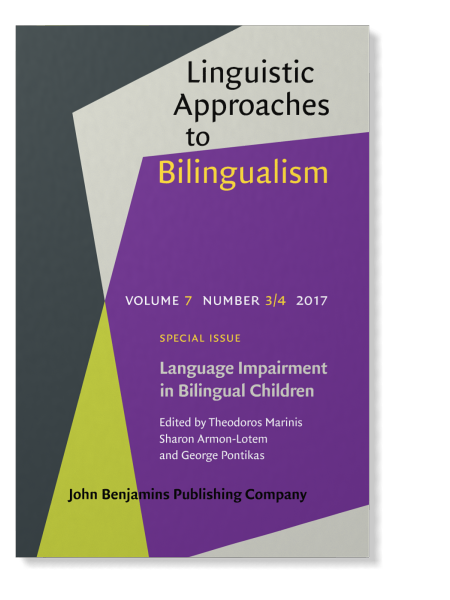
Language performance of sequential bilinguals on an Irish and English sentence repetition task
Published online: 5 April 2017
https://doi.org/10.1075/lab.15026.ant
https://doi.org/10.1075/lab.15026.ant
Abstract
Currently there are no standardized language assessments for English-Irish bilingual school age children that would test languages in a comparable way. There are also no standardized language assessments of Irish for this age group. The current study aimed to design comparable language assessments in both languages targeting structures known to be challenging for children with language impairments. A sentence repetition (SRep) task equivalent to the English SRep task (Marinis, T, Chiat, S, Armon-Lotem, S, Piper, J., & Roy, P. (2011). School-age sentence imitation test- E32. In COST ACTION ISO804, Language impairment in a multilingual society: Linguistic patterns and the road to assessment. Retrieved 5th March 2012, from [URL].) was designed for Irish. Twenty-four typically developing, sequential bilingual children immersed in Irish in the educational setting performed better on the English SRep task than on the Irish SRep task. Different patterns were observed in language performance across sentence types with performance on relative clauses being particularly poor in Irish. Similarly, differences were observed in error patterns with the highest number of errors of omission in Irish, and the highest number of substitution errors in English.
Article outline
- 1.Introduction
- 2.Language proficiency in bilinguals
- 3.Bilingualism and Language impairments
- 4.Sentence repetition task
- 5.Method
- 5.1Construction of Irish SRep task
- 5.2Participants
- 5.3Procedure
- 5.4Scoring
- 5.5Data analysis
- 6.Results
- 6.1Reliability and validity of the SRep tasks
- 6.2Effect of age and length of exposure on language skills
- 6.3Analysis across languages
- 6.4Analysis across sentence types within each language
- 6.5Error analyses
- 6.5.1Analyses across languages
- 6.5.2Analysis across word and error type withing each language
- 6.5.3Qualitative analysis of errors across sentence types
- 6.5.3.1Irish
- 6.5.3.2English
- 7.Discussion
- 7.1Reliability and validity of Irish SRep task
- 7.2Factors that influence L2 performance
- 7.3Language skills in L1 and L2
- 7.3.1Pattern of frequency of correct repetitions across sentence types
- 7.3.2Error patterns
- 7.4Clinical application
- 7.5Future studies
- 8.Conclusion
- Acknowledgements
References

References (57)
Adani, F., van der Lely, H. K., Forgiarini, M., & Guasti, M. T. (2010). Grammatical feature dissimilarities make relative clauses easier: A comprehension study with Italian children. Lingua, 120 (9–3), 2148–2166.
Archibald, L. M. D., & Joanisse, M. F. (2009). On the sensitivity and specificity of nonword repetition and sentence recall to language and memory impairments in children. Journal of Speech, Language, and Hearing Research, 52 (4), 899–914.
Armon-Lotem, S., & de Jong, J. (2015). Introduction chapter. In S. Armon-Lotem, J. de Jong, & N. Meir (Eds.), Methods for Assessing Multilingual Children: Disentangling Bilingualism from Language Impairment (pp. 1–22). Multilingual Matters.
Armon-Lotem, S., Gagarina, N., & Walters, J. (2011). The impact of internal and external factors on linguistic performance in the home language and in L2 among Russian-Hebrew and Russian-German preschool children. Linguistic Approaches to Bilingualism, 1(3), 291–317.
Blom, E., & Vasić, N. (2011). The production and processing of determiner–noun agreement in child L2 Dutch. Linguistic Approaches to Bilingualism, 1(3), 265–290.
Butler, G. Y. & Hajuta, K. (2006). Bilingualism and second language acquisition. In T. K. Bhatia, & W. C. Ritchie (Eds.), The Handbook of Bilingualism (pp. 114–144). Malden: Blackwell Publishers.
Chiat, S., Armon-Lotem, S., Marinis, T., Polišenská, K., Roy, P. & Seeff-Gabriel, B. (2013). Assessment of language abilities in sequential bilingual children: the potential of sentence imitation tasks. In V. C. Gathercole (Ed.), (pp. 56–86). Issues in the Assessment of Bilinguals. Bristol: Multilingual Matters.
Chondrogianni, V., & Marinis, T. (2011). Differential effects of internal and external factors on the development of vocabulary, tense, morphology and morpho-syntax in successive bilingual children. Linguistic Approaches to Bilingualism, 1 (3), 318–345.
Conti-Ramsden, G., Botting, N., & Faragher, B. (2001). Psycholinguistic markers for specific language impairment. Journal of Child Psychology and Psychiatry, 61, 741–748.
Crago, M. B. & Gopnik, M. (1994). From families to phenotypes: theoretical and clinical implications of research into genetic basis of specific language impairment. In R. Watkins, & M. Rice (Eds). Specific Language Impairments in Children, pp 35–51. Baltimore: Paul H Brookes.
Friedmann, N., & Novogrodsky, R. (2004). The acquisition of relative clause comprehension in Hebrew: A study of G-SLI and normal development. Journal of Child Language, 311, 661–681.
(2011). Which questions are most difficult to understand? The comprehension of Wh questions in three subtypes of SLI. Lingua, 1211, 367–382.
Fritzelle, P., & Fletcher, P. (2014). Relative clause constructions in children with specific language impairment. International Journal of Language and Communication Disorders, 49 (2), 255–264.
Gaelscoileanna Teo (2013). Retrieved 1st October 2013, from [URL].
Gaesoileanna (2013). What is immersion education? Retrieved 1st October 2013, from [URL].
Gathercole, V. C. (Ed.). (2007). Language Transmission in Bilingual Families in Wales. Cardiff: Welsh Language Board.
Goodluck, H., Guilfoyle, E., & Harrington, S. (2006). Merge and binding in children relative clauses: the case of Irish. Journal of Linguistics, 42 (3), 629–661.
Goodluck, H., & Stojanović, D. (1996). The structure and acquisition of relative clauses in Serbo-Croatian. Language Acquisition, 51, 285–315.
Harris, J., Forde, P., Archer, P., Nic Fhearaile, & O’Gorman, M. (2006). Irish in Primary Schools: Long-Term National Trends in Achievement. Dublin: Department of Education and Science.
Hickey, T. (2001). Mixing beginners and native speakers in Irish immersion: Who is immersing whom?. Canadian Modern Language Review, 57 (3), 443–474.
Hickey, T. M. (2007). Children's language networks and teachers’ input in minority language immersion: What goes in may not come out. Language and Education, 21 (1), 46–65.
(2012). ILARSP: A grammatical profile of Irish. In M. Ball, & P. Fletcher (Eds.), The Languages of LARSP. Clevedon, Avon: Multilingual Matters, pp. 149–166.
Labelle, M. (1996). The acquisition of relative clauses: movement or no movement? Language Acquisition, 51, 65–82.
Laws, G., & Bishop, D. V. M. (2003). A comparison of language abilities in adolescents with down syndrome and children with specific language impairment. Journal of Speech, Language, and Hearing Research, 46 (6), 1324–1339.
Lofranco, L. A. L., Peña, E. D., & Bedore, L. M. (2006). English language narratives of Filipino children. Language, Speech, and Hearing Services in Schools, 37(1), 28–38.
Marinis, T, Chiat, S, Armon-Lotem, S, Piper, J., & Roy, P. (2011). School-age sentence imitation test- E32. In COST ACTION ISO804, Language impairment in a multilingual society: Linguistic patterns and the road to assessment. Retrieved 5th March 2012, from [URL].
Marinis, T., & Armon-Lotem, S. (2015). Sentence Repetition. In S. Armon-Lotem, J. de Jong, & N. Meir (Eds.), Methods for assessing multilingual children: disentangling bilingualism from Language Impairment. Multilingual Matters, pp. 95–124.
Marinis, T., & Saddy, D. (2013). Parsing the passive: comparing children with Specific Language Impairment to sequential bilingual children. Language Acquisition, 20(2), 155–179.
Marshall, C., Marinis, T., & van der Lely, H. (2007). Passive verb morphology: The effect of phonotactics on passive comprehension in typically developing and grammatical-SLI children. Lingua, 117 (8), 1434–1447.
Měchura, M. B. (2015). Irish Word Frequency List. Retrieved from [URL]
Meir, N., Walters, J., & Armon-Lotem. S. (2016). Disentangling SLI and Bilingualism using Sentence Repetition Tasks: the impact of L1 and L2 properties. International Journal of Bilingualism, 20, 4, 421–452.
McCloskey, J. (1990). Resumptive pronouns, Ã binding and levels of representation in Irish. In R. Hendrick (Ed.), The Syntax of the Modern Celtic Languages, Syntax and Semantics, 231 (pp. 199–248). New York: Academic Press.
Montgomery, J., & Evans, J. (2009). Complex sentence comprehension and working memory in children with Specific Language Impairment. Journal of Speech, Language, and Hearing Research, 521, 269–288.
Montrul, S. (2008). Incomplete acquisition in bilingualism: Re-examining the age factor. Amsterdam: John Benjamins.
Muckley Uí Chomhraí, S. A., & Antonijević, S. (2012). Effects of quantity and quality of input on bilingual language development in contexts of linguistic variation: Insights from the language production of 3 and 5 year old Irish and English speaking bilingual children. ICPLA 14, Cork, Ireland.
Muckley, S. A. (2016). Language Assessment of Native Irish Speaking Children: Towards Developing Diagnostic Testing for Speech and Language Therapy Practice. (Unpublished doctoral dissertation, National University of Ireland, Galway).
Ó Giollagáin, C., Mac Donnacha, S., Ní Chualáin, F., Ní Shéaghdha, A., & O’Brien, M. (2007). Staidéar Cuimsitheach Teangeolaíoch ar Úsáid na Gaeilge sa Ghaeltacht: Príomhthátal agus Moltaí. An Roinn Gnóthaí Pobail, Tuaithe agus Gaeltachta, Acadamh na hOllscolaíochta Gaeilge, Ollscoil na hÉireann, Gaillimh.
O’Toole, C., & Fletcher, P. (2012). Profiling vocabulary acquisition in Irish. Journal of Child Language, 391, 205–220.
O'Toole, C, & Hickey, T. M. (2013). Diagnosing language impairment in bilinguals: Professional experience and perception. Child Language Teaching & Therapy, 291, 91–109
Paradis, J. (2011). Individual differences in child English second language acquisition: Comparing child-Internal and child-external factors. Linguistic Approaches to Bilingualism, 1 (3), 213–237.
Péterváry, T., Ó Curnáin, B., Ó Giollagáin, C., & Sheahan, J. (2014). Analysis of Bilingual Competence: Language Acquisition among Young People in the Gaeltacht. Dublin: An Chomhairle um Oideachas Gaeltachta & Gaelscolaíochta.
Polišenská, K., Chiat, S., & Roy, P. (2015). Sentence repetition: what does the task measure? International Journal of Language and Communication Disorders, 50 (1), 106–118.
Redmond, S. M., Thompson, H. L., & Goldstein, S. (2011). Psycholinguistic profiling differentiates specific language impairment from typical development and from attention deficit/hyperactivity disorder. Journal of Speech, Language, and Hearing Research, 54 (1), 99–117.
Rice, M. L., & Blossom, M. (2012). What do children with specific language impairment do with multiple forms of do? Journal of Speech, Language and Hearing Research, 561, 222–235.
Rice, M. L., & Wexler, K. (1996). A phenotype of specific language impairment: Extended optional infinitives. In M. L. Rice (Ed.), Toward a genetics of a language (pp. 215–237). Mahwah, NJ: Lawrence Erlbaum.
Semel, E., Wiig, E. H., & Secord, W. A. (1995). Clinical Evaluation of Language Fundamental (3rd ed). San Antonio, TX: The Psychological Corporation/Harcourt Brace.
Summers, C., Bohman, T., Peña, E. D., Bedore, L. M., & Gillam, R. B. (2010). Relationships between bilingual children’s nonword repetition and language performance in English and Spanish. International Journal of Language & Communication Disorders, 451, 480–493.
Thomas, E. M., & Roberts, D. B. (2011). Exploring bilinguals’ social use of language inside and out of the minority language classroom. Language and Education, 25 (2), 89–108.
Thomas, E. M., Dafydd, A., & Gwyn, L. (2014). The learner’s voice: exploring bilingual children’s selective language use and perceptions of minority language competence. Language and Education, 28 (4), 340–361.
Thomas, E. M., Lewis, W. G., & Apolloni, D. (2012). Variation in language choice in extended speech in primary schools in Wales: implications for teacher education. Language and Education, 26 (3), 245–261.
Thordardottir, E., & Brandeker, M. (2013). The effect of bilingual exposure versus language impairment on nonword repetition and sentence imitation scores. Journal of Communication Disorders, 46 (1), 1–16.
Cited by (11)
Cited by 11 other publications
Armstrong, Andrew & Silvina Montrul
Kałowski, Piotr, Maria Obarska, Jakub Romaneczko, Dawid Walczak & Natalia Banasik-Jemielniak
Lally, Saoirse, Natalia Banasik‐Jemielniak, Ewa Haman & Stanislava Antonijevic
Kaltsa, Maria, Alexandra Prentza, Leonarda Prela & Ianthi Maria Tsimpli
Antonijevic, Stanislava, Sarah Colleran, Clodagh Kerr & Treasa Ní Mhíocháin
Friesen, Deanna C., Olivia Ward & Lisa M. D. Archibald
Helen Grech
ANTONIJEVIC, Stanislava, Sarah Ann MUCKLEY & Nicole MÜLLER
Antonijevic-Elliott, Stanislava, Rena Lyons, Mary Pat O’ Malley, Natalia Meir, Ewa Haman, Natalia Banasik, Clare Carroll, Ruth McMenamin, Margaret Rodden & Yvonne Fitzmaurice
Meir, Natalia & Rama Novogrodsky
This list is based on CrossRef data as of 23 november 2025. Please note that it may not be complete. Sources presented here have been supplied by the respective publishers. Any errors therein should be reported to them.