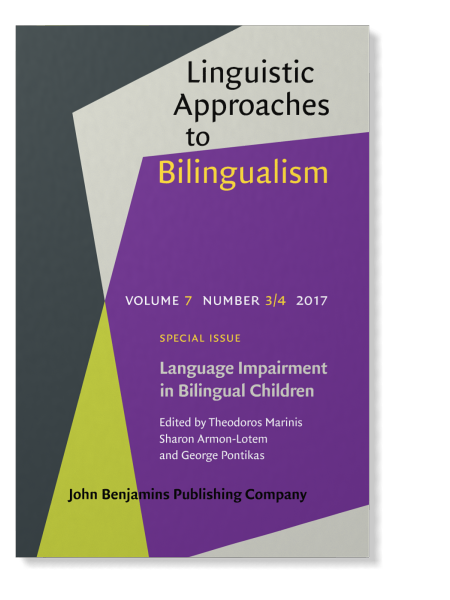
Article published In: Language Impairment in Bilingual Children: State of the art 2017
Edited by Theodoros Marinis, Sharon Armon-Lotem and George Pontikas
[Linguistic Approaches to Bilingualism 7:3/4] 2017
► pp. 460–475
Verbal fluency in bilingual children with Autism Spectrum Disorders
Published online: 16 September 2016
https://doi.org/10.1075/lab.15023.gon
https://doi.org/10.1075/lab.15023.gon
Abstract
We examine the impact of bilingualism on verbal fluency in four groups of school-age (5 to 10 years-old) children: 13 Typically-developing (TYP) monolingual children, 13 TYP bilingual children, 13 monolingual children with Autism Spectrum Disorders (ASD) and 13 bilingual children with ASD. Participants were matched on chronological age and nonverbal IQ. Verbal fluency was examined via the word association subtest of the Clinical Evaluation of Language Fundamentals (CELF-4; Semel, E., Wiig, E. H., & Secord, W. A. (2003). Clinical Evaluation of Language Fundamentals (4th ed.). San Antonio, TX: Psychological Corporation.). The bilingual ASD group performed unexpectedly well on the verbal fluency task, not differing from the typically-developing groups, but outperforming the monolingual ASD group with respect to number of correct words produced. These findings are in line with previous research on bilingual children with ASD (e.g., Hambly, C., & Fombonne, E. (2012). The impact of bilingual environments on language development in children with autism spectrum disorders. Journal of Autism and Developmental Disorders, 421, 1342–1352. ) and taken together suggest that bilingualism does not have a negative impact on the lexical-semantic skills of children with ASD.
Article outline
- 1.Introduction
- 2.Research hypothesis
- 3.Methods
- 3.1Participants
- 3.2Procedure
- 4.Results
- 5.Discussion
- Acknowledgements
References

References (43)
Abwender, D. A., Swan, J.G., Bowerman, J. T., & Connolly, S. W. (2001). Qualitative analysis of verbal fluency output: Review and comparison of several scoring methods. Assessment, 81, 323–336.
American Psychiatric Association. (2013). Diagnostic and statistical manual of mental disorders (5th ed.). Arlington: American Psychiatric Association.
Barac, R., & Bialystok, E. (2012). Bilingual effects on cognitive and linguistic development: Role of language, cultural background, and education. Child Development, 831, 413–422.
Begeer, S., Wierda, M., Scheeren, A. M., Teunisse, J. P., Koot, H. M., & Geurts, H. M. (2014). Verbal fluency in children with autism spectrum disorders: Clustering and switching strategies. Autism, 181, 1014–1018.
Bialystok, E., & Barac, R. (2012). Emerging bilingualism: Dissociating advantages for metalinguistic awareness and executive control. Cognition, 1221, 67–73.
Bialystok, E., & Martin, M. M. (2004). Attention and inhibition in bilingual children: Evidence from the dimensional change card sort task. Developmental Science, 71, 325–339.
Carmo, J. C., Duarte, E., Pinho, S., Marques, F., & Filipe, C. N. (2015). Verbal fluency as a function of time in autism spectrum disorder: An impairment of initiation processes? Journal of Clinical and Experimental Neuropsychology, 371, 710–721.
Chandler, S., Charman, T., Baird, G., Simonoff, E., Loucas, T., Meldrum, D., … & Pickles, A. (2007). Validation of the social communication questionnaire in a population cohort of children with autism spectrum disorders. Journal of the American Academy of Child & Adolescent Psychiatry, 461, 1324–1332.
Drysdale, H., van der Meer, L., & Kagohara, D. (2015). Children with autism spectrum disorder from bilingual families: a systematic review. Review Journal of Autism and Developmental Disorders, 21, 26–38.
Eigsti, I. M. (2011). Executive functions in ASD. In D. A. Fein (Ed.), The neuropsychology of autism (pp. 185–203). New York, NY: Oxford University Press.
Friesen, D. C., Luo, L., Luk, G., & Bialystok, E. (2015). Proficiency and control in verbal fluency performance across the lifespan for monolinguals and bilinguals. Language, Cognition and Neuroscience, 301, 238–250.
Geurts, H., Verté, S., Oosterlaan, J., Roeyers, H., & Sergeant, J. A. (2004). How specific are executive functioning deficits in attention deficit hyperactivity disorder and autism? Journal of Child Psychology and Psychiatry, 451, 836–854.
Gollan, T. H., Montoya, R. I., & Werner, G. A. (2002). Semantic and letter fluency in Spanish-English bilinguals. Neuropsychology, 161, 562–576.
Hambly, C., & Fombonne, E. (2012). The impact of bilingual environments on language development in children with autism spectrum disorders. Journal of Autism and Developmental Disorders, 421, 1342–1352.
Hill, E. L. (2004). Evaluating the theory of executive dysfunction in autism. Developmental Review, 241, 189–233.
Hill, E. L. & Bird, C. M. (2006). Executive processes in Asperger syndrome: Patterns of performance in a multiple case series. Neuropsychologia, 441, 2822–2835.
Klassert, A., Gagarina, N., & Kauschke, C. (2014). Object and action naming in Russian-and German-speaking monolingual and bilingual children. Bilingualism: Language and Cognition, 171, 1–16.
Koren, R., Kofman, O., & Berger, A. (2005). Analysis of word clustering in verbal fluency of school-aged children. Archives of Clinical Neuropsychology, 201, 1087–1104.
Kormi-Nouri, R., Moradi, A. R., Moradi, S., Akbari-Zardkhaneh, S., & Zahedian, H. (2012). The effect on letter and category fluency tasks in primary school children: Advantage or disadvantage? Bilingualism: Language and Cognition, 151, 351–364.
Kremer-Sadlik, T. (2005). To be or not to be bilingual: Autistic children from multilingual families. In Proceedings of the 4th International Symposium on Bilingualism (pp. 1225–1234). Somerville, MA: Cascadilla Press.
Luo, L., Luk, G., & Bialystok, E. (2010). Effect of language proficiency and executive control on verbal fluency performance in bilinguals. Cognition, 1141, 29–41.
Ohashi, J. K., Mirenda, P., Marinova-Todd, S., Hambly, C., Fombonne, E., Szatmari, P., … & Thompson, A. (2012). Comparing early language development in monolingual-and bilingual-exposed young children with autism spectrum disorders. Research in Autism Spectrum Disorders, 61, 890–897.
Ozonoff, S., Cook, I., Coon, H., Dawson, G., Joseph, R. M., Klin, A., … & Wrathall, D. (2004). Performance on Cambridge Neuropsychological Test Automated Battery subtests sensitive to frontal lobe function in people with autistic disorder: evidence from the Collaborative Programs of Excellence in Autism network. Journal of Autism and Developmental Disorders, 341, 139–150.
Petersen, J. M., Marinova-Todd, S. H., & Mirenda, P. (2012). Brief report: An exploratory study of lexical skills in bilingual children with autism spectrum disorder. Journal of Autism and Developmental Disorders, 421, 1499–1503.
Reetzke, R., Zou, X., Sheng, L., & Katsos, N. (2015). Communicative development in bilingually exposed Chinese children with autism spectrum disorders. Journal of Speech, Language, and Hearing Research, 581, 813–825.
Regard, M., Strauss, E., & Knapp, P. (1982). Children’s production on verbal and non-verbal fluency tasks. Perceptual and Motor Skills, 551, 839–844.
Roberts, P. M., & Le Dorze, G. (1997). Semantic organization, strategy use, and productivity in bilingual semantic verbal fluency. Brain and Language, 591, 412–449.
Robinson, S., Goddard, L., Dritschel, B., Wisley, M., & Howlin, P. (2009). Executive functions in children with autism spectrum disorders. Brain and Cognition, 711, 362–368.
Roid, G., & Miller, L. (1997). Leiter International Performance Scale — Revised. Wood Dale: Stoelting.
Rutter, M., Bailey, A., Berument, S. K., Lord, C., & Pickles, A. (2003). Social Communication Questionnaire (SCQ). Los Angeles: Western Psychological Services.
Sandoval, T. C., Gollan, T. H., Ferreira, V. S., & Salmon, D. P. (2010). What causes the bilingual disadvantage in verbal fluency? The dual-task analogy. Bilingualism: Language and Cognition, 131, 231–252.
Sauzéon, H., Lestage, P., Raboutet, C., N’Kaoua, B., & Claverie, B. (2004). Verbal fluency output in children aged 7–16 as a function of the production criterion: Qualitative analysis of clustering, switching processes, and semantic network exploitation. Brain and Language, 891, 192–202.
Semel, E., Wiig, E. H., & Secord, W. A. (2003). Clinical Evaluation of Language Fundamentals (4th ed.). San Antonio, TX: Psychological Corporation.
Spek, A., Schatorjé, T., Scholte, E., & Berckelaer-Onnes, I. (2009). Verbal fluency in adults with high functioning autism or Asperger syndrome, Neuropsychologia, 471, 652–656.
Troster, A. I., Salmon, D. P. McCullough, D., & Butters, N. (1989). A comparison of the category fluency deficits associated with Alzheimer’s and Huntington’s disease. Brain and Language, 371, 500–513.
Troyer, A.K. (2000). Normative data for clustering and switching on verbal fluency tasks. Journal of Clinical and Experimental Neuropsychology, 221, 370–378.
Troyer, A. K., Moscovitch, M., & Winocur, G. (1997). Clustering and switching as two components of verbal fluency: Evidence from younger and older healthy adults. Neuropsychology, 111, 138–146.
Turner, M.A. (1999). Generating novel ideas: Fluency performance in high-functioning and learning disabled individuals with autism. Journal of Child Psychology and Psychiatry, 401, 189–201.
Welsh, M. C., Pennington, B. F., Groisser, D. B. (1991). A normative-developmental study of executive function: A window on prefrontal function in children. Developmental Neuropsychology, 71, 131–149.
Wiig, E., Secord, W., Semel, E., Boulianne, L., & Labelle, M. (2009). Évaluation clinique des notions langagières fondamentales: Version pour francophones du Canada (Clinical Evaluation of Language Fundamentals: French Canadian Version). Toronto, Ontario, Canada: Pearson Canada Assessment.
Yan, S., & Nicoladis, E. (2009). Finding le mot juste: Differences between bilingual and monolingual children’s lexical access in comprehension and production. Bilingualism: Language and Cognition, 121, 323–335.
Cited by (35)
Cited by 35 other publications
Camodeca, Amy
COHEN, S. R., A. WISHARD GUERRA, J. MIGUEL, K. BOTTEMA-BEUTEL & G. OLIVEIRA
Cohen, Shana R., Alison Wishard Guerra, María José Aragón, Angeline Estrada & Eunsu Lee
Cummings, Kaitlin K., Rachel K. Greene, Paul Cernasov, Dang Dang Delia Kan, Julia Parish-Morris, Gabriel Dichter & Jessica L. Kinard
Digard, Bérengère G. & Rachael Davis
Dubé, Daphnée & Elin Thordardottir
Garcia-Alcaraz, Estela & Juana M. Liceras
Garcia-Alcaraz, Estela & Juana M. Liceras
Garrido, D., B. López & G. Carballo
Garrido, D., B. López & G. Carballo
Ge, Haoyan, Albert Kwing Lok Lee, Hoi Kwan Yuen, Fang Liu & Virginia Yip
Grissom, Alaina, Erinn Finke & Emily Zane
Romero, Celia, Zachary T. Goodman, Lauren Kupis, Bryce Dirks, Meaghan V. Parlade, Amy L. Beaumont, Sandra M. Cardona, Jason S. Nomi, Michael Alessandri, Lynn K. Perry & Lucina Q. Uddin
Brandeker, Myrto & Elin Thordardottir
Gilhuber, Christina Sophia, Tracy Jane Raulston & Kasie Galley
Hantman, Rachel M., Boin Choi, Katie Hartwick, Zoe Nadler & Gigi Luk
Hastedt, Ingrid, Abbey Eisenhower, R. Christopher Sheldrick & Alice S. Carter
MEIR, Natalia & Rama NOVOGRODSKY
Tang, Xinzhou, Zihui Hua, Jiayin Xing, Li Yi, Zhaozheng Ji, Liyang Zhao, Xing Su, Tingni Yin, Ran Wei, Xue Li & Jing Liu
Zarokanellou, Vasiliki, K. Papanikolaou, D. Tafiadis & G. Kolaitis
de Valenzuela, J. S., Rosalía Pacheco & Sunaina Shenoy
Prévost, Philippe & Laurice Tuller
2022. Bilingual language development in autism. Linguistic Approaches to Bilingualism 12:1 ► pp. 1 ff.
Yllades, Valeria, Lauren Pierson, Lisa Bowman-Perrott & Claudia Dunn
Klein, Wendy
2021. Managing trouble spots in conversation. Pragmatics. Quarterly Publication of the International Pragmatics Association (IPrA) 31:2 ► pp. 225 ff.
Gonzalez-Barrero, Ana Maria & Aparna Nadig
Gonzalez-Barrero, Ana Maria & Aparna Nadig
Novogrodsky, Rama & Natalia Meir
Novogrodsky, Rama & Natalia Meir
Gonzalez‐Barrero, Ana Maria & Aparna S. Nadig
Lim, Nataly
Lim, Nataly
Nadig, Aparna & Ana Maria Gonzalez-Barrero
2019. Proficient bilingualism may alleviate some executive function difficulties in children with Autism Spectrum Disorders. In Bilingualism, Executive Function, and Beyond [Studies in Bilingualism, 57], ► pp. 337 ff.
Vanegas, Sandra B
Angulo-Jiménez, Henry
[no author supplied]
This list is based on CrossRef data as of 23 november 2025. Please note that it may not be complete. Sources presented here have been supplied by the respective publishers. Any errors therein should be reported to them.