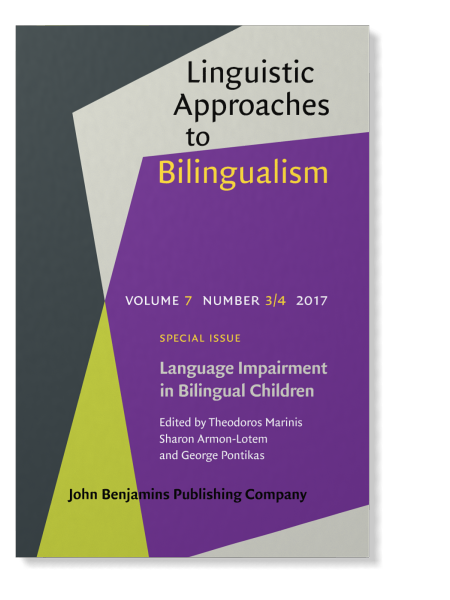
Article published In: Language Impairment in Bilingual Children: State of the art 2017
Edited by Theodoros Marinis, Sharon Armon-Lotem and George Pontikas
[Linguistic Approaches to Bilingualism 7:3/4] 2017
► pp. 331–358
Identification of bilingual children with Specific Language Impairment in France
Laetitia de Almeida | INSERM, U930, Tours, France & Université François-Rabelais de Tours, CHRU de Tours, Tours, France
Sandrine Ferré | INSERM, U930, Tours, France & Université François-Rabelais de Tours, CHRU de Tours, Tours, France
Eléonore Morin | INSERM, U930, Tours, France & Université François-Rabelais de Tours, CHRU de Tours, Tours, France
Philippe Prévost | INSERM, U930, Tours, France & Université François-Rabelais de Tours, CHRU de Tours, Tours, France
Christophe dos Santos | INSERM, U930, Tours, France & Université François-Rabelais de Tours, CHRU de Tours, Tours, France
Laurie Tuller | INSERM, U930, Tours, France & Université François-Rabelais de Tours, CHRU de Tours, Tours, France
Published online: 6 February 2017
https://doi.org/10.1075/lab.15019.alm
https://doi.org/10.1075/lab.15019.alm
Abstract
We report on the usefulness of three LITMUS tools in distinguishing bilingual children with SLI (Bi-SLI) from bilingual children with typical development (Bi-TD), in France: LITMUS-NWR-FR (non-word repetition), LITMUS-SR-FR (sentence repetition), and LITMUS-PABIQ (parental questionnaire). 82 bilingual children, aged 5–8, who had all been exposed to both French and either Arabic, Portuguese or Turkish, recruited both in ordinary schools and in SLP practices, were divided into Bi-TD (n = 61) and Bi-SLI (n = 21) groups based on parental questionnaire (LITMUS-PABIQ) information and standardized language scores in each language. Monolingual controls included 17 children with SLI and 37 TD children. NWR and SR significantly distinguished between the Bi-TD and the Bi-SLI children, and there was minimal impact of different factors related to bilingual development on children’s performance.
Keywords: Bilingualism, Specific Language Impairment, Acquisition
Article outline
- 1.Introduction
- 2.Methods and participants
- 2.1Participants: recruitment and assignment into groups
- 2.2The experimental protocol
- 3.Results
- 3.1Do NWR and SR identify SLI in bilingual children?
- 3.2Are age and French exposure/use linked to performance on NWR and SR?
- 4.Discussion
- 4.1The accuracy of LITMUS-SR-FR and LITMUS-NWR-FR
- 4.2The LITMUS tools and the impact of bilingualism factors
- 5.Conclusion
- Acknowledgements
- Notes
References

References (45)
Armon-Lotem, S. (2012). Introduction: Bilingual children with SLI – the nature of the problem. Bilingualism: Language and Cognition, 151, 1–4.
Armon-Lotem, S, de Jong, J., & Meir, N. (Eds.) (2015). Assessing multilingual children: Disentangling bilingualism from language impairment. Bristol, UK: Multilingual Matters.
Armon-Lotem, S., Walters, J., & Gargarina, N. (2011). The impact of internal and external factors on linguistic performance in the home language and in L2 among Russian- Hebrew and Russian-German preschool children. Linguistic Approaches to Bilingualism, 11, 291–317.
Brandeker, M. & Thordadottir, E. (2015). Language exposure in bilingual toddlers: Performance on nonword repetition and lexical tasks. American Journal of Speech-Language Pathology, 241, 126–138.
Castro, S. L., Caló, S., Gomes, I., Kay, J., Lesser, R., & Coltheart, M. (2007). PALPA-P Provas de Avaliação da Linguagem e da Afasia em Português. Lisboa: CEGOC.
Chevrie-Muller, C. & Plaza, M. (2001). N-EEL Nouvelles épreuves pour l’examen du langage. Paris: ECPA.
Chiat, S. (2015). Nonword repetition. In S. Armon-Lotem, J. de Jong, & N. Meir (Eds.), Assessing multilingual children: Disentangling bilingualism from language impairment (pp. 123–148). Bristol, UK: Multilingual Matters.
Chiat, S., Armon-Lotem, S., Marinis, T., Polišenská, K., Roy, P. & Seeff-Gabriel, B. (2013). The potential of sentence imitation tasks for assessment of language abilities in sequential bilingual children. In V. Mueller-Gathercole (Ed.), Issues in the assessment of bilinguals (pp. 56–89). Bristol, UK: Multilingual Matters.
Chondrogianni, V. & Marinis, T. (2011). Differential effects of internal and external factors on the development of vocabulary, tense morphology and morphosyntax in successive bilingual children. Linguistic Approaches to Bilingualism, 11, 318–345.
Condon, S. & Régnard, C. (2010). Héritage et pratiques linguistiques des descendants d’immigrés en France. Hommes et migrations, 12881, 44–56.
Conti-Ramsden, G., Botting, N., & Faragher, B. (2001). Psycholinguistic markers for specific language impairment (SLI). Journal of Child Psychology and Psychiatry, 421, 741–748.
Ferré, S. & dos Santos, C. (2015). Un test de répétition de non-mots pour évaluer la phonologie des enfants bilingues. LiDiL, 511, 11–34.
Ferré, S., dos Santos, C. & de Almeida, L. (2015). Potential Phonological Markers for SLI in bilingual children. In E. Grillo & K. Jepson (Eds.), Proceedings of the 39th annual Boston University Conference on Language Development (pp. 152–164). Somerville, MA: Cascadilla Press.
Ferré, S., Tuller, L., Sizaret, E., & Barthez, M.-A. (2012). Acquiring and avoiding phonological complexity in SLI vs. typical development of French: The case of consonant clusters. In P. Hoole, L. Bombien, M. Pouplier, C. Mooshammer, & B. Kühnert (Eds.), Consonant clusters and structural complexity (pp. 285–308). Berlin: De Gruyter.
Fleckstein, A., Prévost, P., Tuller, L., Sizaret, E., & Zebib, R. (2016). How to identify SLI in bilingual children? A study on sentence repetition in French. Language Acquisition. .
Genesee, F., Paradis, J., & Crago, M. (2004). Dual language development and disorders: A handbook on bilingualism and second language learning. Baltimore, MD: Paul H. Brookes.
Gibson, T., Summers, C., Peña, E., Bedore, L., Gillam, R., & Bohman, T. (2015). The role of phonological structure and experience in bilingual children’s nonword repetition performance. Bilingualism: Language and Cognition, 181, 551–560.
Girbau, D. & Schwartz, R. G. (2008). Phonological working memory in Spanish-English bilingual children with and without specific language impairment. Journal of Communication Disorders, 411, 124–145
Guttiérez-Clellen, V. F. & Simon-Cereijido, G. (2010). Using nonword repetition tasks for the identification of language impairment in Spanish-English speaking children: Does the language of assessment matter? Learning Disabilities Research & Practice, 25(1), 48–58.
Hamann, C. (2012). Bilingual development and language assessment. In A. K. Biller, E. Y. Chung, & A. E. Kimball (Eds.), Proceedings of the 36th annual Boston University Conference on Language Development (pp. 1–28). Somerville, MA: Cascadilla Press.
Journal officiel (2013). Décret n° 2013–682 du 24-7-2013 du Ministère de l’éducation nationale, J.O. du 28-7-2013. Retrieved from [URL].
Khomsi, A., Khomsi, J., Pasquet, F., & Parbeau-Gueno, A. (2007). Bilan Informatisé de langage Oral au cycle III et au Collège (BILO3C). Paris: ECPA.
Maddieson, I., Flavier, S., Marsico, E. & Pellegrino, F. (2011). LAPSyD: Lyon-Albuquerque Phonological Systems Databases, Version 1.0. [URL].
Marinis, T. & Armon-Lotem, S. (2015). Sentence repetition. In S. Armon-Lotem, J. de Jong, & N. Meir (Eds.), Assessing multilingual children. Disentangling bilingualism from language impairment (pp. 95–122). Bristol, UK: Multilingual Matters.
Paradis, J. (2004). The relevance of SLI in understanding the role of transfer in second language acquisition. Applied Psycholinguistics, 251, 67–82.
(2011). Individual differences in child English second-language acquisition: comparing child-internal and child-external factors. Linguistic Approaches to Bilingualism, 11, 213–237.
Paradis, J. & Crago, M. (2000). Tense and temporality: a comparison between children learning a second language and children with SLI. Journal of Speech, Language and Hearing research, 431, 834–847.
Plante, E. & Vance, R. (1994). Diagnostic accuracy of two tests of preschool language. American Journal of Speech-Language Pathology, 41, 70–76.
Prévost, P., Tuller, L., Scheidnes, M., Ferré, S. & Haiden, M. (2010). Computational complexity effects in the acquisition of wh-questions in child L2 French. In L. Dominguez & P. Guijarres-Fuentes (Eds.), New directions in language acquisition: Romance languages in the generative perspective (pp. 415–444). Newcastle, UK: Cambridge Scholars Publishing.
Prévost, Philippe, Tuller, Laurice and Rasha Zebib. 2012. LITMUS-SR-French. ms, Université François-Rabelais de Tours.
dos Santos, C. & Ferré, S. (2016). A nonword repetition task to assess bilingual children phonology. Language Acquisition.
Scheidnes, M. & Tuller L. (2013). L2 children embed normally, but children with SLI do not. In M. Lobo & A. L. Santos (Eds.), Selected Proceedings of the Romance Turn V (pp. 261–284). Newcastle, UK: Cambridge Scholars Publishing.
Sharp, K. & Gathercole, V. (2013). Can a novel word repetition task be a language-neutral assessment tool? Evidence from Welsh-English bilingual children. Child Language Teaching and Therapy, 291, 77–89.
Sua-Kay E. & Santos, M. E. (2014). Grelha de Avaliação da Linguagem – nível escolar (GOL-E). Alcoitão: Escola Superior de Saúde do Alcoitão. 2ª edição revista.
Thordardottir, E. (2015). Proposed Diagnostic procedures for use in bilingual and cross-linguistic contexts. In S. Armon-Lotem, J. de Jong, & N. Meir (Eds.), Assessing multilingual children: Disentangling bilingualism from language impairment (pp. 331–358). Bristol, UK: Multilingual Matters.
Thordardottir, E. & Brandeker, M. (2013). The effect of bilingual exposure versus language impairment on nonword repetition and sentence imitation scores. Journal of Communication Disorders, 461, 1–16.
Thordardottir, E. & Juliusdottir, A. G. (2013). Icelandic as a second language: A longitudinal study of language knowledge and processing by school-age children. International Journal of Bilingual Education and Bilingualism, 161, 411–435.
Topbaş, S. & Güven, S. (2008). Turkce Erken Dil Gelisim Testi (Test of Early Language Development-TELD3. Turkish adaptation).
Topbaş, S., Kaçar-Kütükçü, D., & Kopkallı-Yavuz, H. (2014). Performance of children on the Turkish nonword repetition test: Effect of word similarity, word length, and scoring. Clinical Linguistics & Phonetics, 281, 602–616.
Tuller, L. (2015). Clinical use of parental questionnaires in multilingual contexts. In S. Armon-Lotem, J. de Jong, & N. Meir (Eds.), Assessing multilingual children: Disentangling bilingualism from language impairment (pp. 299–328). Bristol, UK: Multilingual Matters.
Tuller, L., Abboud, L., Ferré, S., Fleckstein, A., Prévost, P., dos Santos, C., Scheidnes, M. & Zebib, R. (2015). Specific language impairment and bilingualism: Assembling the pieces. In C. Hamann & E. Ruigendijk (Eds.), Language acquisition and development: Proceedings of GALA 2013. (pp. 533–567). Newcastle, UK: Cambridge Scholars Publishing.
Unsworth, S., Argyri, F., Lornips, L., Hulk, A., Sorace, A., & Tsimpli, I. (2014). The role of age of onset and input in early child bilingualism in Greek and Dutch. Applied Psycholinguistics, 351, 765–805.
Xu Rattanasone, N. & Demuth, K. (2014). The acquisition of coda consonants by Mandarin early child L2 learners of English. Bilingualism: Language and Cognition, 171, 646–659.
Zebib, R., Hamann, C., Prévost, P., Aid Ibrahim, L. & Tuller, L. (2016). Syntactic complexity, verbal working memory, and executive function in bilingual children with and without SLI: a sentence repetition study in France and in Germany. Paper presented at the 38th annual conference of the German Linguistic Society (DGfS), University of Konstanz, Germany.
Cited by (44)
Cited by 44 other publications
Almeida, Letícia & Christophe Coupé
Correia, Liliana, Maria Lobo & Cristina Flores
Deroin-Thévenin, Émilie, Geneviève Serre & Dalila Rezzoug
Granfeldt, Jonas
2025. Child L2 acquisition of French. In Approaches and Methods in French Second Language Acquisition Research [Research Methods in Applied Linguistics, 9], ► pp. 308 ff.
Grimm, Angela & Ulrike Domahs
2025. The acquisition of consonant clusters and word stress by early second language learners of German. Linguistic Approaches to Bilingualism 15:2 ► pp. 212 ff.
Hamdani, Saboor, Angel Chan, Rachel Kan, Shula Chiat, Natalia Gagarina, Ewa Haman, Magdalena Łuniewska, Kamila Polišenská & Sharon Armon-Lotem
Kałowski, Piotr, Maria Obarska, Jakub Romaneczko, Dawid Walczak & Natalia Banasik-Jemielniak
Polišenská, Kamila, Shula Chiat, Jakub Szewczyk, Stanislava Antonijevic, Elma Blom, Tessel Boerma, Ute Bohnacker, Angel Chan, Vasiliki Chondrogianni, Nga Ching Fu, Daniela Gatt, Helen Grech, Magdalena Jezek, Svetlana Kapalková, Sari Kunnari, Juliane Maier, Chantal Mayer-Crittenden, Linnéa Öberg, Salomé Schwob, Katrin Skoruppa, Nadine Tabone, Josje Verhagen & Michelle White
Snijders, Vera, Merel van Witteloostuijn, Tessel Boerma, Mona Timmermeister & Elma Blom
Van den Eynde, Lotte, Pieter De Clercq, Ellen Rombouts, Maaike Vandermosten & Inge Zink
Charles, Christina M., Andrea A. N. MacLeod & Ann Sutton
Kaçar-Kütükçü, Dilber & Seyhun Topbaş
Kern, Sophie & Christophe dos Santos
2024. Lexical development of French-Portuguese simultaneous bilinguals. In Multilingual Acquisition and Learning [Studies in Bilingualism, 67], ► pp. 473 ff.
Pourquié, Marie, Urtzi Etxeberria, Hugues Lacroix & Philippe Prévost
Ward, Leah, Kamila Polišenská & Colin Bannard
Farabolini, Gianmatteo, Analí R. Taboh, Maria Gabriella Ceravolo & Federico Guerra
Șan, Nebiye Hilal
Chilla, Solveig
Eikerling, Maren Rebecca, Theresa Sophie Bloder & Maria Luisa Lorusso
Farabolini, Gianmatteo, Pasquale Rinaldi, Maria Cristina Caselli & Alejandrina Cristia
Grimm, Angela
Holzinger, Daniel, Christoph Weber & Magdalena Jezek
Schwob, Salomé & Katrin Skoruppa
Öberg, Linnéa & Ute Bohnacker
Chilla, Solveig, Cornelia Hamann, Philippe Prévost, Lina Abed Ibrahim, Sandrine Ferré, Christophe dos Santos, Racha Zebib & Laurice Tuller
2021. The influence of different first languages on LITMUS nonword-repetition and sentence repetition in second language French and second language German. In Language Impairment in Multilingual Settings [Trends in Language Acquisition Research, 29], ► pp. 227 ff.
David, Céline, Laurice Tuller, Elisabeth Schweitzer, Emmanuel Lescanne, Frédérique Bonnet-Brilhault, Marie Gomot & Sandrine Ferré
Ortiz, José A.
Ortiz, José A.
Schwob, Salomé, Laurane Eddé, Laure Jacquin, Mégane Leboulanger, Margot Picard, Patricia Ramos Oliveira & Katrin Skoruppa
ŞENGÜL, Kübra & Yusufhan YOKUŞ
Altinkamis, Feyza & Ellen Simon
Bonifacci, Paola, Elena Atti, Martina Casamenti, Barbara Piani, Marina Porrelli & Rita Mari
dos Santos, Christophe, Sabine Frau, Sandrine Labrevoit, Racha Zebib, F. Neveu, B. Harmegnies, L. Hriba, S. Prévost & A. Steuckardt
Scheidnes, Maureen
Silleresi, Silvia, Philippe Prévost, Racha Zebib, Fédérique Bonnet‐Brilhault, Donatello Conte & Laurice Tuller
Abed Ibrahim, Lina & István Fekete
de Almeida, Laetitia, Sandrine Ferré, Marie-Anne Barthez & Christophe dos Santos
Ebert, Kerry Danahy & Giang Pham
Köpke, Barbara & Dobrinka Genevska-Hanke
Silleresi, Silvia, Laurie Tuller, Hélène Delage, Stephanie Durrleman, Frédérique Bonnet-Brilhault, Joëlle Malvy & Philippe Prévost
2018. Sentence repetition and language impairment in French-speaking children with ASD. In On the Acquisition of the Syntax of Romance [Language Acquisition and Language Disorders, 62], ► pp. 235 ff.
Tuller, Laurice, Cornelia Hamann, Solveig Chilla, Sandrine Ferré, Eléonore Morin, Philippe Prevost, Christophe dos Santos, Lina Abed Ibrahim & Racha Zebib
Valente, Daniela, Sophie Kern, Christophe dos Santos, F. Neveu, B. Harmegnies, L. Hriba & S. Prévost
Hamann, Cornelia & Lina Abed Ibrahim
[no author supplied]
This list is based on CrossRef data as of 23 november 2025. Please note that it may not be complete. Sources presented here have been supplied by the respective publishers. Any errors therein should be reported to them.