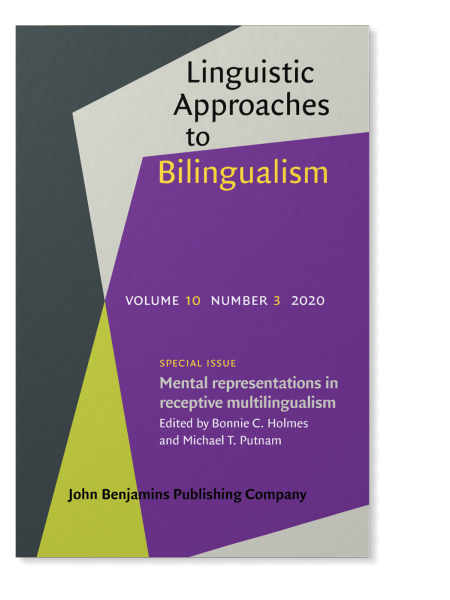
Introduction published In: Mental representations in receptive multilingualism
Edited by Bonnie C. Holmes and Michael T. Putnam
[Linguistic Approaches to Bilingualism 10:3] 2020
► pp. 309–314
Introduction
Mental representations in receptive multilingual grammars
This article is available free of charge.
Published online: 3 June 2020
https://doi.org/10.1075/lab.00029.int
https://doi.org/10.1075/lab.00029.int
Article outline
- 1.What is receptive multilingualism?
- 2.Contributions of this special issue
- Acknowledgments
References

References (18)
Bahtina-Jantsikene, D. (2013). Mind your languages: Lingua receptiva in Estonian-Russian communication. PhD dissertation, University of Utrecht.
Branets, A., Bahtina, D., & Verschik, A. (2020). Mediated Receptive Multilingualism: Estonian-Russian-Ukrainian case study. Linguistic Approaches to Bilingualism, 10(3), 380–411.
Cabo, D. P. Y., & Rothman, J. (2012). The (il)logical problem of heritage speaker bilingualism and incomplete acquisition. Applied linguistics, 33(4), 450–455.
Cook, V. J. (2013). Premises of multi-competence. In V. J. Cook & L. Wei (Eds.), The Cambridge handbook of linguistic multi-competence (pp. 1–25). Cambridge: Cambridge University Press.
Gibson, T., Peña, E., & Bedore, L. (2014). The receptive-expressive gap in bilingual children with and without primary language impairment. American Journal of Speech-Language, 231, 655–667.
Gooskens, C. & Heeringa, W. (2014). The role of dialect exposure in receptive multilingualism. Applied Linguistics Review, 5(1), 247–271.
Gooskens, C. & van Heuven, J. (2020). How well can intelligibility of closely related languages in Europe be predicted by linguistic and non-linguistic variables? Linguistic Approaches to Bilingualism, 10(3), 351–379.
Lipski, J. (2020). What you hear is (not always) what you get: subjects and verbs among receptive Palenquero-Spanish bilinguals. Linguistic Approaches to Bilingualism, 10(3), 315–350.
Pliatsikas, C. (2020). Understanding structural plasticity in the bilingual brain: The Dynamic Restructuring Model. Bilingualism: Language and Cognition, 23(2), 459–471.
Putnam, M., Carlson, M., & Reitter, D. (2018). Integrated, not isolated. Defining typological proximity in an integrated multilingual architecture. Frontiers in Psychology, 81, 2212.
Rehbein, J., ten Thije, J. D., & Vershik, A. (2012). Lingua receptiva (LaRa) – remarks on the quintessence of receptive multilingualism. International Journal of Bilingualism, 16(3), 248–264.
Rehbein, J., & Romaniuk, O. (2014). How to check understanding across languages. An introduction into the Pragmatic Index of Language Distance (PILaD) usable to measure mutual understanding in receptive multilingualism, illustrated by conversations in Russian, Ukrainian, and Polish. Applied Linguistics Review, 5(1), 131–171.
Rothman, J., González Alonso, J., & Puig-Mayenco, E. (2019). Third language acquisition and linguistic transfer. Cambridge: Cambridge University Press.
Sherkina-Lieber, M. (2015). Tense, aspect, and agreement in heritage Labrador Inuttitut: Do receptive bilinguals understand functional morphology? Linguistic Approaches to Bilingualism, 5(1), 30–61.
(2020). A classification of receptive bilinguals: Why we need to distinguish them, and what they have in common. Linguistic Approaches to Bilingualism, 10(3), 412–440.
Sherkina-Lieber, M., Pérez-Leroux, A. T., & Johns, A. (2011). Grammar without speech production: the case of Labrador Inuttitut heritage receptive bilinguals. Bilingualism: Language and Cognition, 14(3), 301–317.
Ten Thije, J. D., & Zeevaert, L. (eds.) (2007). Receptive multilingualism. Amsterdam: John Benjamins.
Cited by (3)
Cited by three other publications
Montrul, Silvina
Halmari, Helena
This list is based on CrossRef data as of 23 november 2025. Please note that it may not be complete. Sources presented here have been supplied by the respective publishers. Any errors therein should be reported to them.