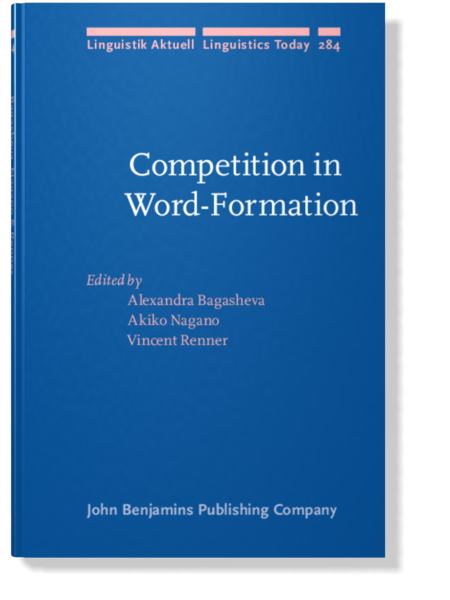
In:Competition in Word-Formation
Edited by Alexandra Bagasheva, Akiko Nagano and Vincent Renner
[Linguistik Aktuell/Linguistics Today 284] 2024
► pp. 247–274
Chapter 8A diachronic perspective on competition in denominal verb
formation in Italian
Published online: 8 May 2024
https://doi.org/10.1075/la.284.08iac
https://doi.org/10.1075/la.284.08iac
Abstract
Three derivational processes compete in the
formation of Italian denominal verbs: suffixation, conversion and
parasynthesis. The rivalry between these processes goes back to the
early history of the Italian language. Based on the analysis of an
original dataset, this chapter aims to offer a comprehensive
overview of denominal verb formation in Italian from a diachronic
perspective. The results of a macro-level analysis concern the
availability of nouns to form verbs, the distribution of the
competing verbalising processes over different diachronic stages, a
comparative overview of the meanings encoded by each process, and
the competition between synonymous verbs formed by means of
different processes from a same noun. A micro-level analysis
outlines the productivity of the specific derivational means
expressing each process. The data suggest a higher differentiation
of the processes over time, along with their enduring vitality, a
decreased abundance of verbs derived from the same noun, and a
recent growth in the employment of suffixation, which, however, does
not coincide with a significant decline in the resort to either of
the other two processes.
Keywords: denominal verbs, competition, word-formation, Italian, diachronic morphology
Article outline
- 1.Introduction
- 2.Dataset
- 3.How nouns surface as verbs in Italian
- 3.1Denominal verbs: Derivational properties
- 3.2Denominal verbs: Semantic properties
- 3.2.1‘be (like a) n’
- 3.2.2‘(make) become (like a) n’
- 3.2.3‘make n’
- 3.2.3.1‘make [put, cover oneself in, produce, develop, etc.] n’
- 3.2.3.2‘make (undergo) [provoke, arouse, cause to acquire, etc.] n’
- 3.2.3.3‘(cause to) become [bring together, arrange, etc.] a n’
- 3.2.3.4‘(cause to) become [divide, break into, etc.] n’
- 3.2.4‘to have [to be in, feel, show, etc.] n’
- 3.2.5Spatial meanings
- 3.3.5.1Locatum
- 3.2.5.2Location
- 3.2.6Instrumental meanings
- 3.2.7Weather verbs
- 3.2.8Mapping between derivational processes and semantic types
- 4.Analysis
- 4.1Base nouns and verbal derivation: Quantitative aspects
- 4.2Verb derivatives
- 4.2.1Diachronic distribution and competition at a macro-level
- 4.2.2Diachronic distribution and competition at a micro-level
- 5.Conclusions
Notes References

References (36)
. 2016. Competition
and the
lexicon. In Livelli
di analisi e fenomeni di interfaccia: Atti del XLVII
congresso internazionale della società di linguistica
italiana, Annibale Elia, Claudio Iacobini & Miriam Voghera (eds), 39–52. Rome: Bulzoni.
. 2019. Competitors
and alternants in linguistic
morphology. In Competition
in Inflection and Word
Formation, Franz Rainer, Francesco Gardani, Wolfgang U. Dressler & Hans Christian Luschützky (eds), 39–66. Berlin: Springer.
Bauer, Laurie, Lieber, Rochelle & Plag, Ingo. 2013. The
Oxford Reference Guide to English
Morphology. Oxford: OUP.
D’Achille, Paolo & Grossmann, Maria (eds). 2017. Per
la storia della formazione delle parole in italiano: un
nuovo corpus in rete (MIDIA) e nuove prospettive di
studio. Florence: Franco Cesati.
Darwin, Charles. 1859. On
the Origin of Species by Means of Natural Selection, or the
Preservation of Favoured Races in the Struggle for
Life. London: John Murray.
Dressler, Wolfgang U. & Thornton, Anna Maria. 1991. Doppie
basi e binarismo nella morfologia
italiana. Rivista di
Linguistica 3(1): 3–22.
Fabrizio, Claudia. 2013. The
meaning of a noun converted into a verb: A semantic
exploration on
Italian. Rivista di
Linguistica 25(2): 175–219.
Fally, Irene & Goryczka, Pamela. 2021. Quid
manet? A diachronic approach to the Italian derivational
suffixes ‑izzare and
‑eggiare. Lingue
e
linguaggio 20(1): 57–79.
GDLI = Battaglia, Salvatore (ed). 1961–2009. Grande
dizionario della lingua
italiana. Turin: Utet. [URL]
Grossmann, Maria. 2004a. Verbi
denominali. In La
formazione delle parole in
italiano, Maria Grossmann & Franz Rainer (eds), 450–459. Tübingen: Niemeyer.
. 2004b. Conversione
in
verbi. In La
formazione delle parole in
italiano, Maria Grossmann & Franz Rainer (eds), 534–546. Tübingen: Niemeyer.
Grossmann, Maria & Rainer, Franz (eds). 2004. La
formazione delle parole in
italiano. Tübingen: Niemeyer.
Grossmann, Maria & Iacobini, Claudio. 2022. Concorrenza
tra parasintesi, suffissazione e conversione nella storia
dell’italiano: la formazione dei verbi
deaggettivali. Paper
presented at the XXXème Congrès
International de Linguistique et de Philologie
Romanes, La
Laguna, 4–9
July.
Huyghe, Richard & Varvara, Rossella. 2023. Affix
rivalry: Theoretical and methodological
challenges. Word
Structure 16: 1–23.
Iacobini, Claudio. 2004. Parasintesi. In La
formazione delle parole in
italiano, Maria Grossmann & Franz Rainer (eds), 167–188. Tübingen: Niemeyer.
. 2010. Les
verbes parasynthétiques: de l’expression de l’espace à
l’expression de l’action. De
Lingua
Latina 3: 1–16.
. 2020. Parasynthesis
in
morphology. In Oxford
Research Encyclopedia of
Linguistics, Mark Aronoff (ed-in-chief), 1–20. Oxford: OUP.
Iacobini, Claudio & Thornton, Anna Maria. 1992. Tendenze nella formazione delle parole nell'italiano del ventesimo secolo. In Linee di tendenza dell'italiano contemporaneo, Lugano 19-21 settembre 1991: Atti del XXV Congresso Internazionale di Studi della Società di Linguistica Italiana, Bruno Moretti, Dario Petrini & Sandro Bianconi (eds.), 25–55. Rome: Bulzoni.
Malkiel, Yakov. 1941. Atristar-entristecer:
Adjectival verbs in Spanish, Portuguese, and
Catalan. Studies in
Philology 38: 429–461.
Melloni, Chiara & Dal Maso, Serena. 2022. For
a topology of derivational
paradigms. In Paradigms
in Word Formation: Theory and
Applications, Cristina Fernández-Alcaina, Alba E. Ruz & Cristina Lara-Clares (eds), 21–56. Amsterdam: John Benjamins.
Micheli, M. Silvia. 2023. Linee
di tendenza aggiornate della formazione di parola
dell’italiano
contemporaneo. Revue
Romane, online-first.
Peša Matracki, Ivica. 2006. Linee
di tendenza nella formazione delle parole nell’italiano
contemporaneo. Studia
Romanica et Anglica
Zagrabiensia 51: 103–146.
Plag, Ingo. 1999. Morphological
Productivity: Structural Constraints in English
Derivation. Berlin: Mouton de Gruyter.
Rainer, Franz. 1988. Towards
a theory of blocking: The case of Italian and German quality
nouns. In Yearbook
of Morphology 1988, Geert Booij & Jaap van Marle (eds), 155–185. Dordrecht: Foris.
. 2012. Morphological
metaphysics: Virtual, potential, and actual
words. Word
Structure 5(2): 165–182.
Renner, Vincent. 2020. An
ecosystem view of English
word-formation. The Mental
Lexicon 15(1): 4–20.
Thornton, Anna Maria, Iacobini, Claudio & Burani, Cristina. 1997. BDVDB:
Una base di dati sul vocabolario di base della lingua
italiana. Rome: Bulzoni.
Valera, Salvador. 2020. Semantic
patterns in noun-to-verb conversion in
English. In Complex
Words: Advances in Morphology, Livia Körtvélyessy & Pavol Štekauer (eds), 311–334. Cambridge: CUP.
Villalva, Alina. 2022. Complex
verbs: The interplay of suffixation, conversion, and
parasynthesis in Portuguese and
English. In Paradigms
in Word Formation: Theory and
Applications, Alba E. Ruz, Cristina Fernández-Alcaina & Cristina Lara-Clares (eds), 249–282. Amsterdam: John Benjamins.