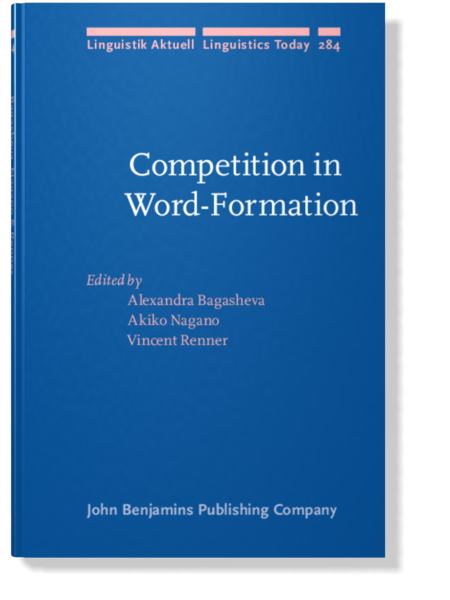
In:Competition in Word-Formation
Edited by Alexandra Bagasheva, Akiko Nagano and Vincent Renner
[Linguistik Aktuell/Linguistics Today 284] 2024
► pp. 176–205
Chapter 6Diminutive formation in Modern Greek
Variation and competition
Published online: 8 May 2024
https://doi.org/10.1075/la.284.06eft
https://doi.org/10.1075/la.284.06eft
Abstract
The aim of this chapter is to investigate
variation in Modern Greek diminutive derivational means (affixes and
affixoids) by focusing on their selectional restrictions (e.g.
phonological, morphological, semantic) and their competition (e.g.
psilo.xondrós ‘dim.fat’ vs.
xondr.oúlis ‘fat.dim’). Given that the use of
all Greek diminutive morphemes (affixes or affixoids) is subject to
selectional restrictions, it is shown that the variation found in
diminutive derivational morphemes can be explained with reference to
their particular restrictions and their multifunctional character.
Furthermore, it is demonstrated that the domain of Modern Greek
diminutive morphemes can be thought of as a complex ecosystem
structured around a fairly complementary distribution (rather than
competition).
Keywords: Modern Greek, diminutives, competition, restrictions, complementarity
Article outline
- 1.Introduction
- 2.The basic characteristics of diminution
- 3.Diminution in Modern Greek
- 4.Productivity and constraints
- 4.1Nominal suffixes
- 4.2Adjectival suffixes
- 4.3The prefix ipo‑ and prefixoids
- 4.4Summary of the properties of diminutive morphological means
- 5.Competition and complementarity
- 5.1Less productive suffixes and “niche productivity”
- 5.2Rivalry between adjectival suffixes and the prefixoid psilo-
- 5.3Affixal rivalry between the prefixoid psilo‑ and the suffix ‑áki
- 5.4Rivalry between suffixation and prefixation
- 5.5Rivalry between affixes and prefixoids
- 5.6Rival prefixoids
- 5.7Interim summary
- 6.(Nearly) synonymous diminutives
- 7.Conclusion
Acknowledgments Notes References

References (69)
Alexopoulos, Evita. 1994. The
use of diminutives and augmentatives in Modern
Greek. In Themes
in Greek Linguistics, Irene Philippaki-Warburton, Katerina Nicolaidis & Maria Sifianou (eds), 283–288. Amsterdam: John Benjamins.
Amiot, Dany & Stosic, Dejan. 2014. When
evaluative morphology, pluractionality and aspect get
tangled up: Α case study of French suffixed
verbs. In Mélanges
offerts à Anna
Anastassiadis-Syméonidis, Zoe Gavriilidou & Anthi Revithiadou (eds), 16–33. Kavala: Saita Publishers.
Anastassiadis-Symeonidis, Anna. 2002. The
Reverse Dictionary of Modern
Greek [in
Greek]. Thessaloniki: Institouto Neoellinikon Spoudon.
Anshen, Frank & Aronoff, Mark. 1988. Producing
morphologically complex
words. Linguistics 26: 641–655.
. 2019. Competitors
and alternants in linguistic
morphology. In Competition
in Inflection and
Word-Formation, Franz Rainer, Francesco Gardani, Wolfgang U. Dressler & Hans Christian Luschützky (eds), 39–66. Cham: Springer.
Aronoff, Mark & Anshen, Frank. 1998. Morphology and the lexicon: Lexicalization and productivity. In The Handbook of Morphology, Andrew Spencer & Arnold M. Zwicky (eds), 237–247. Oxford: Blackwell.
Aronoff, Mark. 2020. -less
and
-free. In Complex
words: Advances in Morphology, Lívia Körtvélyessy & Pavol Štekauer (eds), 55–64. Cambridge: CUP.
Aronoff, Mark & Lindsay, Mark. 2014. Productivity,
blocking, and
lexicalization. In The
Oxford Handbook of Derivational
Morphology, Rochelle Lieber & Pavol Štekauer (eds), 67–83. Oxford: OUP.
Baayen, Harald & Lieber, Rochelle. 1991. Productivity
and English derivation: A corpus-based
study. Linguistics 29: 801–843.
Babiniotis, Georgios. 1969. Diminution
and Compounding [in
Greek]. PhD
dissertation. Athens: University of Athens.
Bauer, Laurie, Lieber, Rochelle & Plag, Ingo. 2013. The
Oxford Reference Guide to English
Morphology. Oxford: OUP.
Booij, Geert. 1977. Dutch Morphology: A Study of Word Formation in Generative Grammar. Lisse: The Peter de Ridder Press.
Corbin, Danielle. 1987. Morphologie
dérivationnelle et structuration du
lexique. Tübingen: Niemeyer.
Daltas, Periklis. 1985. Some
patterns of variability in the use of diminutive and
augmentative suffixes in spoken Modern Greek Koine
(MGK), Glossologia 4: 63–88.
Delveroudi, Rea & Vassilaki, Sophie. 1999. Préfixes
d’intensité en grec moderne: para‑,
kata‑, poly‑ et
olo-. In Les
opérations de détermination:
quantification/qualification, Alain Deschamps & Jacqueline Guillemin-Flescher (eds), 149–167. Paris: Ophrys.
Dimela, Eleonora & Melissaropoulou, Dimitra. 2009. On
prefix like adverbs in Modern
Greek. Patras Working Paper
in
Linguistics 1: 72–94.
Dressler, Wolfgang U. & Merlini-Barbaresi, Lavinia. 1994. Morphopragmatics:
Diminutives and Intensifiers in Italian, German and Other
Languages. Berlin: Mouton de Gruyter.
Dressler, Wolfgang U., Merlini Barbaresi, Lavinia, Schwaiger, Sonja, Ransmayr, Jutta, Sommer-Lolei, Sabine & Korecky-Kröll, Katharina. 2019. Rivalry
and lack of blocking among Italian and German diminutives in
adult and child
language. In Competition
in Inflection and
Word-Formation, Franz Rainer, Francesco Gardani, Wolfgang U. Dressler & Hans Christian Luschützky (eds), 123–143. Cham: Springer.
Efthymiou, Angeliki. 2013. On
the interaction between semantics and phonetic iconicity in
evaluative morphology. SKASE
Journal of Theoretical
Linguistics 10(1): 152–166.
. 2015. Modern
Greek diminutive and augmentative adjectives (in a
cross-linguistic
perspective). SKASE Journal
of Theoretical
Linguistics 21(1): 57–71.
. 2017b. A
morphosemantic investigation of diminutive verbs in French
and Modern
Greek. In Morphological
Variation: Synchrony and
Diachrony, Nikos Koutsoukos, Jenny Audring & Francesca Massini (eds), Online
Proceedings of the 11th Mediterranean Morphology Meeting
(MMM11), 26–35.
Fernández-Domínguez, Jesús. 2013. Morphological
Productivity Measurement: Exploring Qualitative versus
Quantitative
Approaches. English
Studies 94(4): 422–447.
Fotiadou, Georgia, Gerhard-Krait, Francine, Vassiliadou, Hélène & Lammert, Marie. 2023. Pseudo(-)
in Greek: A morpheme in categorization, approximation and
depreciation. Zeitschrift für
Wortbildung / Journal of Word
Formation 7(1): 234–262.
Fradin, Bernard. 2019. Competition
in derivation: What can we learn from French doublets in
‑age and
‑ment? In Competition
in Inflection and
Word-Formation, Franz Rainer, Francesco Gardani, Wolfgang. U. Dressler & Hans Christian Luschützky (eds), 67–93. Cham: Springer.
Fradin, Bernard & Montermini, Fabio. 2009. La
morphologie
évaluative. In Aperçus
de morphologie du français, Bernard Fradin, Françoise Kerleroux & Marc Plénat (eds), 231–266. Saint-Denis: Presses Universitaires de Vincennes.
Gardani, Francesco, Dressler, Wolfgang U. & Luschützky, Hans Christian (eds). 2019. Competition
in Morphology: A Historical
Outline. In Competition
in Inflection and
Word-Formation. Rainer, Franz, Gardani, Francesco, Dressler, Wolfgang U. & Luschützky, Hans Christian (eds), 3–36. Cham: Springer.
Giannoula, Asimina. 2022. Evaluative
and Polarity Morphology in Modern
Greek. PhD
dissertation. Chicago, Illinois: University of Chicago.
Giannoulopoulou, Giannoula. 2003. Morphemes
in the boundaries between derivation and compounding: The
case of θeo‑, psilo‑ and
‑ferno [in
Greek]. In Proceedings
of the 6th International Conference of Greek
Linguistics, Katsimali Georgia, Kalokairinos Alexis, Anagnostopoulou Elena & Kappa Ioanna (eds), Rethymno: University of Crete.
Grandi, Nicola. 2005. Sardinian
evaluative morphology in typological
perspective. Language
Typology and
Universals 58: 188–209.
. 2009. Restrictions
on Italian verbal evaluative suffixes: The role of aspect
and actionality. York Papers
in
Linguistics 2: 46–66.
. 2015. The
place of evaluation within
morphology. In Edinburgh
Handbook of Evaluative
Morphology, Nicola Grandi & Livia Körtvélyessy (eds), 74–90. Edinburgh: EUP.
Joseph, Brian. 1994. Modern
Greek ts: Beyond sound
symbolism. In Sound
Symbolism, Leanne Hinton, Johanna Nichols & John Ohala (eds), 222–236. Cambridge: CUP.
Kilgarriff, Adam, Baisa, Vít, Bušta, Jan, Jakubíček, Miloš, Kovář, Vojtěch, Michelfeit, Jan, Rychlý, Pavel & Suchomel, Vít. 2014. The Sketch Engine: Ten years on. Lexicography 1(1): 7–36.
Klairis, Christos & Babiniotis Georgios. 2009
[2004]. Modern Greek
Grammar. Athens: Ellinika Grammata.
Körtvélyessy, Livia. 2014. Evaluative
derivation. In The
Oxford Handbook of Derivational
Morphology, Rochelle Lieber & Pavol Stekauer (eds), 296–316. Oxford: OUP.
Lindsay, Mark & Aronoff, Mark. 2013. Natural
selection in self-organizing morphological
systems. In Morphology
in Toulouse: Selected proceedings of Décembrettes
7, Fabio Montermini, Gilles Boyé & Jesse Tseng (eds), 133–153. Munich: Lincom Europa.
Litsos, Athanasios. 2020. The
suffix ‑íδio in Modern Greek [in
Greek]. Studies in Greek
Language 40: 643–553.
Mackridge, Peter. 1985. The
Modern Greek Language: A Descriptive Analysis of Standard
Modern
Greek. Oxford: OUP.
Melissaropoulou, Dimitra. 2015. Modern
Greek. In Edinburgh
Handbook of Evaluative
Morphology, Nicola Grandi & Livia Körtvélyessy (eds), 278–286. Edinburgh: EUP.
Melissaropoulou, Dimitra & Ralli Angela. 2008. Headedness
in diminutive formation: Evidence from Modern Greek and its
dialectal variation. Acta
Linguistica
Hungarica 55 (1–2): 138–204.
Merlini Barbaresi, Lavinia & Wolfgang, U. Dressler. 2020. Pragmatic
explanations in
morphology. In Word
Knowledge and Word Usage, Vito Pirelli, Ingo Plag & Wolfgang U. Dressler (eds), 406–451. Berlin: De Gruyter Mouton.
Mutz, Katrin. 2015. Evaluative
morphology in a diachronic
perspective. In Edinburgh
Handbook of Evaluative
Morphology, Nicola Grandi & Livia Körtvélyessy (eds), 142–154. Edinburgh: EUP.
Nagano, Akiko. 2023. Affixal
rivalry and its purely semantic resolution among English
derived adjectives. Journal
of
Linguistics 59(3): 499–530.
Plag, Ingo. 1999. Morphological
Productivity: Structural Constraints in English
Derivation. Berlin: Mouton de Gruyter.
. 2021. Productivity. In The
Handbook of English Linguistics, Second
edition, Bas Aarts, April McMahon & Lars Hinrichs (eds), 483–499. Hoboken, NJ: Wiley.
Prieto, Victor Moises. 2005. Spanish Evaluative Morphology: Pragmatic, Sociolinguistic, and
Semantic Issues. PhD
dissertation, University of Florida.
Ralli, Angela. 2020. Affixoids:
An intriguing intermediate morphological
category. In Complex
Words: Advances in Morphology, Livia Körtvélyessy & Pavol Štekauer (eds), 217–238. Cambridge: CUP.
Renner, Vincent. 2020. An
ecosystem view of English
word-formation. The Mental
Lexicon 15(1): 4–20.
Savvidou, Paraskevi. 2012. Mitigation
and intensification with the use of the morphemes
θeo‑ and psilo-: A
corpus-based analysis [in
Greek]. In Selected
Papers of the 10th International Conference of Greek
Linguistics, Zoe Gavriilidou, Angeliki Efthymiou, Evangelia Thomadaki & Penelope Kambaki-Vougioukli (eds), 1090–1099. Komotini: Democritus University of Thrace.
2013. The
truth about diminutives, and how we can find it: Some
theoretical and methodological
considerations. SKASE Journal
of Theoretical
Linguistics 10(1): 137–151
Sifianou, Maria. 1992. The
use of diminutives in expressing politeness: Modern Greek
versus English. Journal of
Pragmatics 17: 155–173.
Stavrianaki, Katerina. 2002. Constructed
words in ‑áki: Is a unified analysis
possible? [in Greek]. Studies
in Greek
Language 22: 605–615.
Stilianou, Evangelia. 2018. The
suffix ‑ískos in Modern Greek [in
Greek]. Studies in Greek
Language 38: 345–354.
Szymanek, Bogdan. 2005. The
latest trends in English
word-formation. In Handbook
of Word-Formation, Pavol Štekauer & Rochelle Lieber (eds), 429–448. Dordrecht: Springer.
Thomadaki, Evangelia & Ursula, Stephany. 2007. Diminutives
in Greek child
language. In The
Acquisition of Diminutives: A Cross-Linguistic
Perspective, Ineta Savickienė & Wolfgang U. Dressler (eds), 89–123. Amsterdam: John Benjamins.
Triandafyllidis, Manolis. 1991/1941. Modern
Greek grammar (3rd revised
ed.) [in
Greek]. Thessaloniki: Manolis Triandafyllidis Foundation.
Tseres, Nikolaos. 2014. The
function of diminutives in oral conversation [in
Greek]. In Spoken
Language in Greek, Dionysis Goutsos (ed), 139–162. Kavala: Saita.
Vassilaki, Sophie. 2011. Genre
et suffixation diminutive: formes et valeurs du
féminin. In Masculin
/ féminin dans la langue, la littérature et l’art grecs
modernes: Actes du XXIème colloque international des
néo-hellénistes des universités
francophones, Sophie Coavoux (ed), 327–342. Lyon: Publications de l’IETT.