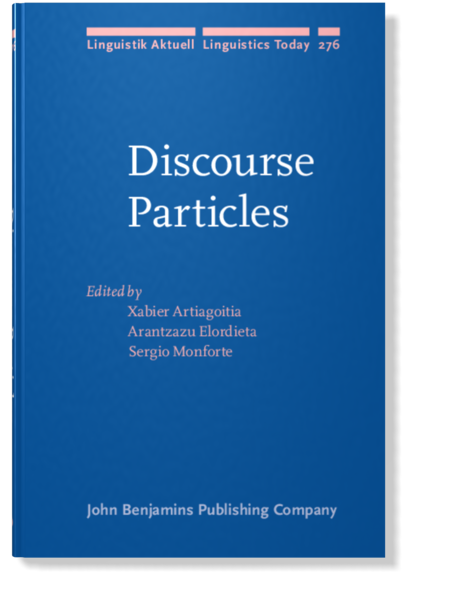
In:Discourse Particles: Syntactic, semantic, pragmatic and historical aspects
Edited by Xabier Artiagoitia, Arantzazu Elordieta and Sergio Monforte
[Linguistik Aktuell/Linguistics Today 276] 2022
► pp. v–vi
Get fulltext
This article is available free of charge.
Published online: 17 May 2022
https://doi.org/10.1075/la.276.toc
https://doi.org/10.1075/la.276.toc
Table of contents
Introduction: Discourse particles: syntactic, semantic, pragmatic and historical aspects
1
Xabier Artiagoitia
Arantzazu Elordieta
Sergio Monforte
Part I.Diachronic issues and the development of discourse particles
11
Chapter 1.On the adverbial origin of German modal particles
13
Marco Coniglio
Chapter 2.A particle-like use of hwæþer Wisdom’s questions in Boethius
41
Regine Eckardt
George Walkden
Chapter 3.The discourse particle es que in Spanish and in other Iberian languages
65
Manuel Pérez-Saldanya
José Ignacio Hualde
Part II.Syntactic analyses of discourse particles
99
Chapter 4.Agreeing complementizers may just be moody
101
Ömer Demirok
Balkız Öztürk
Chapter 5.Outer particles vs tag particles: A distinction in homophony
131
Aitor Lizardi Ituarte
Chapter 6.Anchoring primary and secondary interjections to the context
157
Nicola Munaro
Chapter 7.Sentence-final particles in mandarin Chinese: Syntax, semantics and acquisition
179
Waltraud Paul
Shanshan Yan
Part III.The semantic-pragmatics of discourse particles
207
Chapter 8.Meaning and use of the Basque particle bide
209
Kepa Korta
Larraitz Zubeldia
Chapter 9.Three German discourse particles as speech act modifiers
229
Johannes Schneider
Language index
255
Subject index
257
