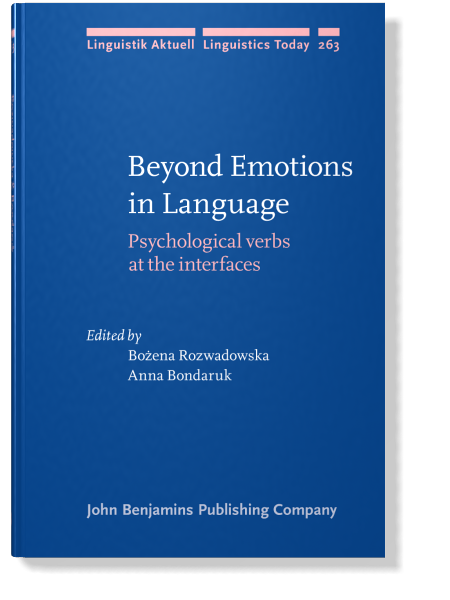
In:Beyond Emotions in Language: Psychological verbs at the interfaces
Edited by Bożena Rozwadowska and Anna Bondaruk
[Linguistik Aktuell/Linguistics Today 263] 2020
► pp. 113–140
Chapter 4
Initiators, states and passives in Spanish psych verbs
Published online: 8 December 2020
https://doi.org/10.1075/la.263.04fab
https://doi.org/10.1075/la.263.04fab
The goal here is twofold: the first one is to point out the existence of at least two classes of Object Experiencer psychological verbs (henceforth, OEPV) in Spanish with respect to their passive behavior, casting doubt on Landau (2010), who proposes that passivization of OEPVs correlates with the availability of pseudo-passives in a language. The second one is to argue that passives of OEPVs match the aspectual and argumental properties of verbs in such a way that the verbs which do not satisfy the condition that passives must involve events in Spanish must build those events through a repetitive, pluractional interpretation.
Keywords: psych predicates, onset boundary, passives, pluractionality, agentivity
Article outline
- 1.The problem
- 2.Class 1 (acosar): Verbs that allow passive in an unrestricted way
- 3.Class 2 (sorprender ‘surprise’): Verbs that only admit non-specific passives
- 4.The two subclasses in group 3 (enfadar and aburrir): Verbs that reject the passive form
- 5.Analysis
- 6. How to obtain an eventive process if there is none
- 7. Conclusions
Notes References

References (34)
Åfarli, T. (1992). The syntax of Norwegian passive constructions. Amsterdam: John Benjamins.
(1999). What counts as a class? The case of psych verbs. MIT Working Papers in Linguistics, 35, 1–23.
Belletti, A., & Rizzi, L. (1988). Psych-verbs and Theta Theory. Natural Language and Linguistic Theory 6, 291–352.
Bertinetto, P. M., & Lenci A. (2011). Habituality, pluractionality and imperfectivity. In R. Binnick (Ed.), The Oxford handbook of tense and aspect (pp. 852–881). Oxford: Oxford University Press.
Brucart, J. M. (1990). Pasividad y atribución en español: Un análisis generativo. In V. Demonte, & V. Garza (Eds.), Estudios de lingüística de España y de México (pp. 179–208). México: Colegio de México.
Carlson, G. (2011). Habitual and generic aspect. In R. Binnick (Ed.), The Oxford handbook of tense and aspect (pp. 828–852). Oxford: Oxford University Press.
Fábregas, A., & Marín, R. (2015). Deriving individual-level and stage-level psych verbs in Spanish. The Linguistic Review, 32(2), 227–275.
Filip, H. (1996). Psychological predicates and the syntax-semantics interface. In A. Goldberg (Ed.), Conceptual structure, discourse and language (pp. 131–147). Stanford, CA: CSLI.
García Pardo, A. (2018).
The morphosyntax of the Spanish verb phrase
(Unpublished doctoral dissertation). University of Southern California.
Landau, I. (2002). A typology of psych passives. In The Proceedings of the 32nd Conference of the North Eastern Linguistic Society, NELS 32 (pp. 271–286). Amherst, MA: GLSA.
Marín, R. (2010). Spanish adjectives within bounds. In P. Cabredo & O. Matushansky (Eds.), Adjectives. Formal analyses in syntax and semantics (pp. 307–331). Amsterdam: John Benjamins.
Marín, R., & McNally, L. (2005). The Aktionsart of Spanish reflexive psychological verbs and their English counterparts. In Proceedings of Sinn und Bedeutung, 9 ), pp. 212–225). Nijmegen: NCS.
(2011). Inchoativity, change of state, and telicity: Evidence from Spanish reflexive psychological verbs. Natural Language and Linguistic Theory, 29(2), 467–502.
Meinschäfer, J. (2006). Event-oriented adjectives and the semantics of deverbal nouns in Germanic and Romance: The role of boundedness and the mass/count distinction. In A. Thorton & M. Grossmann (Eds.), La formazione delle parole (pp. 355–368). Roma: Bulzoni.
Piñón, C. (1997). Achievements in an event semantics. In A. Lawson & E. Cho (Eds.), Proceedings of Semantics and Linguistic Theory, 7 (pp. 273–296). Ithaca, NY: CLC Publications.
Pylkkänen, L. (2000). On stativity and causation. In C. Tenny & J. Pustejovsky (Eds.), Events as grammatical objects (pp. 417–442). Stanford, CA: CSLI.
Rothmayr, A. (2009). The structure of stative verbs. Amsterdam: John Benjamins.
Rozwadowska, B. (2003). Initial boundary and telicity in the semantics of perfectivity. In P. Kosta, J. Błaszczak, J. Frasek, L. Geist, & M. Żygis (Eds.), Investigations into formal Slavic linguistics (pp. 859–872). Berlin: Peter Lang
Cited by (3)
Cited by three other publications
Bondaruk, Anna
2020.
The syntax of accusative and dative Experiencers in Polish. In Beyond Emotions in Language [Linguistik Aktuell/Linguistics Today, 263], ► pp. 141 ff.
Jiménez-Fernández, Ángel L.
2020.
The information structure of high and low datives and their psychological import. In Beyond Emotions in Language [Linguistik Aktuell/Linguistics Today, 263], ► pp. 213 ff.
Rozwadowska, Bożena
2020.
Polish psych verbs as non-achievements. In Beyond Emotions in Language [Linguistik Aktuell/Linguistics Today, 263], ► pp. 23 ff.
This list is based on CrossRef data as of 23 november 2025. Please note that it may not be complete. Sources presented here have been supplied by the respective publishers. Any errors therein should be reported to them.