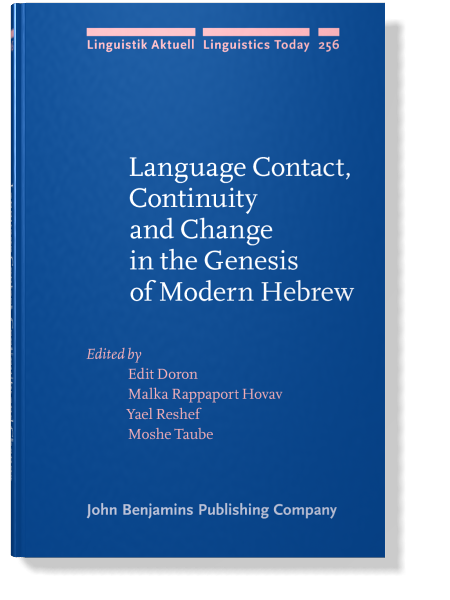
In:Language Contact, Continuity and Change in the Genesis of Modern Hebrew
Edited by Edit Doron, Malka Rappaport Hovav, Yael Reshef and Moshe Taube
[Linguistik Aktuell/Linguistics Today 256] 2019
► pp. vii–viii
Get fulltext
This article is available free of charge.
Published online: 18 September 2019
https://doi.org/10.1075/la.256.toc
https://doi.org/10.1075/la.256.toc
Table of contents
Acknowledgement and Preface
Introduction
Edit Doron
Malka Rappaport Hovav
Yael Reshef
Moshe Taube
The limits of multiple-source contact influence: The case of ecel ‘at’ in Modern Hebrew
Moshe Taube
Existential possessive modality in the emergence of Modern Hebrew
Aynat Rubinstein
The derivation of a concessive from an aspectual adverb by reanalysis in
Modern Hebrew
Avigail Tsirkin-Sadan
Why did the future form of the verb displace the imperative form in the
informal register of Modern Hebrew?
Chanan Ariel
The change in Hebrew from a V-framed to an S-framed Language
Malka Rappaport Hovav
From written to spoken usage: The contribution of pre-revival linguistic habits to the formation of the
colloquial register of Modern Hebrew
Yael Reshef
Language change, prescriptive language, and spontaneous speech in Modern
Hebrew: A corpus-based study of early recordings
Einat Gonen
The Biblical sources of Modern Hebrew syntax
Edit Doron
Can there be language continuity in language contact?
Brian D. Joseph
Our creolized tongues
Enoch O. Aboh
Why do children lead contact-induced language change in some contexts but not
others?
Carmel O’Shannessy
Variation and conventionalization in language emergence: The case of two young sign language of Israel
Irit Meir
Wendy Sandler
“Mame Loshen”: The role of gender-biased language contact in the syntactic development of
Yiddish
Asya Pereltsvaig
Index
