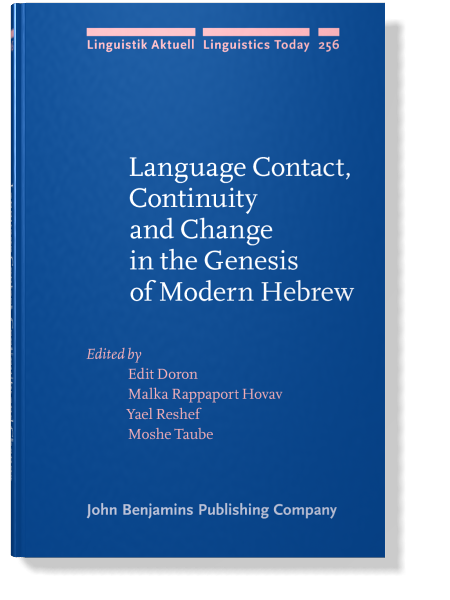
In:Language Contact, Continuity and Change in the Genesis of Modern Hebrew
Edited by Edit Doron, Malka Rappaport Hovav, Yael Reshef and Moshe Taube
[Linguistik Aktuell/Linguistics Today 256] 2019
► pp. 287–320
Our creolized tongues
Published online: 18 September 2019
https://doi.org/10.1075/la.256.11abo
https://doi.org/10.1075/la.256.11abo
It is often assumed that creole languages represent ‘exceptional’
language development in which a contact language or a variety largely spoken
by late L2 learners nativizes and becomes the main language of a community.
It is therefore not uncommon that scholars of contact languages or
revitalized languages (e.g., Hebrew) ask whether such languages are creoles
or not. The common assumption is that so-called creoles exhibit certain
specific linguistic features which distinguish them from other non-creolized
languages, and which could be used as a yardstick to evaluate the status of
other languages as creoles. But, what if any given language is a creolized
form of a pre-existing language spoken by previous generations? In this
paper, I argue that language acquisition always happens in a situation of
contact comparable to creole contexts, in which learners are faced with
heterogeneous inputs and recombine competing linguistic features into new
linguistic items. Under this view, all natural languages involve a hybrid
grammar. I further discuss how recombination leads to linguistic variation
both at the learner’s and population level.
Article outline
- 1.Introduction
- 2.Everyone speaks a creolized language
- 3.Language acquisition and creolization: Linguistic hybridism
- 4.Recombination of syntactic features
- 5.Capturing variation and constrains on variation during recombination
- 6.Recombination within CP: The case of Saramaccan
- 7.Conclusion
Acknowledgement Notes References

References (110)
Aboh, Enoch O. 2002. La morphosyntaxe de la péripherie gauche
nominale. In La syntaxe de la définitude, Anne Zribi-Hertz & Anne Daladier (eds),
Recherches Linguistiques de Vincennes
31: 9–26.
2005. Deriving relative and factive constructions in
Kwa. In Contributions to the Thirtieth Incontro di Grammatica
Generativa, Laura Brugè, Giuliana Giusti, Nicola Munaro, Walter Schweikert & Giuseppina Turano (eds), 265–285. Venice: Libreria Editrice Cafoscarina.
2006. The role of the syntax-semantics interface in language
transfer. In L2 Acquisition and Creole Genesis: Dialogues [Language Acquisition and Language Disorders 42], Claire Lefebvre, Lydia White & Christine Jourdan (eds), 221–252. Amsterdam: John Benjamins.
2007. La genèse de la périphérie gauche du
saramaka: Un cas d’influence du substrat? In Grammaires Créoles et Grammaire
Comparative, Karl Gadelii & Anne Zribi-Hertz (eds), 73–97. Saint-Denis: Presses Universitaires de Paris.
2009. Competition and selection: That’s all. In Complex Processes in New Languages [Creole Language Library 35], Enoch O. Aboh & Norval Smith (eds), 317–344. Amsterdam: John Benjamins.
2010. Information Structuring begins with the
numeration. IBERIA 2(1): 12–42. <[URL]>
2016a. Creole distinctiveness: A dead end. Journal of Pidgin and Creole Languages 31: 400–418.
2016b. Grammaticalization: A population factor. In
From Variation to Iconicity. Festschrift
for Olga Fischer
, Anne Bannink & Wim Honselaar (eds), 1–16. Amsterdam: Uitgeverij Pegasus.
Forthcoming. Pourquoi parlons-nous tous un créole? Le
changement linguistique à travers le prisme de la
créolistique. In Faits de Langue. <[URL]>
Aboh, Enoch O. & Smith, Norval. 2009. Simplicity, simplification, complexity and
complexification: Where have the interfaces gone? In Complex Processes in New Languages [Creole Language Library 35], Enoch O. Aboh & Norval Smith (eds), 1–25. Amsterdam: John Benjamins.
Aboh, Enoch O. & DeGraff, Michel. 2014. Some notes on bare noun phrases in Haitian Creole and in
Gungbe: A transatlantic Sprachbund perspective. In The Sociolinguistics of Grammar [Studies in Language Companion Series 154], Tor A. Åfarli & Brit Mæhlum (eds), 203–236. Amsterdam: John Benjamins.
. 2016. A Null Theory of creole formation based on Universal
Grammar. In Handbook of Universal Grammar, Ian Roberts (ed.). Oxford: OUP.
Arends, Jacques, Muysken, Pieter & Smith, Norval. 1995. Pidgins and Creoles: An Introduction [Creole Language Library 15]. Amsterdam: John Benjamins.
Atindogbé, Gratien Gualbert & Grollemund, Rebeca (eds). 2017. Relative Clauses in Cameroonian Languages Structure, Function
and Semantics. Berlin: Mouton de Gruyter.
Baker, Mark. 1985. The Mirror Principle and morphosyntactic
explanation. Linguistic Inquiry 16: 373–415.
. 2000. The raising analysis of relative clauses: A reply to
Borsley. Linguistic Inquiry 31: 123–140.
. 1988. Creole languages and the Bioprogram. Linguistics: The Cambridge Survey, Vol. II: Linguistic Theory: Extensions and Implications, Frederick Newmeyer (ed.), 268–284. Cambridge: CUP.
. 2008. Bastard Tongues: A Trail-blazing Linguist Finds Clues to our
Common Humanity in the World’s Lowliest Languages. New York NY: Hill and Wang.
Borer, Hagit. 1984. Parametric Syntax: Case Studies in Semitic and Romance
Languages. Dordrecht: Foris.
Bybee, Joan L. 1985. Morphology: A Study of the Relation between Meaning and
Form [Typological Studies in Language 9]. Amsterdam: John Benjamins.
Cinque, Guglielmo. 1996. 1996. The “Antisymmetric” Program: Theoretical and typological
implications. Journal of Linguistics 32: 447–464.
Clark, Robin & Roberts, Ian. 1993. A computational model of language learning and language
change. Linguistic Inquiry 24: 299–345.
Dahl, Östen. 2004. The Growth and Maintenance of Linguistic Complexity [Studies in Language Companion Series 71]. Amsterdam: John Benjamins.
. 2001. On the origins of Creole: A Cartesian critique of
Neo-Darwinian linguistics. Linguistic Typology 5: 213–310.
. 2005. Morphology and word order in “creolization” and
beyond. In The Oxford Handbook of Comparative Syntax, Guglielmo Cinque & Richard Kayne (eds), 293–372. Oxford: OUP.
. 2009. Language acquisition in creolization (and language
change): Some Cartesian uniformitarian boundary
conditions. Language and Linguistic Compass 3–4: 888–971.
Dostie, Gaétane. 2007. La réduplication pragmatique des marqueurs
discursifs. De là à là là. Langue Française 154: 45–60.
Essegbey, James. 1999. Inherent Complement Verbs Revisited: Towards an Understanding of
Argument Structure in Ewe [MPI Series]. Wageningen: Ponsen & Looijen.
Foley, William A. & Van Valin Robert D. Jr., 1984. Functional Syntax and Universal Grammar. Cambridge: CUP.
Ghyselen, Anne-Sophie. 2016. From diglossia to diaglossia: A West Flemish
case-study. In The Future of Dialects, Marie-Hélène Côté, Remco Knooihuizen & John Nerbonne (eds), 35–63. Berlin: Language Science Press.
Goad Heather & White, Lydia. 2004. Ultimate attainment of L2 inflection. Effects of L1
prosodic structure. In Eurosla Yearbook 4, Susan Foster-Cohen, Mike Sharwood Smith, Antonella Sorace & Mitsuhiko Ota (eds), 119–145. Amsterdam: John Benjamins.
Haegeman, Liliane. 2009. Linguistic variation in Belgium: Dialects and
tussentaal. A case study: West Flemish negation. Paper presented at
Meertens Institute. <[URL]>
Haznedar, Belma & Schwartz, Bonnie D. 1997 Are there optional infinitives in child L2
acquisition? In BUCLD 21: Proceeding of the Annual Boston University Conference
on Language Development, Elizabeth Hughes, Mary Hughes & Annabel Greenhill (eds), 257–268. Somerville MA: Cascadilla Press.
Hengeveld, Kees. 1989. Layers and operators in Functional
Grammar. Journal of Linguistics 25: 127–157.
. 2006. Linguistic typology. In Linguistic Universals, Ricardo Mairal & Juana Gil (eds), 46–66. Cambridge: CUP.
. 2012. The grammaticalization of tense and
aspect. In The Oxford Handbook of Grammaticalization, Bernd Heine & Heiko Narrog (eds). Oxford: OUP.
Hulk, Aafke. 2000. Non-selective access and activation in child
bilingualism. In Cross-linguistic Structures in Simultaneous
Bilingualism [Studies in Bilingualism, 21] Susanne Döpke (ed.), 57–78. Amsterdam: Benjamins.
Hulk, Aafke & Müller, Natascha. 2000. Bilingual first language acquisition at the interface
between syntax and pragmatics. Bilingualism: Language and Cognition 3: 227–244.
Huttar, George, Aboh, Enoch O. & Ameka, Felix. 2013. Relative clauses in Suriname creoles and Gbe
languages. Lingua 129: 96–123.
Kraybill, Donald B., Johnson-Weiner, Karen & Nolt, Steven M. 2013. The Amish. Baltimore MD: Johns Hopkins University Press.
Kroch, Anthony & Taylor, Ann. 1997 Verb movement in Old and Middle English: Dialect
variation and language contact. In Parameters of Morphosyntactic Change, Ans van Kemenade & Nigel Vincent (eds), 297–325. Cambridge: CUP.
Kroch, Anthony. 1989. Reflexes of grammar in patterns of language
change. Language Variation and Change 1: 199–244.
. 2001. Syntactic change. In The Handbook of Contemporary Syntactic Theory, Mark Baltin & Chris Collins (eds), 699–729. Malden MA: Blackwell.
Kusters C. W. 2003. Linguistic Complexity: The Influence of Social Change on
Verbal Inflection. PhD dissertation, University of Leiden. (LOT publications).
Lardiere, Donna. 2000. Mapping features to forms in second language
acquisition. In Second Language Acquisition and Linguistic Theory, John Archibald (ed.). Malden MA: Blackwell.
Lupyan, Gary & Dale, Rick. 2010. Language structure is partly determined by social
structure. PLoS ONE 5(1): e8559.
Mchombo, Sam. 2001. Effects of head-marking on constituent order in
Chichewa. In Proceedings of the LFG 01 Conference, Miriam Butt & Tracy Holloway King (eds), 221–237. Stanford CA: CSLI.
Meisel, Jürgen M. 2011. Bilingual language acquisition and theories of diachronic change: Bilingualism as cause and effect of grammatical change. Bilingualism: Language and Cognition 14: 121-145.
2005. Language evolution: The population genetics
way. In Genes, Language and their Evolution, Guenther Hauska (ed). Regensburg: Universitätsverlag.
Muysken, Pieter. 1981. Creole tense/mood/aspect systems: The unmarked
case? In Generative Studies on Creole Languages, Pieter Muysken (ed.), 181–199. Dordrecht: Foris.
. 1988. Are creoles a special type of language? In Linguistics: The Cambridge Survey, Vol. II: Linguistic Theory:
Extensions and Implications, Frederick Newmeyer (ed.), 285–301. Cambridge: CUP.
. 2013. Language contact outcomes as the result of bilingual
optimization strategies. Bilingualism: Language and Cognition 16(4): 709–730.
Niyogi, Partha & Berwick, Robert C. 1995. The Logical Problem of Language Change. A.I. Memo No. 1516, C.B.C.L. Paper No. 115: 1–18. MIT, MA: Cambridge.
Pelleprat, P.1655([1965]). Relation des missions des pères de la Compagnie de Jésus dans
les iles et dans la terre ferme de l’Amérique méridionale. Paris: Cramoisy. Span. ed. Relato de las misiones de los padres de la compañía de Jesús en
las islas y en tierra firme de América meridional. Caracas: Fuentes para la Historia Colonial de Venezuela.
Prévost, Philippe & White, Lydia. 2000. Missing surface inflection or impairment in second
language acquisition? Evidence from tense and
agreement. Second Language Research 16/2:103–133.
Price, Richard. 2008. Travels with Tooy. History, Memory, and the African American
Imagination. Chicago IL: Chicago University Press.
Rizzi, Luigi. 1997. The fine structure of the Left Periphery. In Elements of Grammar, Liliane Haegeman (ed.), 281–337. Dordrecht: Kluwer.
Rountree, S. Catherine. 1992. Saramaccan Grammar Sketch [Languages of the Guianas 8]. Paramaribo: Summer Institute of Linguistics.
Schuchardt, Hugo. 1914. Die Sprache der Saramakkaneger in Surinam. Verhandelingen der Koninklijke Akademie van Wetenschappen te
Amsterdam. Afdeeling Letterkunde, n.s. 14(6). Amsterdam: Johannes Müller.
Sebregts, Koen D. C. J. 2015. The Sociophonetics and Phonology of Dutch r. Utrecht: LOT Dissertation Series.
Smith, Norval. 1987. The Genesis of the Creole Languages of
Surinam. PhD dissertation, University of Amsterdam.
Sorace, Antonella. 2005. Selective optionality in language
development. In Syntax and Variation. Reconciling the Biological and the
Social [Current Issues in Linguistic Theory 265], Leonie Cornips & Karen P. Corrigan (eds), 55–80. Amsterdam: John Benjamins.
Spears, Arthur K. & Winford, Donald (ed.). 1997. The Structure and Status of Pidgins and Creoles [Creole Language Library 19]. Amsterdam: John Benjamins.
Trudgill, Peter. 2011. Sociolinguistic Typology: Social Determinants of Linguistic
Complexity. Oxford: OUP.
Tsimpli, Ianthi M. & Sorace, Antonella. 2006. Differentiating interfaces: L2 performance in syntax
semantics and syntax-discourse phenomena. In BUCLD 30: Proceedings of the 30th Annual Boston University
Conference on Language Development, Vol. 2, David Bamman, Tatiana Magnitskaia & Colleen Zaller (eds), 653–664. Somerville, MA: Cascadilla Press.
Van der Vate, M. 2011. Tense, Aspect and Modality in a Radical Creole: The Case
of Saamáka. PhD dissertation, University of Tromsoe.
Veenstra, Tonjes. 1996. Serial verbs in Saramaccan: Predication and Creole
genesis [HIL Dissertations 17]. The Hague: HAG.
Walkden, George. 2017. Language contact and V3 in Germanic varieties new and
old. Journal of Comparative Germanic Linguistics 20: 49–81.
Weerman, Fred. 2003. Nominative-dative inversion and the decline of
Dutch. Germania et alia: A Linguistic Webschrift for Hans den
Besten. <[URL]>
. 2011. Diachronic change: Early versus late
acquisition. Bilingualism: Language and Cognition 14: 149–151.
Vellupilai, Viveka. 2015. Pidgins, Creoles and Mixed Languages: An Introduction [Creole Language Library 48]. Amsterdam: John Benjamins.
Wexler, Kenneth. 1998. Very early parameter setting and the unique checking
constraint: A new explanation of the optimal infinitive
stage. Lingua 106: 23–79.
Wichmann, Sören & Holman, Eric W. 2009. Population size and rates of language
change. Special issue on Demography and Cultural Macroevolution 81. <[URL] >
Cited by (5)
Cited by five other publications
Muhsina Alleesaib & Julie Lefort
Lohndal, Terje & Michael T. Putnam
2024. The importance of features and exponents. Linguistic Approaches to Bilingualism 14:1 ► pp. 1 ff.
Aboh, Enoch O. & Cécile B. Vigouroux
Aboh, Enoch O.
[no author supplied]
This list is based on CrossRef data as of 22 november 2025. Please note that it may not be complete. Sources presented here have been supplied by the respective publishers. Any errors therein should be reported to them.