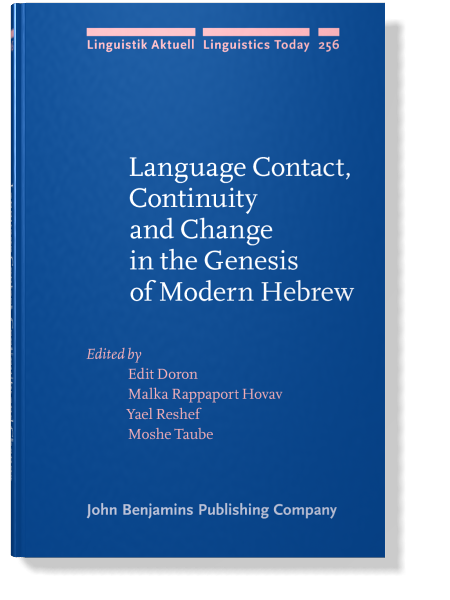
In:Language Contact, Continuity and Change in the Genesis of Modern Hebrew
Edited by Edit Doron, Malka Rappaport Hovav, Yael Reshef and Moshe Taube
[Linguistik Aktuell/Linguistics Today 256] 2019
► pp. 257–286
Can there be language continuity in language contact?
Published online: 18 September 2019
https://doi.org/10.1075/la.256.10jos
https://doi.org/10.1075/la.256.10jos
The paper argues that contact-induced change is no more unusual or
“inorganic” than any sort of language change, and that it does not affect
the basic continuity that language transmission across generations ensures.
Language continuity depends on an unbroken line of transmission, which may
be preserved not only in cases of system-internal changes, but also in
changes induced by language contact, even in creoles and mixed languages.
The paper illustrates these points by examining three cases of language
contact: Judezmo (Judeo-Spanish spoken by Jewish communities in the Balkans
before World War II); the Constantinople Judeo-Greek dialect of the 16th
century; the diglossia in 19th century Greece between Demotic and
Katharevousa.
Article outline
- 1.Introduction
- 2.Case study #1: Judezmo
- 3.Case study #2: Judeo-Greek of Ottoman Constantinople
- 4.Case study #3: Greek diglossia
- 5.Concluding remarks
Notes References

References (41)
Baldissera, Valeria. 2013. The Griko Dialect of Salento: Balkan Features and
Linguistic Contact. PhD dissertation, Ca' Foscari University of Venice.
. 2015. Dissertation Summary – The Griko dialect of Salento:
Balkan features and linguistic contact. Journal of Greek Linguistics 15(2): 171–179.
Belléli, Lazare. 1890. Une version grecque du Pentateuque du sixième
siècle. Revue des Etudes Grecques 3: 1–20.
Björck, Gudmund. 1940. Ἦν διδάσκων: Die periphrastischen Konstruktionen im
Griechischen. Uppsala: Almqvist & Wiksell.
Blass, Friedrich & Debrunner Albert. 1961. A Greek Grammar of the New Testament and Other Early Christian
Literature. Cambridge: CUP .
Brown, Christopher G. 2011. Review article – Doing without the Fez: Greek Language
Questions. Journal of Greek Linguistics 11: 249–257.
Bunis, David M. 1999. Voices from Jewish Salonika. Jerusalem-Thessaloniki: Misgav Yerushalayim, National Authority for Ladino Culture, Ets Ahaim foundation of Thessaloniki.
Friedman, Victor A. 2003. Evidentiality in the Balkans with special attention to
Macedonian and Albanian. In Studies in Evidentiality [Typological Studies in Language 54], Alexandra Y. Aikhenvald & Robert M. W. Dixon (eds), 189–218. Amsterdam: John Benjamins.
Friedman, Victor A. & Joseph, Brian D. 2014. Lessons from Judezmo about the Balkan Sprachbund and
contact linguistics. International Journal of the Sociology of Language 226: 3–23.
Hesseling Dirk C. 1897. Les cinq livres de la loi (Le pentateuque),
Traduction en néo-grec publiée en caractères hébraïques à
Constantinople en 1547 transcrite et accompagnée d’une introduction,
d’un glossaire, et d’un fac-simile. Leipzig: Otto Harrassowitz.
Joseph, Brian D. 1983. The Synchrony and Diachrony of the Balkan Infinitive: A Study in
Areal, General, and Historical Linguistics. Cambridge: CUP.
1990. Morphology and Universals in Syntactic Change: Evidence from
Medieval and Modern Greek [Outstanding Dissertations in Linguistics Series]. New York NY: Garland. (Expanded and updated version of Harvard University PhD dissertation, 1978.)
1992. Diachronic explanation: Putting speakers back into the
picture. In Explanation in Historical Linguistics [Current Issues in Linguistic Theory 84], Garry Davis & Gregory Iverson (eds), 123–144. Amsterdam: John Benjamins.
2000. Processes of spread for syntactic constructions in the
Balkans. In Balkan Linguistik: Synchronie und
Diachronie, Christos Tzitzilis & Charalambos Symeonidis (eds), 139–150. Thessaloniki: Aristotle University of Thessaloniki.
2001. Is there such a thing as
“grammaticalization”? Language Sciences 23(2–3): 163–186. Special issue Grammaticalization: A Critical Assessment, Lyle Campbell (ed.).
2011. Children rule, or do they (as far as innovations are
concerned)? Bilingualism: Language and Cognition 14(2): 156–158.
Joseph, Brian D. & Janda, Richard D. (eds.). 2003. The Handbook of Historical Linguistics. Oxford: Blackwell.
Krivoruchko, Julia G. 2008. The Constantinople Pentateuch within the context of
Septuagint studies. In XIII Congress of the International Organization for Septuagint
and Cognate Studies, Ljubljana, 2007, Melvin K. H. Peters (ed.), 255–276. Atlanta: Society of Biblical Literature.
2014. Medieval and Early Modern Judaeo-Greek biblical
translations. A linguistic perspective. In The Jewish-Greek Tradition in Antiquity and the Byzantine
Empire, James K. Aitken & James Carleton Paget (eds), 152–170. Cambridge: CUP.
Pappas, Panayiotis & Joseph, Brian D. 2002. On some recent views concerning the development of the
Greek future system. Byzantine and Modern Greek Studies 26: 247–273.
Rohlfs, Gerhard. 1958. La perdita dell’infinitivo nelle lingue
balcaniche e nell’Italia meridionale. Omagiu lui Iorgu Iordan cu prilejul împlinirii a
70 de ani, 733–744. Bucuresti.
Sala, Marius. 1971. Phonétique et phonologie du Judéo-Espagnol de
Bucarest [Janua Linguarum Series Practica 142]. The Hague: Mouton.
Sitaridou, Ioanna. 2014. The Romeyka infinitive: Continuity, contact and change in
the Hellenic varieties of Pontus. Diachronica 31(1): 23–73.
Slobin, Dan I. 2016. Thinking for speaking and the construction of
evidentiality in language contact. In Exploring the Turkish Linguistic Landscape: Essays in Honor of
Eser Erguvanlı-Taylan [Studies in Language Companion Series 175], Mine Güven, Didar Akar, Balkız Öztürk & Meltem Kelepir (eds), 105–120. Amsterdam: John Benjamins.
Thomason, Sarah G. 2001. Language Contact. An Introduction. Washington DC: Georgetown University Press.
Thomason, Sarah G. & Kaufman, Terrence. 1988. Language Contact, Creolization, and Genetic Linguistics. Berkeley CA: University of California Press.
Thumb, Albert. 1964. A Handbook of the Modern Greek Language. Grammar, Texts,
Glossary. Chicago IL: Argonaut (reprinting of 1912 edn.).
Cited by (1)
Cited by one other publication
This list is based on CrossRef data as of 22 november 2025. Please note that it may not be complete. Sources presented here have been supplied by the respective publishers. Any errors therein should be reported to them.