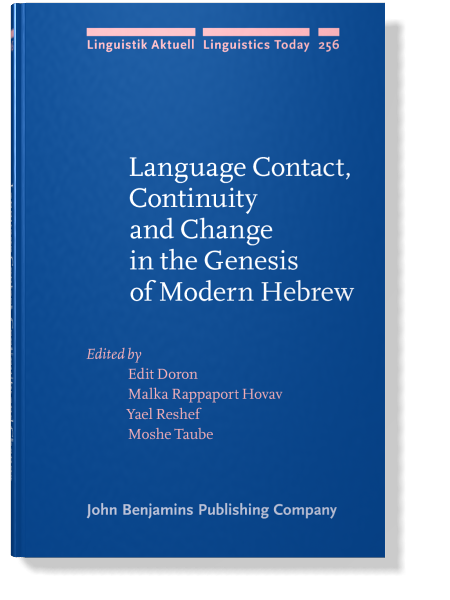
In:Language Contact, Continuity and Change in the Genesis of Modern Hebrew
Edited by Edit Doron, Malka Rappaport Hovav, Yael Reshef and Moshe Taube
[Linguistik Aktuell/Linguistics Today 256] 2019
► pp. 201–220
Language change, prescriptive language, and spontaneous speech in Modern Hebrew
A corpus-based study of early recordings
Published online: 18 September 2019
https://doi.org/10.1075/la.256.08gon
https://doi.org/10.1075/la.256.08gon
Unlike most living languages, the use of Hebrew as a spoken
language is characterized by historical discontinuity. In this article, I
discuss certain features of spoken usage among the first generations of
speakers of Modern Hebrew (henceforth: MH), using a unique corpus – ten hours
of unstructured interviews recorded in 1956–1966 with speakers born between
1885–1925. Using these recordings, I suggest a distinction between two types
of language change:
1.
Dynamic organic language change evident from the
comparison between two stages of a spoken language.
2.
Disparity between the planned prescriptive language and
the spoken language used from the first few decades of MH
(henceforth: Early Modern Hebrew – EMH) through the present.
This analysis sheds light on linguistic processes reflected in
present-day Hebrew, as it allows us to distinguish between the two types of
changes. My proposal is that dynamic language changes occurred in MH only
when there is a language change among different generations of MH speakers.
This type of changes is similar to the common linguistic changes of any
other normal living language. By contrast, the second type of a change is
the linguistic differences between MH and prescriptive language (which is
based on Classical Hebrew) that do not reflect a process of normal language
change, but a partial adoption (along with partial rejection) of the
prescriptive language already by the first generations of speakers.
Article outline
- 1.Theoretical background
- 1.1The consolidation of Modern Hebrew grammar
- 1.2Types of language change in present-day Hebrew
- 1.3The corpus
- 2.Phenomena reflecting dynamic language change
- 2.1The use of the noun erec ‘land’ and derived
adjectives
- 2.1.1The attributive arc-israʔel-i (land-Israel-adj ‘of the land of Israel’)
- 2.1.2xuc-l-a-ʔarc-i (outside-of-the-land-adj ‘from abroad’)
- 2.2The noun strategya (‘strategy’)
- 2.3The nominal pattern miCCaCa/ maCCeCa
- 2.3.1The noun midraxa/madrexa (‘sidewalk’)
- 2.3.2The noun maħleqa/ maħlaqa (‘department’)
- 2.3.3The noun miflaga (‘political party’)
- 2.1The use of the noun erec ‘land’ and derived
adjectives
- 3.Phenomena reflecting linguistic disparity
- 3.1Pronunciation of the function clitics
- 3.2The noun namel / namal (‘harbor’)
- 4.Mixed coexistence: Aspects of disparity and dynamic change combined
- 5.Conclusion
Notes References

References (39)
Avineri, Yitzhak. 1930. The ways of the Hebrew language in Israel, Chapter 2: The
noun. Lĕšonénu 2(3):287–306. (in Hebrew)
Barak, Smadar & Gadish, Ronit. 2008. Safa Qama: Selections from the Leshonenu La’am Column,
Haʼaretz, 1932–1944. Jerusalem:The Academy of the Hebrew Language. (in Hebrew)
Berman, Ruth A. 1987. Productivity in the lexicon: New-word formation in Modern
Hebrew. Folia Linguistica 21:425–461.
Bolozky, Shmuel. 2002. Phonological and morphological variation in spoken
Hebrew. In Speaking Hebrew: Studies in the Spoken Language and in
Linguistic Variation in Israel [Te'uda 18], Shlomo Izre'el (ed.), 239–278. Tel Aviv:Tel Aviv University. (in Hebrew)
Brown, Francis, Driver, Samuel R. & Briggs, Charles A. 1907. A Hebrew and English Lexicon of the Old Testament. Oxford:Clarendon.
Cohen, Chaim E. 1996. “On the Qamec vs. Cere war” – Natan
Alterman. Leshonenu La’am 47(2):82–83 (in Hebrew).
Eldar, Ilan. 2010. Language Planning in Israel. Jerusalem:The Academy of the Hebrew Language (in Hebrew).
Gadish, Ronit. 2010. The noun patterns Mafʕel and Mafʕela, Mifʕal and
Mifʕala. Lĕšonénu 72(3):287–319 (in Hebrew).
Gesenius, Wilhelm. 1910. Gesenius' Hebrew Grammar, edited and enlarged by Emil Kautzsch, second English edition revised by Arthur E. Cowley. Oxford:Clarendon.
Gonen, Einat. 2006. The Inflection of Nouns in Spoken Hebrew: Processes of
Vocalic Reduction. PhD dissertation, The Hebrew University of Jerusalem (in Hebrew).
. 2015. Grammatical variation in Israeli Hebrew in the light of
the formation of early Modern Hebrew. Language Studies XVI:121–138 (in Hebrew).
Gonen, Einat, Silber-Varod, Vered & Reshef, Yael. 2016. A window to the past: A spoken Hebrew corpus of
recordings from the 1960s. Carmillim 12:129–150 (in Hebrew).
Gonen, Einat & Reshef, Yael. 2017. The prefix vowel in the verbal template hif'il in spoken
Hebrew: Evidence from early recordings. Lĕšonénu 79(4):442–461 (in Hebrew).
. 2018, Morphological Variability in the Formation of Spoken
Modern Hebrew: The Case of the Nominal Template
Maqtela/Miqtala. Lĕšonénu 80(3):324–347 (in Hebrew).
Grasovsky, Yehuda & Klausner, Joseph. 1900. Pocket Dictionary from Hebrew to Russian and from Russian to
Hebrew and Ashkenazic. Warsaw: Tushiya (in Hebrew).
Izre'el, Shlomo. 2012. “Hebrew spoken here”: Here and not there. A linguistic
analysis of the recorded language. In The Speech Machine as a Language Teacher: Hebrew Spoken
Here, Shlomo Izre'el (ed.), 237–283. Tel Aviv: Tel Aviv University (in Hebrew)
Joüon, Paul & Muraoka, Takamitsu. 1996. A Grammar of Biblical Hebrew. Rome: Pontificio Istituto Biblico.
Köhler, Ludwig & Baumgartner, Walter. 1958. Lexicon in Veteris Testamenti Libros. Leiden: E.J. Brill.
Medan, Meir. 1952. On the forms Moʕaca, Miflaga and Maħlaqa from: “On the
grammar committee of Vaʕad Halašon”. Leshonenu La’am 3(7): 13–16. (in Hebrew)
Morag, Shelomo. 1947. On language mistakes and the ways to uproot
them. Haħinux 21: 325–345. (Cited from: Bar-Asher, Moshe, Breuer, Yochanan & Maman, Aharon (eds). 2003. Studies in Hebrew. Jerusalem: Magnes). (in Hebrew)
Naor, Menahem. 1933. A Practical Textbook of the Hebrew Language: For Teaching and
Self-Instruction. Jerusalem: Divan. (in Hebrew)
. 1949. Hebrew, Language and Grammar: A Practical Textbook for Teaching
and Self-Instruction. Jerusalem: Rubin Mass. (in Hebrew)
Reshef, Yael. 2015. Hebrew in the Mandate Period. Jerusalem: The Academy of the Hebrew Language. (in Hebrew)
Reshef, Yael & Gonen, Einat. Forthcoming. Ashkenazic traits in spoken Hebrew in the
early 1960s. Masorot. (in Hebrew)
Schwarzwald, Ora R. 2016. Selected morphological phenomena in the corpus of spoken
Hebrew. In Studying Spoken Hebrew [Te'uda 27], Einat Gonen (ed.), 251–274. Tel-Aviv: Tel-Aviv University. (in Hebrew)
Sharvit, Shimon. 2016. Phonology of Mishnaic Hebrew. Jerusalem: The Academy of the Hebrew Language. (in Hebrew)
Shatil, Nimrod. 2011. The nominal patterns CaCáC and CaCéC in contemporary
Hebrew. Lĕšonénu 73(1): 77–106. (in Hebrew)
Cited by (2)
Cited by two other publications
Gonen, Einat
Reshef, Yael & Einat Gonen
2018. Imperfect language learning vs. dynamic sound change. Journal of Historical Linguistics 8:2 ► pp. 169 ff.
This list is based on CrossRef data as of 22 november 2025. Please note that it may not be complete. Sources presented here have been supplied by the respective publishers. Any errors therein should be reported to them.