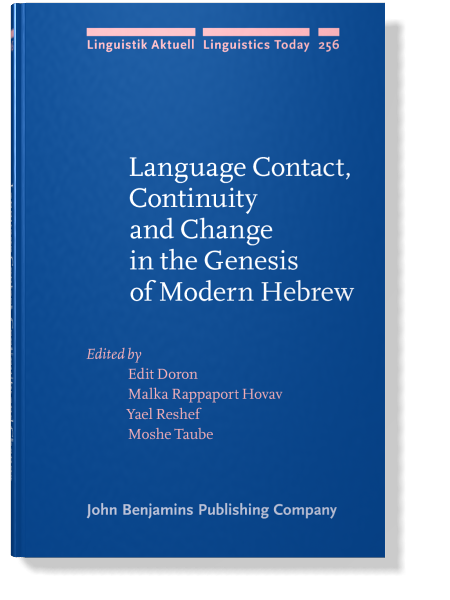
In:Language Contact, Continuity and Change in the Genesis of Modern Hebrew
Edited by Edit Doron, Malka Rappaport Hovav, Yael Reshef and Moshe Taube
[Linguistik Aktuell/Linguistics Today 256] 2019
► pp. 55–94
Existential possessive modality in the emergence of Modern Hebrew
Aynat Rubinstein | Department of Hebrew Language and Department of Linguistics | The Hebrew University of Jerusalem
Published online: 18 September 2019
https://doi.org/10.1075/la.256.03rub
https://doi.org/10.1075/la.256.03rub
This paper documents the evolution of existential possessive
modals in a literary corpus of Emergent Modern Hebrew (EMH). Modal uses of
the existential element yeš are shown to have changed their
form and their meaning during this period. Morphosyntactically, the
possessive variant declined, and it became impossible to inflect modal
yeš. Semantically, a special meaning of ability that
was available in the classical Hebrew variants of the construction was lost,
and modal yeš turned into an expression that exclusively
conveys impersonal deontic necessity. Language contact, primarily with
Russian, is suggested to have shaped the morphosyntax of existential
possessive modals in EMH, whereas internally-motivated processes based on
the inherited semantics may explain the meaning modal yeš
ultimately developed. On this view, the grammar of Modern Hebrew exhibits recombination of
features from languages in contact at the time of language revival.
Article outline
- 1.Introduction
- 2.Existential possessive modality in EMH: A construction in flux
- 2.1Research questions
- 2.2Procedure
- 2.3Corpus findings
- 2.3.1Frequencies of the constructions
- 2.3.2Modal force
- 2.3.3Modality type
- 3.Continuity and forces of change
- 3.1Existential possessive modality in classical Hebrew
- 3.2The role of contact
- 3.3The exceptionality of modern Hebrew
- 4.Theoretical implications
- 4.1Theoretical implications: Meaning
- 4.2Theoretical implications: Form
- 5.Conclusion
Acknowledgments Notes References

References (97)
Aarts, Bas, Close, Joanne & Wallis, Sean. 2010. Recent changes in the use of the progressive construction
in English. In Distinctions in English Grammar. Offered to Renaat
Declerck, Bert Cappelle & Naoaki Wada (eds), 148–167. Tokyo: Kaitakusha.
Ariel, Chanan. 2015. Deviations from the Mishnaic Hebrew syntax in
Mishneh Torah due to the influence of Arabic:
Subordination or intentional usage? Ms, The Hebrew University of Jerusalem.
Azar, Moshe. 1995. The Syntax of Mishnaic Hebrew. Jerusalem: The Academy of the Hebrew Language and the University of Haifa. (in Hebrew)
Bachi, Roberto. 1956. A statistical analysis of the revival of Hebrew in
Israel. Scripta Hierosolymitana 3:179–247.
Bar-Asher, Moshe. 2012. Studies in Modern Hebrew. Jerusalem: The Academy of Hebrew Language. (in Hebrew)
Bar-Asher Siegal, Elitzur A. 2011. From typology to diachrony: Synchronic and diachronic
aspects of predicative possessive constructions in
Akkadian. Folia Linguistica Historica 45:43–88.
Bauman, Joseph. 2016. From possession to obligation via shifting distributions
and particular constructions. Diachronica 33: 297–329.
Ben-Yehuda, Eliezer. 1908[1980]. Milon ha-lashon ha-‘ivrit ha-yeshanah ve-ha-h. adashah. Jerusalem: Makor Publishing. (in Hebrew)
Berman, Ruth A. 1980. The case of an (S)VO language: Subjectless constructions
in Modern Hebrew. Language 56:759–776.
Berman, Ruth A. 2011. Revisiting impersonal constructions in Modern Hebrew:
Discourse based perspectives. In Impersonal Constructions: A Cross-linguistic
Perspective [Studies in Language Companion Series 124], Andrej L. Malchukov & Anna Siewierska (eds), 323–355. Amsterdam: John Benjamins.
Bhatt, Rajesh. 1998. Obligation and possession. In Papers from the UPenn/MIT Roundtable on Argument Structure and
Aspect, Heidi Harley (ed.) [MIT Working Papers in Linguistics 32], 21–40. Cambridge MA: MITWPL.
. 2006. Covert Modality in Non-finite Contexts [Interface Explorations 8]. Berlin: Mouton de Gruyter.
Bjorkman, Bronwyn & Cowper, Elizabeth. 2016. Possession and necessity: From individuals to
worlds. Lingua 182: 30–48.
. 1965. Some Yiddish influences in Israeli Hebrew. In The Field of Yiddish: Studies in Language, Folklore, and
Literature, 2nd edn, Uriel Weinreich (ed.), 185–201. The Hague: Mouton.
Boneh, Nora. 2013. Mood and modality: Modern Hebrew. In Encyclopedia of Hebrew Language and Linguistics, Vol. 2, Geoffrey Khan (ed.), 693–703. Leiden: Brill.
Boneh, Nora & Doron, Edit. 2010. Modal and temporal aspects of habituality. In Syntax, Lexical Semantics, and Event Structure, Malka Rappaport Hovav, Edit Doron & Ivy Sichel (eds), 338–363. Oxford: OUP.
Boneh, Nora & Sichel, Ivy. 2010. Deconstructing possession. Natural Language and Linguistic Theory 28: 1–40.
Brinton, Laurel J. 1991. The origin and development of quasimodal have
to in English. Ms, The University of British Columbia.
Bybee, Joan L., Perkins, Revere & Pagliuca, William. 1994. The Evolution of Grammar: Tense, Aspect, and Modality in the
Languages of the World. Chicago IL: University of Chicago Press.
Clark, Eve. 1978. Locationals: Existential, locative, and possessive
constructions. In Universals of Human Language, Vol. 4, Joseph H. Greenberg, Charles A. Ferguson & Edith A. Moravcsik (eds), 85–126. Stanford CA: Stanford University Press.
Doron, Edit. 2015. Introduction: Language contact and the development of
Modern Hebrew. Journal of Jewish Languages 3: 5–26. Reprinted in Doron, Edit (ed.). 2016. Language Contact
and the Development of Modern Hebrew, 1–22. Leiden:
Brill..
Dubnov, Keren. 2005. Structural Loan Translations in Early Modern
Hebrew. PhD dissertation, The Hebrew University of Jerusalem. (in Hebrew)
. 2008. Adjectives functioning as impersonals (ḥagam) in Early
Modern Hebrew. Iggud: Selected Essays in Jewish Studies 3: 31–40. (in Hebrew)
. 2013. Slavic influence on Hebrew. In Encyclopedia of Hebrew Language and Linguistics, Geoffrey Khan (ed.), 576–578. Leiden: Brill.
Fischer, Olga. 1994. The development of quasi-auxiliaries in English and
changes in word order. Neophilologus 78: 137–164.
Francez, Itamar. 2007. Existential Propositions. PhD dissertation, Stanford University.
Goossens, Louis. 2000. Patterns of meaning extension, ‘parallel chaining’,
subjectification, and modal shifts. In Metaphor and Metonymy at the Crossroads: A Cognitive
Perspective, Antonio Barcelona (ed.), 149–169. Berlin: Mouton de Gruyter.
Goshen-Gottstein, Moshe H. 2006. Syntax and Vocabulary of Mediaeval Hebrew: As Influenced by
Arabic. Jerusalem: Ben Zvi Institute. Revised version of the author’s dissertation, published in
1951. (in Hebrew)
de Haan, Ferdinand. 2002. Strong modality and negation in Russian. In Using Corpora to Explore Linguistic Variation [Studies in Corpus Linguistics 9], Randi Reppen, Susan M. Fitzmaurice & Douglas Biber (eds), 91–110. Amsterdam: John Benjamins.
Hacquard, Valentine & Cournane, Ailís. 2016. Themes and variations in the expression of
modality. In NELS 46: Proceedings of the 46th Annual Meeting of the North
East Linguistic Society, Vol. 2, Christopher Hammerly & Brandon Prickett (eds), 21–42. Amherst MA: GSLA.
Hansen, Björn. 2014. Yiddish modals, with special reference to their
polyfunctionality and constructional properties. In Yiddish Language Structures, Marion Aptroot and Björn Hansen (eds), 145–183. Berlin: Walter de Gruyter.
Harley, Heidi. 2002. Possession and the double object
construction. Linguistic Variation Yearbook 2: 31–70.
Henkin-Roitfarb, Roni. 2013. Possession, Modern Hebrew. In Encyclopedia of Hebrew Language and Linguistics, Geoffrey Khan (ed.), 191–195. Leiden: Brill.
Hofmann, T. Ronald. 1976. Past tense replacement and the modal
system. In Notes from the Linguistic Underground [Syntax and Semantics 7], James D. McCawley (ed.), 85–100. New York NY: Academic Press. First version appeared in 1966, Mathematical Linguistics and
Automatic Translation Report NSF-17, Harvard University.
Isačenko, Alexander V. 1974. On ‘have’ and ‘be’ languages (a typological
sketch). In Slavic Forum: Essays in Linguistics and Literature, Michael S. Flier (ed.), 43–77. The Hague: Mouton.
Jung, Hakyung. 2011. The Syntax of the Be-Possessive: Parametric Variation and
Surface Diversities [Linguistik Aktuell/Linguistics Today 172]. Amsterdam: John Benjamins.
Kayne, Richard S. 1993. Toward a modular theory of auxiliary
selection. Studia Linguistica 47: 3–31.
Kratzer, Angelika. 1981. The notional category of modality. In Words, Worlds, and Contexts, Hans-Jürgen Eikmeyer & Hannes Rieser (eds), 38–74. Berlin: Walter de Gruyter. Reprinted in Porter, Paul & Partee, Barbara H. (eds). 2002.
Formal Semantics: The Essential Readings,
289–323. Oxford: Blackwell.
. 1991. Modality. In Semantik: Ein internationales Handbuch zeitgenössischer
Forschung, Arnim von Stechow & Dieter Wunderlich (eds), 639–650. Berlin: De Gruyter.
Krug, Manfred G. 2000. Emerging English Modals: A Corpus-based Study of
Grammaticalization [Topics in English Linguistics 32]. Berlin: Mouton de Gruyter.
. 2012. Sentence Patterns in English and Hebrew [Constructional Approaches to Language 12]. Amsterdam: John Benjamins.
McAnallen, Julia. 2011. The History of Predicative Possession in Slavic: Internal
Development vs. Language Contact. PhD dissertation, University of California, Berkeley.
Mor, Uri. 2017. Prepositional predicates with nominalized complements in
Classical Hebrew. Hebrew Studies 58: 25–46.
Mor, Uri & Pat-El, Na’ama. 2016. The development of predicates with prepositional subjects
in Hebrew. Journal of Semitic Studies 61: 327–346.
Narrog, Heiko. 2012. Modality, Subjectivity, and Semantic Change: A Cross-linguistic
Perspective. Oxford: OUP.
Nauze, Fabrice Dominique. 2008. Modality in Typological Perspective. PhD dissertation, University of Amsterdam.
Pat-El, Na’ama. 2013. Possession: Pre-modern Hebrew. In Encyclopedia of Hebrew Language and Linguistics, Geoffrey Khan (ed.), 190–191. Leiden: Brill.
Perlmutter, David. 1970. The two verbs begin. In Readings in English Transformational Grammar, Roderick A. Jacobs & Peter S. Rosenbaum (eds), 107–119. Waltham MA: Ginn.
Peterson, Tyler. 2010. Epistemic Modality and Evidentiality in Gitksan at the
Semantics-pragmatics Interface. PhD dissertation, The University of British Columbia.
Rabin, Chaim. 1985. Biblical and Mishnaic elements in contemporary
Hebrew. In Language Studies, Vol. 1, Moshe Bar-Asher (ed.), 273–285. Jerusalem: The Institute of Jewish Studies.
Reshef, Yael. 2009. Continuity versus change in the emergence of standard
Modern Hebrew: The verbal system in the early Mandate
period. In Modern Hebrew: Two Hundred and Fifty Years [Studies in Language VIII], Chaim E. Cohen (ed.), 143–176. Jerusalem: Academy of the Hebrew Language (in Hebrew)
. 2013a. Revival of Hebrew: Grammatical structure and
lexicon. In Encyclopedia of Hebrew Language and Linguistics, Geoffrey Khan (ed.), 397–405. Leiden: Brill.
. 2013b. Revival of Hebrew: Sociolinguistic
dimension. In Encyclopedia of Hebrew Language and Linguistics, Geoffrey Khan (ed.), 408–415. Leiden: Brill.
Reshef, Yael & Helman, Anat. 2009. Instructing or recruiting? Language and style in 1920s
and 1930s Tel Aviv municipal posters. Jewish Studies Quarterly 16: 306–332.
Ross, John. 1969. Auxiliaries as main verbs. In Studies in Philosophical Linguistics, William Todd (ed.). Evanston, IL: Great Expectations Press.
Rubinstein, Eliezer. 1967. The Nominal Sentence in Modern Hebrew. PhD dissertation, The Hebrew University of Jerusalem. (in Hebrew)
Rullmann, Hotze, Matthewson, Lisa & Davis, Henry. 2008. Modals as distributive indefinites. Natural Language Semantics 16: 317–357.
Schwartz, Daniel R. 1992. What should he have said? “and live by
them”. In Sanctity of Life and Martyrdom: Studies in Memory of Amir
Yekutiel, Isaiah M. Gafni & Aviezer Ravitzky (eds), 69–83. Jerusalem: The Zalman Shazar Center for Jewish History. (in Hebrew).
Sharvit, Shimon. 1993. Modal infinitive sentences in Mishnaic
Hebrew. In Studies in Bible and Exegesis, Vol. 3, Moshe Bar-Asher, Devorah Dimant, Moshe Garsiel & Yehoshua, Maori (eds), 413–437. Ramat Gan: Bar-Ilan University Press. (in Hebrew)
Shehadeh, H. 1991. Gilguley ha-bituy ‘yesh (lo) lilmod’/‘haya (lo)
lilmod’. In Studies on Hebrew and Other Semitic Languages Presented to
Professor Chaim Rabin on the Occassion of his Seventy-fifth
Birthday, Moshe H. Goshen-Gottstein, Shelomo Morag & Simcha Kogut (eds), 415–442. Jerusalem: Academon Press. (in Hebrew)
Smith, Nicholas. 2005. A Corpus-based Investigation of Recent Change in the Use
of the Progressive in British English. PhD dissertation, Lancaster University.
Stern, Naphtali 1983. Impersonals (ḥ.g.m.) and verboids + infinitive in Israeli
Hebrew. Leshonenu 47: 248–263.
Tagliamonte, Sali A. 2004. Have to, gotta, must: Grammaticalisation, variation and
specialization in English deontic modality. In Corpus Approaches to Grammaticalization in English [Studies in Corpus Linguistics 13], Hans Lindquist & Christian Mair (eds), 33–55. Amsterdam: John Benjamins.
Taube, Moshe. 2015. The usual suspects: Slavic, Yiddish, and the accusative
existentials and possessives in Modern Hebrew. Journal of Jewish Languages 3: 27–37. Reprinted in Doron, Edit (ed.). 2016. Language Contact
and the Development of Modern Hebrew, 25–35. Leiden:
Brill.
Traugott, Elizabeth Closs. 1989. On the rise of epistemic meanings in English: An example
of subjectification in semantic change. Language 65: 31–55.
Visser, Frederikus Theodorus. 1969–1973. An Historical Syntax of the English Language. Leiden: Brill.
Wigoder, Geoffrey. 1969. The Meditation of the Sad Soul: Abraham Bar Ḥayya. London: Routledge & Kegan Paul.
Cited by (2)
Cited by two other publications
Izre'el, Shlomo
Taube, Moshe
2019. The limits of multiple-source contact influence. In Language Contact, Continuity and Change in the Genesis of Modern Hebrew [Linguistik Aktuell/Linguistics Today, 256], ► pp. 33 ff.
This list is based on CrossRef data as of 22 november 2025. Please note that it may not be complete. Sources presented here have been supplied by the respective publishers. Any errors therein should be reported to them.