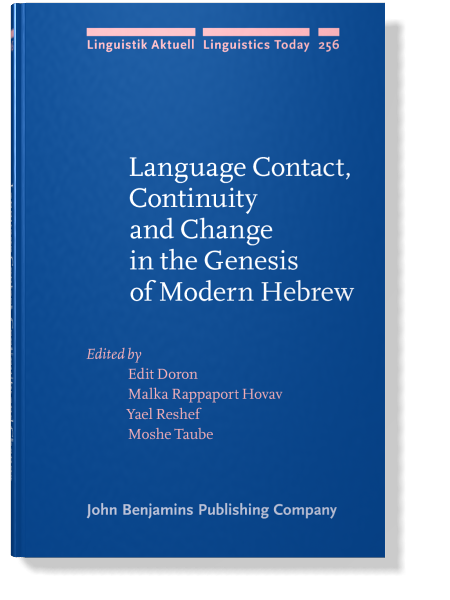
In:Language Contact, Continuity and Change in the Genesis of Modern Hebrew
Edited by Edit Doron, Malka Rappaport Hovav, Yael Reshef and Moshe Taube
[Linguistik Aktuell/Linguistics Today 256] 2019
► pp. 1–32
Introduction
Published online: 18 September 2019
https://doi.org/10.1075/la.256.01dor
https://doi.org/10.1075/la.256.01dor
Article outline
- 1.1Hebrew and the question of language continuity
- 1.2A framework for analyzing language transmission
- 1.3The history of Hebrew
- 1.4Previous approaches to the emergence of Modern Hebrew
- 1.5(Dis)continuity in Hebrew
- 1.5.1Hebrew throughout the ages
- 1.5.2Emergent Modern Hebrew of the first generation of speakers
- 1.5.3Hebrew of the first generation of native Modern Hebrew speakers
- 1.6Conclusion
- 1.7Summary of papers in the volume
- 1.7.1Contact, continuity and change in the emergence of Modern
Hebrew
- 1.7.1.1Syntactic evolution in the history of Hebrew
- 1.7.1.2The foundations of Modern Hebrew on previous stages of Hebrew
- 1.7.2General issues of contact, continuity and change
- 1.7.1Contact, continuity and change in the emergence of Modern
Hebrew
Notes References

References (100)
Avelar, Juanito & Galves, Charlotte. 2014. O papel das línguas africanas na emergência da gramática
do português brasileiro (The role of African languages in the
emergence of Brazilian Portuguese grammar). Lingüística 30(2): 241–288.
Bakker, Peter. 1997. A Language of Our Own. The Genesis of Michif, the Mixed
Cree-French Language of the Canadian Métis. Oxford: OUP.
Ben-Asher, Mordechai. 1969. The Crystallization of Normative Grammar in Modern
Hebrew. Tel-Aviv: Hakibbutz Hameuchad. (in Hebrew)
Ben-Hayyim, Ze’ev. 1953. Lashon atiqa bi-meci'ut hadasha. Leshonenu
La'am 4: 3–5 and 8–9. reprinted 1992. The Struggle for a Language. The Academy of the Hebrew Language. (in Hebrew)
. 1968. The Israeli Koiné as an emergent national
standard. In Language Problems of Developing Nations, Joshua A. Fishman, Charles A. Ferguson & Jyotirindra Das Gupta (eds), 237–251. New York NY: John Wiley and Sons.
Blau, Joshua. 1978. The historical periods of the Hebrew
language. In Jewish Languages: Theme and Variations, Herbert H. Paper (ed.), 1–13. Cambridge MA: Association for Jewish Studies.
Dahl, Östen. 2001. Inflationary effects in language and
elsewhere. In Frequency and the Emergence of Linguistic Structure [Typological Studies in Language 45], Joan Bybee & Paul Hopper (eds), 471–480. Amsterdam: John Benjamins.
. 2019. The modal carix ‘need’. In E. Doron (ed.) The Emergence of Modern Hebrew (EMODHEBREW) Online. The Hebrew University of Jerusalem. [URL]
Emonds, Joseph E. & Faarlund, Jan Terje. 2014. English: The Language of the Vikings [Olomouc Modern Languages Monographs 3]. Olomouc, Czech Republic: Palacký University.
Fishman, Joshua. 1967. Bilingualism with and without diglossia; diglossia with
and without bilingualism. Journal of Social Issues 23(2): 29–38.
Garrett, Andrew J.. 2008 Paradigmatic uniformity and markedness: Historical
convergence and universal grammar. In Linguistic Universals and Language Change, Jeff Good (ed.), 125–143. Oxford: OUP.
Glinert, Lewis. 2006. The Hasidic tale and the sociolinguistic modernization of
the Jews of Eastern Europe. In Ma’aseh Sippur: Studies in Jewish Narrative, Rella Kushelevsky & Avidov Lipsker (eds), 7–36. Ramat Gan: Bar Ilan University Press
Goldenberg, Gideon. 1996. Hebrew as a living Semitic language. In Evolution and Renewal – Trends in the Development of the Hebrew
Language: Lectures Commemorating the 100th Anniversary of the
Establishment of the Hebrew Language Council, 148–190. Jerusalem: Publications of the Israel Academy of the Sciences and Humanities.
Harshav, Benjamin. 1993. Language in Time of Revolution. Berkeley CA: University of California Press.
Horvath, Julia & Wexler, Paul. 1997. Relexification: Prolegomena to a research
program. In Relexification in Creole and Non-Creole Languages, Julia Horvath & Paul Wexler (eds), 11–71. Wiesbaden: Otto Harrassowitz.
Izre’el, Shlomo. 1986.
[URL]
. In Proceedings of the Ninth World Congress for Jewish
Studies, Part 4, Vol. 1: Hebrew and Judaic Languages; Other Languages, 77–84. Jerusalem. (in Hebrew)
. 2001. On processes in the formation of the Hebrew spoken in
Israel. In Speaking Hebrew: Research of Spoken Language and Linguistic
Variation in Israel, Teuda 18, Shlomo Izre’el (ed.), 217–238. Tel Aviv: TAU Press. (in Hebrew)
. 2003. The emergence of spoken Israeli Hebrew. In Corpus Linguistics and Modern Hebrew: Towards the Compilation of
The Corpus of Spoken Israeli Hebrew (CoSIH), Benjamin H. Hary (ed.), 85–104. Tel Aviv: Tel Aviv University, the Chaim Rosenberb School of Jewish Studies.
Janse, Mark. 1998. Cappadocian clitics and the syntax-morphology
interface. In Themes in Greek Linguistics II [Current Issues in Linguistic Theory 159], Brian D. Joseph, Geoffrey C. Horrocks & Irene Philippaki-Warburton (eds), 257–281. Amsterdam: John Benjamins.
. 2015. A Grammar of the Eastern European Hasidic Hebrew Tale [Studies in Semitic Languages and Linguistics 77]. Leiden: Brill.
. 2018. The Ashkenazic Hebrew of Nathan Nata Hannover’s Yeven
Meṣula (1653). In Studies in Semitic Linguistics and Manuscripts: A Liber
Discipulorum in Honour of Professor Geoffrey Khan, Nadia Vidro, Ronny Vollandt, Esther-Miriam Wagner & Judith Olszowy-Schlanger (eds), 151–180. Uppsala: Acta Universitatis Upsaliensis.
Kegl, Judy, Senghas, Ann & Coppola, Marie. 1999. Creation through contact: Sign language emergence and
sign language change in Nicaragua. In Language Creation and Language Change: Creolization, Diachrony
and Development, Michel DeGraff (ed.), 179–237. Cambridge MA: The MIT Press.
Khan, Geoffrey. 2013. A Short Introduction to the Tiberian Masoretic Bible and its
Reading Tradition, 2nd edn. Piscataway NJ: Gorgias.
. 2017. Learning to read Biblical Hebrew in the Middle Ages: The
transition from oral standard to written standard. In Jewish Education from Antiquity to the Middle Ages: Studies in
Honour of Philip S. Alexander, George J. Brooke & Renate Smithuis (eds), 269–295 Leiden: Brill. 269–295.
Kroch, Anthony S. 2001. Syntactic change. In The Handbook of Contemporary Syntactic Theory, Mark Baltin & Chris Collins (eds), 699–729. Malden MA: Blackwell.
Kuzar, Ron. 2001. Hebrew and Zionism: A Discourse-Analytic Cultural Study. Berlin: Mouton de Gruyter.
Labov, William. 1966. The Social Stratification of English in New York. Washington DC: Center for Applied Linguistics.
Laufer, Asher. 2008. Contemporary Hebrew feeds mainly on its own Hebrew roots
(Hebrew is not a Creole language). In Modern Hebrew and Jewish Languages. Sha’arei Lashon: Studies in
Hebrew, Aramaic and Jewish Languages Presented to Moshe Bar-Asher, Aharon Maman, Steven Fassberg & Yochanan Breuer (eds), 96–116. Jerusalem: The Bialik Institute. (in Hebrew)
Lefebvre, Claire. 1998. Creole Genesis and the Acquisition of Grammar: The Case of
Haitian Creole. Cambridge: CUP.
Lumsden, John. 1999. Language acquisition and creolization. In Language Creation and Language Change: Creolization, Diachrony,
and Development, Michel DeGraff (ed.), 129–157. Cambridge MA: The MIT Press.
Meisel, Jürgen M. 2011. Bilingual language acquisition and theories of diachronic
change: Bilingualism as cause and effect of grammatical
change. Bilingualism: Language and Cognition 14(2): 121–145.
Meir, Irit, Sandler, Wendy, Padden, Carol A. & Aronoff, Mark. 2010. Emerging sign languages. In Oxford Handbook of Deaf Studies, Language, and
Education, Vol. 2., Marc Marschark & Patricia Elizabeth Spencer (eds), 267–280. Oxford: OUP.
. 2017. Prescriptivism, nation, and style: The role of
nonclassical elements in the stylistic stratification of Modern
Hebrew. Sociolinguistic Studies 11: 1–20.
. Forthcoming. Prescriptive activity in Modern
Hebrew. In Studies in Modern Hebrew, Vol. 1: Background, Morphology, Syntax, Ruth A. Berman (ed.). Amsterdam: John Benjamins.
Morag, Shelomo. 1993. The emergence of Modern Hebrew: Some sociolinguistic
perspectives. In Hebrew in Ashkenaz, Lewis Glinert (ed.), 208–221. Oxford: OUP.
Ornan, Uzzi. 1984. Hebrew in Palestine before and after 1882. Journal of Semitic Studies 29: 225–254.
O’Shannessy, Carmel. 2012. The role of code-switched input to children in the origin
of a new mixed language. Linguistics 50(2): 305–340.
Pintzuk, Iris. 2004. Reading Jewish Women - Marginality and Modernization in Nineteenth-Century Eastern European Jewish Society. Boston: Brandeis University Press.
Pintzuk, Susan. 2008. Variationist approaches to syntactic
change. In The Handbook of Historical Linguistics, Brian D. Joseph & Richard D. Janda (eds), pp.509–528. New York NY: Wiley & Sons.
Rabin, Chaim. 1999. What was the revival of the Hebrew
language. Linguistic Studies, 359–376. Jerusalem: Academy of the Hebrew Language. (in Hebrew)
Reshef, Yael. 2008. English in Israel: Sociolinguistic and linguistic
aspects. In Il mio cuore è a oriente: Studi di linguistica storica,
filologia e cultura ebraica dedicati a Maria Mayer Modena (Quaderni di ACME 101), Francesco Aspesi et al. (eds), 733–751. Milano: Cisalpino.
. 2016. Written Hebrew of the revival generation as a distinct
phase in the evolution of Modern Hebrew. Journal of Semitic Studies 61: 187–213.
. Forthcoming. The role of children in the revival of
Hebrew. Studies in Contemporary Jewry 32.
Reshef, Yael & Helman, Anat. 2009. Instructing or recruiting? Language and style in 1920s
and 1930s Tel Aviv municipal posters. Jewish Studies Quarterly 16: 306–332.
Rosén, Haiim B. 1956. Ha-ʿIvrit šelanu: Dmuta be-ʾor šiṭot ha-balšanut. Tel-Aviv: Am Oved. (in Hebrew)
Rosenzweig, Franz. 1925. Neuhebräisch? Anläßlich der Übersetzung von Spinozas
Ethik. Der Morgen: Monatsschrift der Juden in Deutschland 1: 105–109.
Spolsky, Bernard. 1995. Conditions for language revitalization: A comparison of
the cases of Hebrew and Maori. Current Issues in Language & Society 2: 177–201.
Sportiche, Dominique. 1988. A theory of floating quantifiers and its corollaries for
constituent structure. Linguistic Inquiry 19: 425–449.
Thomason, Sarah G. & Kaufman, Terrence. 1988. Language Contact, Creolization, and Genetic Linguistics. Berkeley CA: UC Press.
1995. Subjectification in grammaticalisation. In Subjectivity and Subjectivication, Dieter Stein & Susan Wright (eds), 31–54. Cambridge: CUP.
Van Coetsem, Frans. 2000. A General and Unified Theory of the Transmission Process in
Language Contact. Heidelberg: Winter.
Wexler, Paul 1990. The Schizoid Nature of Modern Hebrew: A Slavic Language in
Search of a Semitic Past. Wiesbaden: Otto Harrassowitz.
Wheeler, Benjamin Ide. 1887. Analogy and the Scope of its Application. Ithaca NY: University Press. (reprinted 1965 by Johnson Reprint Corp. New York)
Cited by (1)
Cited by one other publication
Gonen, Einat
2024. Review of Reshef (2020): Historical Continuity in the Emergence of Modern Hebrew. Journal of Historical Linguistics 14:3 ► pp. 472 ff.
This list is based on CrossRef data as of 22 november 2025. Please note that it may not be complete. Sources presented here have been supplied by the respective publishers. Any errors therein should be reported to them.