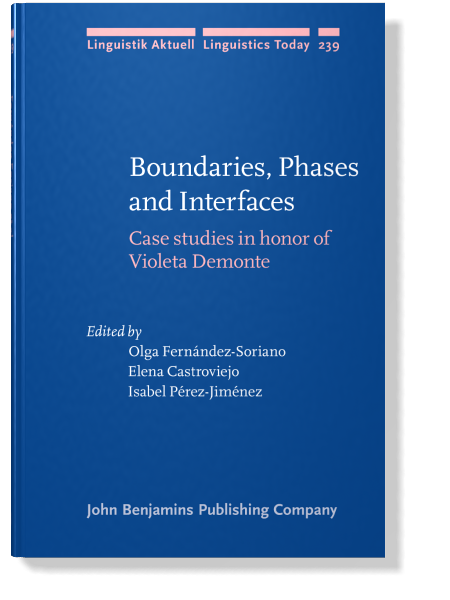
In:Boundaries, Phases and Interfaces: Case studies in honor of Violeta Demonte
Edited by Olga Fernández-Soriano, Elena Castroviejo Miró and Isabel Pérez-Jiménez
[Linguistik Aktuell/Linguistics Today 239] 2017
► pp. 129–150
On weak definites and their contribution to event kinds
Published online: 14 June 2017
https://doi.org/10.1075/la.239.07esp
https://doi.org/10.1075/la.239.07esp
In this paper we focus on the meaning of definite DPs that allow a weak reading. We review three different proposals for weak definites, and we present a new analysis with special reference to Romance languages. We submit that the eventual weak reading of a definite DP and its contribution to a ‘familiar’ kind of activity is exclusively dependent on whether certain stereotypical information encoded on the N present in the DP is activated at the time of utterance interpretation. These DPs do not refer to kinds and do not correspond to incorporated objects. Hence, their interpretation is not compositionally driven, but rather pragmatically inferred. We predict that the identification of weak definites takes place beyond grammar and is constrained by encyclopedic information.
Article outline
- 1.On weak definites
- 1.1Aguilar-Guevara and Zwarts: WDs and reference to kinds
- 1.2Carlson: WDs and semantic incorporation
- 1.3Schwarz: WDs and a compositional account of event kinds
- 2.Proposal: How WDs contribute to event kinds
- 3.Conclusion and predictions
Acknowledgements Notes References

References (56)
Aguilar-Guevara, Ana. 2014. Weak Definites: Semantics, Lexicon and Pragmatics. Utrecht: LOT Publications.
Aguilar-Guevara, Ana & Zwarts, Joost. 2010. Weak definites and reference to kinds. Proceedings of
SALT
20: 1–15.
Birner, Betty & Ward, Gregory. 1994. Uniqueness, familiarity and the definite article in English. Berkeley Linguistics Society 20: 93–102.
Borik, Olga & Espinal, M. Teresa. 2012. On definite kinds. Recherches Linguistiques de Vincennes 41: 123–146.
. 2015. Reference to kinds and to other generic expressions: Definiteness and number. The Linguistic Review 32(2): 167–225.
Borthen, Kaja. 2003. Norwegian Bare Singulars. PhD Dissertation, Norwegian University of Science and Technology.
Carlson, Greg. 1977. References to Kinds in English. PhD dissertation, University of Massachusetts at Amherst. Published by Garland, New York 1980.
. 2006. The meaningful bounds of incorporation. In Non- Definiteness and Plurality [Linguistik Aktuell/Linguistics Today 95], Svetlana Vogeleer & Liliane Tasmowski (eds), 35–50. Amsterdam: John Benjamins.
. 2010. Generics and concepts. In Kinds, Things and Stuff: Mass Terms and Generics, Francis J. Pelletier (ed.), 16–35. Oxford: OUP.
Carlson, Greg & Sussman, Rachel S. 2005. Seemingly indefinite definites. In Linguistic Evidence: Empirical, Theoretical and Computational Perspectives, Stephan Kepser & Marga Reis (eds), 71–85. Berlin: Mouton de Gruyter.
Carlson, Greg, Sussman, Rachel S., Klein, Natalie M. & Tanenhaus, Michael K. 2006. Weak definite noun phrases. In NELS 36 Proceedings of the North East Linguistic Society, Christopher Davis, Amy Rose Deal & Youri Zabbal (eds), 179–196. Amherst MA: GLSA.
Chierchia, Gennaro. 1984. Topics in the Syntax and Semantics of Infinitives and Gerunds. PhD dissertation, University of Massachusetts Amherst.
. 1995. Individual-level predicates as inherent generics. In The Generic Book, Carlson, Greg & Francis J. Pelletier (eds), 176–223. Chicago IL: The University of Chicago Press.
Christophersen, Paul. 1939. The Articles: A Study of their Theory and Use in English. Copenhagen: Einar Munksgaard.
Corblin, Francis. 2013. Weak definites as bound relational definites. Recherches Linguistiques de Vincennes 42: 91–122.
Cyrino, Sonia & Espinal, M. Teresa. 2015. Bare nominals in Brazilian Portuguese: More on the DP/NP analysis. Natural Language & Linguistic Theory 33(2): 471–521.
Dobrovie-Sorin, Carmen, Bleam, Tania & Espinal, M. Teresa. 2006. Bare nouns, number and types of incorporation. In Non−definiteness and Plurality [Linguistik Aktuell/Linguistics Today 95], Svetlana Vogeleer & Liliane Tasmowski (eds), 51–79. Amsterdam: John Benjamins.
Dobrovie-Sorin, Carmen & Pires de Oliveira, Roberta. 2007. Reference to kinds in Brazilian Portuguese: Bare singulars vs. definite singulars. Sinn und Bedeutung 12, Atle Grønn (ed.), 107–121. Oslo: Department of Literature, Area Studies and European Languages.
Doron, Edit & Meyr, Irit. 2013. Amount definites. Recherches Linguistiques de Vincennes 42: 139–165.
Espinal, M. Teresa. 2010. Bare nominals in Catalan and Spanish. Their structure and meaning. Lingua 120: 984–1009.
Espinal, M. Teresa. (In press). Morphosyntactic defectiveness in complex predicate predication. In On Verb Valency Change: Theoretical and typological perspectives, Ía Navarro & Albert Álvarez (eds). Amsterdam: John Benjamins.
Espinal, M. Teresa & Dobrovie-Sorin, Carmen. 2006. Tipología semántica de los nombres escuetos. El caso particular de los nombres escuetos singulares contables. In Homenaje a Andolin Eguzkitza, Beatriz Fernández & Itziar Laka (eds), 269–285. Vitoria: Universidad del País Vasco.
Espinal, M. Teresa & McNally, Louise. 2007a. Bare singular nominals and incorporating verbs. In Definiteness, Specificity and Animacy in Ibero-Romance Languages, Georg Kaiser & Manuel Leonetti (eds). Arbeitspapier 122: 45–62. Konstanz: University of Konstanz.
. 2007b. Bare singulars: Variation at the syntax-semantics interface. Paper presented at the Workshop on Bare Nouns and Nominalizations
, University of Stuttgart, June 22.
. 2011. Bare nominals and incorporating verbs in Catalan and Spanish. Journal of Linguistics 47: 87–128.
Farkas, Donka & de Swart, Henriette. 2003. The Semantics of Incorporation: From Argument Structure to Discourse Transparency. Stanford CA: CSLI.
Grimm, Scott & Louise McNally. 2015. The -ing dynasty: Rebuilding the semantics of nominalizations. Proceedings of SALT 25, 82–102.
Hale, Kenneth. 1986. Notes on world view and semantic categories: Some Warlpiri examples. In Features and Projections, Peter Muysken, & Henk van Riemsdijk (eds), 233–254. Dordrecht: Foris.
Heim, Irene. 1982. The Semantics of Definite and Indefinite Noun Phrases. PhD dissertation, University of Massachusetts at Amherst.
Ionin, Tania & Matushansky, Ora. 2006. The composition of complex cardinals. Journal of Semantics 23: 315–360.
Klein, Natalie M., Gegg-Harrison, Whitney M., Carlson, Greg N. & Tanenhaus, Michael K. 2013. Experimental investigations of weak definite and weak indefinite noun phrases. Cognition 128: 187–213.
Kratzer, Angelika. 1995. Stage-level and individual-level predicates. In The Generic Book, Greg Carlson & Francis J. Pelletier (eds), 125–175. Chicago IL: The University of Chicago Press.
Krifka, Manfred. 1998. The origins of telicity. In Events and Grammar, Susan Rothstein (ed.), 197–235. Dordrecht: Kluwer.
Krifka, Manfred, Francis J. Pelletier, Greg Carlson, Alice ter Meulen, Godehard Link & Gennaro Chierchia. 1995. Introduction. In Greg Carlson & Francis J. Pelletier (eds.), The Generic Book, 1–124. Chicago: The University of Chicago Press.
McNally, Louise & Boleda, Gemma. 2004. Relational adjectives as properties of kinds. In Empirical Issues in Formal Syntax and Semantics, Olivier Bonami & Patricia Cabredo Hoffher (eds), 5: 179–196. <[URL]>
McNally, Louise & van Geenhoven, Veerle. 1998. Redefining the weak/strong distinction. Paper presented at the Second Paris Syntax and Semantics Colloquium.
Partee, Barbara. 1987. Noun phrase interpretability and type-shifting principles. In Studies in Discourse Representation Theory and the Theory of Generalized Quantifiers, Jeroen A.G. Groenendijk, Dick de Jongh & Martin J.B. Stokhof (eds), 115–144. Foris: Dordrecht.
Pereltsvaig, Asya. 2011. On numberlessness and paucal numerals in Russian. Paper presented at Formal Approaches to Slavic Linguistics 20. MIT, 13–15 May.
Schwarz, Florian. 2014. How weak and how definite are weak definites? In Weak Referentiality [Linguistik Aktuell/Linguistics Today 219], Ana Aguilar-Guevara, Bert Le Bruyn & Joost Zwarts (eds), 213–235. Amsterdam: John Benjamins.
Stvan, Laurel S. 1998. The Semantics and Pragmatics of Bare Singular Noun Phrases. PhD dissertation, Northwestern University.
Vergnaud, Jean-Roger & Zubizarreta, Maria Luisa. 1992. The definite determiner and the inalienable constructions in French and in English. Linguistic Inquiry 23(4): 595–652.
Zamparelli, Roberto. 2002. Definite and bare kind-denoting nouns phrases. In Romance Languages and Linguistic Theory 200. Selected Papers from
Going Romance 2000 [Current Issues in Linguistic Theory 232], Frank Drijkoningen, Claire Beyssade, Paola Monachesi & Reineke Bok-Bennema (eds), 305–342. Amsterdam: John Benjamins.
Zwarts, Joost. 2014. Functional frames in the interpretation of weak nominals. In Weak Referentiality [Linguistik Aktuell/Linguistics Today 219], Ana Aguilar-Guevara, Bert Le Bruyn & Joost Zwarts (eds), 265–285. Amsterdam: John Benjamins.
Cited by (3)
Cited by three other publications
Giusti, Giuliana
Morosi, Paolo & M. Teresa Espinal
Real-Puigdollers, Cristina
This list is based on CrossRef data as of 22 november 2025. Please note that it may not be complete. Sources presented here have been supplied by the respective publishers. Any errors therein should be reported to them.