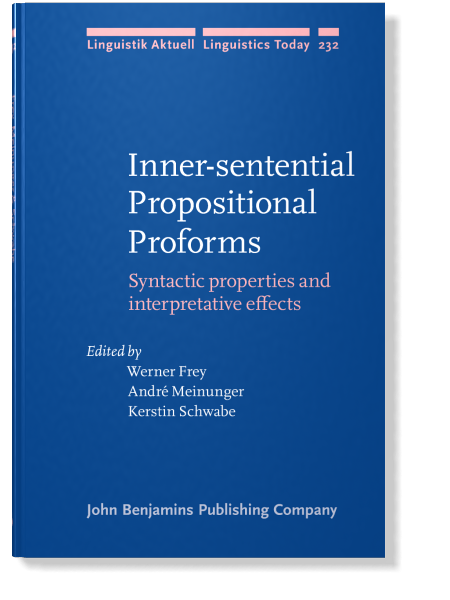
In:Inner-sentential Propositional Proforms: Syntactic properties and interpretative effects
Edited by Werner Frey, André Meinunger and Kerstin Schwabe
[Linguistik Aktuell/Linguistics Today 232] 2016
► pp. 73–104
On properties differentiating constructions with inner-sentential pro-forms for clauses
Published online: 26 July 2016
https://doi.org/10.1075/la.232.04fre
https://doi.org/10.1075/la.232.04fre
The paper discusses various syntactic properties of different constructions featuring a dependent clause associated with a pro-form. The paper adopts the thesis of Pütz (19862) and Sudhoff (2003) that the pro-form construction with verbs of the class to which bedauern (‘to regret’) belongs and the pro-form construction with verbs of the class which contains behaupten (‘to claim’) have to be differentiated. With regard to the former it is argued that contrary to standard assumptions, the presence of the pro-form makes a syntactic and a semantic difference. Regarding the construction in which the pro-form has the function of a prepositional object the argumentation is different in that the very same syntax is present independent of whether the pro-form is lexically realised or not, whether the pro-form is unstressed or stressed, or whether it is reduced or not. However, a special interpretation – narrow focus on the dependent clause – arises when the prepositional part of the pro-form is stressed. For the construction with a dependent adverbial clause the presence or absence of a lexically realised pro-form is again crucial. Finally and most importantly, it is demonstrated that a further construction has to be distinguished. It features a psych-verb with an experiencer-object, es and a clausal argument. In this construction, es is not a pro-form for the clausal argument as such but an independent argument which is co-referential with the clause and encodes the causer of the emotion.

References (31)
Altmann, Hans. 1981. Formen der ‘Herausstellung’ im Deutschen. Rechtsversetzung, Linksversetzung, Freies Thema und verwandte Konstruktionen. Tübingen: Niemeyer.
Bayer, Josef. 2001. Asymmetry in emphatic topicalization. In Audiatur Vox Sapientiae [Studia Grammatica 52], Caroline Féry & Wolfgang Sternefeld (eds), 15-47. Berlin: Akademie-Verlag.
Bayer, Josef & Obenauer, Hans-Georg. 2011. Discourse Particles, Clause Structure, and Question Types. The Linguistic Review28: 449-491.
Bennis, Hans. 2004. Unergative adjectives and psych verbs. In Studies in Unaccusativity: The Syntax-Lexicon Interface, Artemis Alexiadou & Martin Everaert (eds), 84-113. Cambridge: CUP.
Brandt, Margareta. 1990. Weiterführende Nebensätze. Zu ihrer Syntax, Semantik und Pragmatik [Lunder Germanistische Forschungen 57]. Stockholm: Almqvist und Wiksell.
Breindl, Eva. 1989. Präpositionalobjekte und Präpositionalobjektsätze im Deutschen. Tübingen: Niemeyer.
Cinque, Guglielmo. 1990. Ergative adjectives and the lexicalist hypothesis. Natural Language and Linguistic Theory 8: 1-39.
Coniglio, Marco. 2011. Die Syntax der deutschen Modalpartikeln: Ihre Distribution und Lizenzierung in Haupt- und Nebensätzen [Studia Grammatica 73]. Berlin: Akademie-Verlag.
Fox, Danny & Pesetsky, David. 2004. Cyclic linearization of syntactic structure. Special Issue on Object Shift in Scandinavian
, Katalin É. Kiss (ed). Theoretical Linguistics 31(1-2): 1-46.
Frey, Werner. 2015. Zur Struktur des Nachfelds im Deutschen. In Das Nachfeld im Deutschen: Theorie und Empirie, Hélène Vinckel-Roisin (ed), 53-75. Berlin: De Gruyter.
. 2011. Peripheral adverbial clauses, their licensing and the prefield in German. In Satzverknüpfung – Zur Interaktion von Form, Bedeutung und Diskursfunktiont, Eva Breindl, Gisella Ferraresi & Anna Volodina (eds), 41-77. Berlin: De Gruyter.
Haegeman, Liliane. 2004. The Syntax of Adverbial Clauses and Its Consequences for Topicalisation. Antwerp Papers in Linguistics 107: 61-90.
. 1995. Downright down to the right. In On Extraction and Extraposition in German [Linguistik Aktuell/Linguistics Today 11], Uli Lutz & Jürgen Pafel, 145-271. Amsterdam: John Benjamins.
Holler, Anke. 2013. Reanalyzing German correlative es
. In Proceedings of the 20th International Conference on Head-Driven Phrase Structure Grammar, Stefan Müller (ed), 90-109. Stanford CA: CSLI.
Jacobs, Joachim. 1986. Abtönungsmittel als Illokutionstypmodifikatoren. Groninger Arbeiten zur Germanistischen Linguistik 27: 100–111.
Ott, Dennis & de Vries, Mark. 2016. Right-dislocation as deletion. Natural Language & Linguistic Theory 34: 641-690.
Pütz, Herbert. 1986. Über die Syntax der Pronominalform >es< im modernen Deutsch. Tübingen: Gunter Narr.
Ross, John. 1967. Constraints on Variables in Syntax. PhD dissertation, MIT. Appeared in 1986 as Infinite Syntax. Norwood NJ: Ablex.
Cited by (2)
Cited by two other publications
Angelopoulos, Nikos
Hartmann, Jutta M.
2024. Locative-based expletives as situation proforms. Evolutionary Linguistic Theory 6:1-2 ► pp. 94 ff.
This list is based on CrossRef data as of 22 november 2025. Please note that it may not be complete. Sources presented here have been supplied by the respective publishers. Any errors therein should be reported to them.