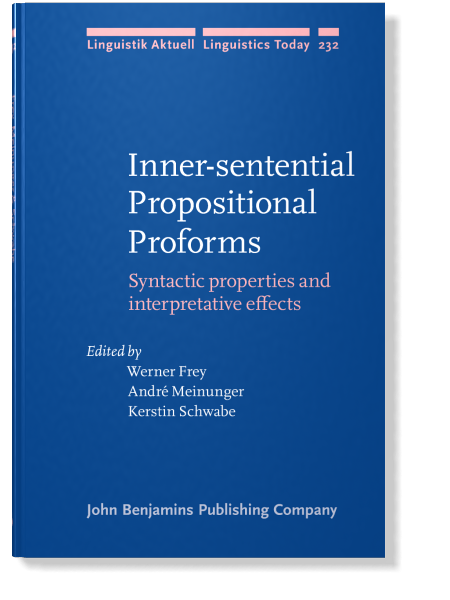
In:Inner-sentential Propositional Proforms: Syntactic properties and interpretative effects
Edited by Werner Frey, André Meinunger and Kerstin Schwabe
[Linguistik Aktuell/Linguistics Today 232] 2016
► pp. 23–48
Correlates of object clauses in German and Dutch
Published online: 26 July 2016
https://doi.org/10.1075/la.232.02sud
https://doi.org/10.1075/la.232.02sud
This paper deals with usages of the German pronoun es (and its counterpart het in Dutch) as a correlate of extraposed object clauses. It is argued (i) that es is the head of an argument DP and takes the embedded clause as its complement; (ii) that there are two types of matrix predicates, one of them being compatible with correlate-es, the other one incompatible; and (iii) that correlate-es has to be distinguished from an anaphoric use of the pronoun es that is possible in constructions with both types of matrix predicates, but has different contextual requirements.

References (36)
Averintseva-Klisch, Maria. 2006. The 'Separate Performative' account of the German Right Dislocation. In Proceedings of the Sinn und Bedeutung 10, vol. 1, Christian Ebert & Cornelia Endriss (eds), 15-28. Berlin: ZAS.
Bayer, Josef & Suchsland, Peter. 1997. Expletiva und leere Subjekte im Deutschen. Groninger Arbeiten zur Germanistischen Linguistik 41: 12‑38.
den Besten, Hans. 1983. On the interaction of root transformation and lexical deletive rules. In On the Formal Syntax of the Westgermania [Linguistik Aktuell/Linguistics Today 3], Werner Abraham (ed), 47-138. Amsterdam: John Benjamins.
Breindl, Eva. 1989. Präpositionalobjekte und Präpositionalobjektsätze im Deutschen. Tübingen: Niemeyer.
Büring, Daniel & Hartmann, Katharina. 1995. All Right! In On Extraction and Extraposition in German [Linguistik Aktuell/Linguistics Today 11], Uli Lutz & Jürgen Pafel, 179-211. Amsterdam: John Benjamins.
Cinque, Guglielmo. 1993. A null theory of phrase and compound stress. Linguistic Inquiry 24: 239-97.
Fabricius-Hansen, Cathrine. 1980. Sogenannte ergänzende wenn-Sätze. Ein Beispiel semantisch-syntaktischer Argumentation. In Festschrift für Gunnar Bech, Mogens Dyhr, Karl Hyldgaard-Jensen & Jørgen Olsen (eds), 160-188. København: Institut for germansk filologi.
Fabricius-Hansen, Cathrine & Sæbø, Kjell Johan. 2011. Behabitive Reports. In Understanding Quotation, Elke Brendel, Jörg Meibauer & Markus Steinbach (eds), 85-106. Berlin: De Gruyter.
Frey, Werner. 2006. How to get an object-es into the German prefield. In Form, Structure, and Grammar. A Festschrift Presented to Günther Grewendorf on Occasion of his 60th Birthday, Patrick Brandt & Eric Fuß (eds), 159-185. Berlin: Akademie-Verlag.
Haider, Hubert. 1994. Detached Clauses – The Later the Deeper. Arbeitspapiere des Sonderforschungsbereichs 340 41: 1-22.
. 1997. Projective economy. On the minimal functional structure of the German clause. In German: Syntactic Problems – Problematic Syntax, Werner Abraham & Elly van Gelderen (eds), 83-103. Tübingen: Niemeyer.
Hinterwimmer, Stefan. 2010.
When-clauses, factive verbs and correlates. In Language and Logos: Festschrift for Peter Staudacher on his 70th Birthday, Gisbert Fanselow & Thomas Hanneforth (eds), 176-189. Berlin: Akademie-Verlag.
Lenerz, Jürgen. 1993. Zu Syntax und Semantik deutscher Personalpronomina. In Wortstellung und Informationsstruktur, Marga Reis (ed), 117-153. Tübingen: Niemeyer.
Müller, Gereon. 1995. On extraposition & successive cyclicity. In On Extraction and Extraposition in German [Linguistik Aktuell/Linguistics Today 11], Uli Lutz & Jürgen Pafel, 213-243. Amsterdam: John Benjamins.
Müller, Gereon & Sternefeld, Wolfgang. 1993. Improper movement and unambiguous binding. Linguistic Inquiry 24: 461-507.
Pittner, Karin. 1999. Adverbiale im Deutschen. Untersuchungen zu ihrer Stellung und Interpretation. Tübingen: Stauffenburg.
Pütz, Herbert. 1986. Über die Syntax der Pronominalform >es< im modernen Deutsch, 2nd edn. Tübingen: Narr.
Safir, Ken. 1985. Missing subjects in German. In Studies in German Grammar, Jindřich Toman (ed), 193-229. Dordrecht: Foris.
Sandberg, Bengt. 1998. Zum es bei transitiven Verben vor satzförmigem Akkusativobjekt. Tübingen: Narr.
Sonnenberg, Bernhard. 1992. Korrelate im Deutschen. Beschreibung, Geschichte und Grammatiktheorie. Tübingen: Niemeyer.
Sternefeld, Wolfgang. 2006. Syntax. Eine morphologisch motivierte generative Beschreibung des Deutschen. Tübingen: Stauffenburg.
Steube, Anita. 1992. Syntax und Semantik freier Relativsätze in der deutschen Gegenwartssprache. In Fügungspotenzen. Zum 60. Geburtstag von Manfred Bierwisch, Ilse Zimmermann & Anatoli Strigin (eds), 189-206. Berlin: Akademie-Verlag.
Sudhoff, Stefan. 2003. Argumentsätze und es-Korrelate. Zur syntaktischen Struktur von Nebensatzeinbettungen im Deutschen. Berlin: WVB.
Tomaselli, Alessandra. 1986. Das unpersönliche "es" – Eine Analyse im Rahmen der Generativen Grammatik. Linguistische Berichte 102: 171-190.
Travis, Lisa. 1984. Parameters and Effects of Word Order Variation. PhD dissertation, MIT.
Cited by (8)
Cited by eight other publications
Angelopoulos, Nikos
Tatsumi, Yuta
Hartmann, Jutta M.
2024. Locative-based expletives as situation proforms. Evolutionary Linguistic Theory 6:1-2 ► pp. 94 ff.
Hinterhölzl, Roland
Ørsnes, Bjarne
Bentzen, Kristine & Merete Anderssen
Weisser, Philipp
Molnár, Valéria
2015. The Predicationality Hypothesis. In Approaches to Hungarian [Approaches to Hungarian, 14], ► pp. 209 ff.
This list is based on CrossRef data as of 22 november 2025. Please note that it may not be complete. Sources presented here have been supplied by the respective publishers. Any errors therein should be reported to them.