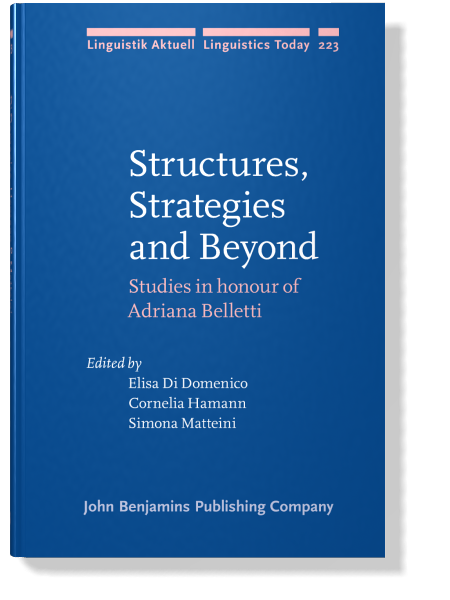
In:Structures, Strategies and Beyond: Studies in honour of Adriana Belletti
Edited by Elisa Di Domenico, Cornelia Hamann and Simona Matteini
[Linguistik Aktuell/Linguistics Today 223] 2015
► pp. 17–46
Notes on labeling and subject positions
Published online: 27 August 2015
https://doi.org/10.1075/la.223.02riz
https://doi.org/10.1075/la.223.02riz
This paper investigates aspects of the “halting problem” for subject movement: under what conditions is it obligatory? Where must it stop, giving rise to freezing effects? I will first introduce a particular implementation of the labeling approach presented in Chomsky (2013), and illustrate its explanatory power in connection with freezing effects. Then, I will use this approach to address subject-object asymmetries in extraction contexts. The freezing properties of subjects will be illustrated both for the preverbal subject position and for the special focal position in the low periphery of the clause analyzed in Belletti (2001b, 2004). A brief discussion of the consequences of labeling for the possibility of moving specifiers and complements will conclude the paper.
Keywords: focus, freezing, labeling, Relativized Minimality, subject positions

References (74)
. 2001a. Agreement projections. In Handbook of Generative Syntax, Mark Baltin & Chris Collins (eds). Oxford: Blackwell.
. 2001b. Inversion as focalization. In Subject Inversion in Romance and the Theory of Universal Grammar, Aafke Hulk & Jean-Yves Pollock (eds), 60–90. Oxford: OUP.
. 2004. Aspects of the low IP area. In The Structure of CP and IP: The Cartography of Syntactic Structures, Vol. 2, Luigi Rizzi (ed.), 16–51. Oxford: OUP.
Belletti Adriana, Bennati, Elisa & Sorace, Antonella. 2007. Theoretical and developmental issues in the syntax of subjects: Evidence from near native Italian. Natural Language and Linguistic Theory 25(4): 657–689.
Belletti, Adriana. To appear. The Focus map of clefts: Extraposition and predication. In Beyond Functional Sequence, Ur Shlonsky (ed.). Oxford: OUP.
Belletti, Adriana & Rizzi, Luigi. 1988. Psych-verbs and Theta Theory. Natural Language and Linguistic Theory 6(3): 291–352.
. 2012. Moving verbal chunks in the low functional field. In Functional Heads – The Cartography of Syntactic Structures 7, Laura Brugè, Anna Cardinaletti, Giuliana Giusti, Nicola Munaro & Cecilia Poletto, 129–137. Oxford: OUP.
Benincà, Paola & Poletto, Cecilia. 2004. Topic, Focus and V2: Defining the CP sublayers. In The Structure of CP and IP: The Cartography of Syntactic StructuresVol. 2, Luigi Rizzi (ed.), 52–75. Oxford: OUP.
Bianchi, Valentina, Bocci, Giuliano & Cruschina, Silvio. Forthcoming. Mirative Focus. Ms, University of Siena, University of Geneva, University of Vienna.
Bianchi, Valentina & Chesi, Cristiano. 2012. Subject islands and the subject criterion. In Enjoy Linguistics! Papers Offered to Luigi Rizzi on the Occasion of his 60th Birthday, Valentina Bianchi & Cristiano Chesi (eds), 25–53. Siena: CISCL Press.
Bošković, Želiko. 1997. The Syntax of Non-finite Complementation: An Economy Approach. Cambridge MA: The MIT Press.
Brandi, Luciana & Cordin, Patrizia. 1989. Two Italian dialects and the null subject parameter. In The Null Subject Parameter, Osvaldo Jaeggli & Ken Safir (eds), 111–142. Dordrecht: Kluwer.
Bresnan, J. 1977. Variables in the Theory of Transformations. In Formal Syntax, P. Culicover, et al. (eds), New York: Academic Press.
Calabrese, Andrea. 1986. Some properties of the Italian pronominal system: An analysis based on the notion of thema as subject of predication. In Tema-Rema in Italiano, Harro Stammerjohann (ed.), 25–36. Tübingen: Gunter Narr.
Cardinaletti, Anna. 2004. Towards a cartography of subject positions. In The Structure of CP and IP, Luigi Rizzi (ed.), 115–165. Oxford: OUP.
Cecchetto, Carlo & Donati, Caterina. 2010. On labeling: Principle C and head movement. Syntax 13(3): 241–273.
Chao, Wynn. 1980. Pro drop languages and non-obligatory control. Ms, University of Massachusetts, Amherst.
. 2008. On phases. In Foundational Issues in Linguistic Theory. Essays in Honor of Jean-Roger Vergnaud, Robert Freidin, Carlos P. Otero & Maria Luisa Zubizarreta (eds), 291–321 Cambridge MA: The MIT Press.
Cinque, Guglielmo. 1999. Adverbs and Functional Heads: A Cross – Linguistic Perspective. Oxford: OUP.
Danckaert, Lieven & Haegeman, Liliane. 2014. Speculations on subject extraction and wh agreement in English. Paper presented at IGG 2014, University of Trento.
Frascarelli, M. & R. Hinterhölzl. 2007. Types of Topics in German and Italian. In On Information Structure, Meaning and Form, S. Winkler and K. Schwabe (eds), 87–116. Amsterdam: Benjamins.
Greco, Ciro. 2014. Subjects and Arguments in A¢-Syntax. Ph.D. dissertation, University of Milano-Bicocca.
Haegeman, Liliane (ed.). 2012. Adverbial Clauses, Main Clause Phenomena, and the Composition of the Left Periphery. The Cartography of Syntactic Structures, Vol. 8. Oxford: OUP.
Kenstowicz, Michael. 1989. The null subject parameter in Modern Arabic dialects. In The Null Subject Parameter, Osvaldo Jaeggli & Ken Safir (eds), 263–277. Dordrecht:Kluwer.
Krapova, Ilyiana & Cinque, Guglielmo. 2008. On the order of wh-phrases in Bulgarian multiple wh-fronting. In Formal Description of Slavic Languages: The Fifth Conference, Gerhild Zybatow, Luka Szucsich, Uwe Junghanns & Roland Meyer (eds), 318–336. Frankfurt: Peter Lang.
Kuroda, Siege-Yuki. 1972. The categorical and the thetic judgment. Foundations of Language 9: 153–185.
Ladusaw, William. 1994. Thetic and categorical, stage and individual, weak and strong. In Proceedings of the 4th Semantics and Linguistic Theory Conference (SALT 4), Mandy Harvey & Lynn Santelmann (eds), 220–229. ásemanticsarchives.netñ
Longobardi, Giuseppe. 1985. Su alcune proprietà della sintassi e della forma logica delle frasi copulari. In Sintassi e morfologia della lingua italiana d’uso. Teorie e applicazioni descrittive. Atti del XVII Congresso Internazionale SLI, Leonardo M. Savoia & Annalisa Franchi De Bellis (eds), 213–223. Roma: Bulzoni.
Manzini, M. Rita & Savoia, Leonardo M. 2005. I dialetti italiani e romanci. Alessandria: Edizioni dell’Orso.
McCloskey, James. 1997. Subjecthood and subject positions. In Elements of Grammar, Liliane Haegeman (ed.), 197–236. Dordrecht: Kluwer.
Menuzzi, Sergio. 2000. That-trace effects in Portuguese. Forum Lingüístico 2(1): 13–39. Florianópolis: UFSC.
Nicolis, M. 2005. On Pro Drop. Ph.D. dissertation, University of Siena.
Perlmutter, D. 1971. Deep and Surface Structure Constraints in Syntax. New York NY: Holt, Rinehart and Winston.
Poletto, Cecilia. 2000. The Higher Functional Field. Evidence from Northern Italian Dialects. Oxford: OUP.
. 1991. Residual verb second and the wh criterion. In Geneva Working Papers on Formal and Computational Linguistics, republished in Rizzi, Luigi, 2000, Comparative Syntax and Language Acquisition, 213–240, London: Routledge.
. 1997. The fine structure of the left periphery. In Elements of Grammar, Liliane Haegeman (ed.), 281–337. Dordrecht: Kluwer.
. 2004. Locality and left periphery. In Structures and Beyond. The Cartography of Syntactic Structures, Vol.3, Adriana Belletti (ed.), 223–251. Oxford: OUP.
. 2006. On the form of chains: Criterial positions and ECP effects. In On Wh Movement, Lisa Cheng & Norbert Corver (eds), 97–133. Cambridge MA: The MIT Press.
. 2010. On some properties of criterial freezing. In The Complementizer Phase: Subjects and Operators, E. Phoevos Panagiotidis (ed.), 17–32. Oxford: OUP.
. 2011. Some locality principles and Italian syntax. Ms, University of Siena. To be published in The Syntax of Italian, Giuseppe Longobardi, (ed.). Cambridge: CUP.
. 2013. Focus, Topic and the cartography of the left periphery. In The Bloomsbury Companion to Syntax, Cristina Parodi & Silvia Luraghi (eds), 436–451. London: Bloomsbury.
. 2014. Some consequences of criterial freezing: Asymmetries, anti- adjacency and extraction from cleft sentences. In Functional Structure from Top to Toe. The Cartography of Syntactic Structures, Vol. 9, Peter Svenionius (ed.), 19–45. Oxford:OUP.
. 2015. Cartography, criteria, and labeling. In Beyond Functional Sequence, Ur. Shlonsky (ed.), 314–338. Oxford: OUP.
Rizzi, Luigi & Shlonsky, Ur. 2007. Strategies of subject extraction. In Interfaces + Recursion = Language? Chomsky’s Minimalism and the View from Syntax-Semantics, Hans Martin Gärtner & Uli Sauerland (eds), 115–160. Berlin: Mouton de Gruyter.
Ruwet, Nicolas. 1975. Les phrases copulatives en français. Recherches Linguistiques, Université de Paris VIII, 143–191.
Salulessa, Salulessa. 2004. The Structure of Relative Clauses in Lingala: A Comparative Study in Bantu Word Order Variation and Left Periphery. MA thesis, University of Geneva.
Shlonsky, Ur. 2014. Subject positions, subject extraction, EPP and the subject criterion. In Locality, Enoch Aboh, Maria Teresa Guasti & Ian Roberts (eds), 58–85. Oxford: OUP.
Sobin, Nicolas. 2002. The comp-trace effect, the adverb effect and minimal CP. Journal of Linguistics 38: 527–560.
Sportiche, Dominique. 1988. A theory of floating quantifiers and its corollaries for constituent structure. Linguistic Inquiry 19(3): 425–449.
Starke, Michal. 2001. Move Dissolves into Merge. Ph.D. dissertation, University of Geneva.
Cited by (18)
Cited by 18 other publications
Landau, Idan
Li, Xiangyu & Victor Junnan Pan
Rubin, Edward
Hu, Yaqing & Andrew Simpson
Shlonsky, Ur
Samo, Giuseppe
Samo, Giuseppe
2025. Cartography, movement and reordering of arguments. In The Ziggurat of Grammar [Language Faculty and Beyond, 20], ► pp. 511 ff.
Yip, Ka-Fai & Tommy Tsz-Ming Lee
2022. Modal movement licensed by focus. In New Explorations in Chinese Theoretical Syntax [Linguistik Aktuell/Linguistics Today, 272], ► pp. 165 ff.
Quarezemin, Sandra
Reeve, Matthew
Ishii, Toru
Zyman, Erik
Rizzi, Luigi & Giuliano Bocci
Rizzi, Luigi
2016. EPP and ECP revisited. In Romance Languages and Linguistic Theory 10 [Romance Languages and Linguistic Theory, 10], ► pp. 211 ff.
[no author supplied]
This list is based on CrossRef data as of 22 november 2025. Please note that it may not be complete. Sources presented here have been supplied by the respective publishers. Any errors therein should be reported to them.