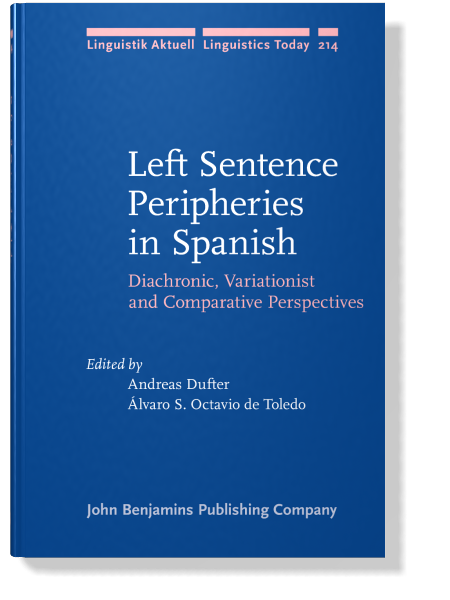
In:Left Sentence Peripheries in Spanish: Diachronic, Variationist and Comparative Perspectives
Edited by Andreas Dufter and Álvaro S. Octavio de Toledo y Huerta
[Linguistik Aktuell/Linguistics Today 214] 2014
► pp. 283–308
Chapter 10. Informational status and the semantics of mood in Spanish preposed complement clauses
Published online: 31 July 2014
https://doi.org/10.1075/la.214.15bec
https://doi.org/10.1075/la.214.15bec
This corpus-based study examines the principles of mood selection in Spanish preposed complement clauses. It tries to prove that the relevant factor for mood selection is not the informational status of the preposed complement clause but its semantic nature or, more precisely, the contrast between intensional and referential readings. This contrast constitutes a specific principle of the Spanish (and that of Romance in general) mood system which comes to bear whenever the subordinate complement clause is not under the scope of a modal operator. This article also shows how the speakers exploit this specific mood contrast in order to produce certain pragmatic and/or stylistic effects.

References (35)
CORDE = Real Academia Española. Corpus diacrónico del español. <[URL]> (10 May 2012).
CREA = Real Academia Española. Corpus de referencia del español actual. <[URL]> (21 May 2012).
Farkas, Donka. 1992. On the semantics of subjunctive complements. In
Romance Languages and Modern Linguistic Theory
, Paul Hirschbühler & Konrad Koerner (eds), 69–104. Amsterdam: John Benjamins.
Frege, Gottlob. 1997[1892]. Über Sinn und Bedeutung. In
Funktion, Begriff, Bedeutung. Fünf logische Studien
, Günther Patzig (ed.), 40–65. Göttingen: Vandenhoeck. English translation: On sense and reference, transl. by Max Black. In Readings in the Philosophy of Language (1997), Peter Ludlow (ed.), 563–584. Cambridge MA: The MIT Press.
Fuente Gómez, Rafael, Fernández Álvarez, Jesús & Feijoo, Lope G. 1977.
El subjuntivo
. Madrid: Edi-6.
Gil, Alberto. 2002. Zum Verhältnis von Grammatik und Pragmatik bei iberoromanischen Faktivsätzen. In
Gramática y pragmática del español. Actas de la sección Grammatik und Pragmatik im Spanischen del XIII. Deutscher Hispanistentag, Leipzig (8.–11.III.2001)
, Alberto Gil & Christian Schmitt (eds), 37–56. Bonn: Romanistischer Verlag.
Giorgi, Alessandra & Pianesi, Fabio. 1997.
Tense and Aspect: From Semantics to Morphosyntax
. Oxford: OUP.
Guitart, Jorge M. 1984. Syntax, semantics and pragmatics of mood in Spanish noun clauses.
Hispanic Journal
6(1): 159–177.
Haverkate, Henk. 2002.
The Syntax, Semantics and Pragmatics of Spanish Mood
[Pragmatics & Beyond New Series 96]. Amsterdam: John Benjamins.
Heim, Irene. 1992. Presuppositional projection and the semantics of attitude verbs.
Journal of Semantics
9(3): 183–221.
Hummel, Martin. 2004.
El valor básico del subjuntivo español y románico
. Cáceres: Universidad de Extremadura.
. 2005. Zum Gebrauch des Konjunktivs im gesprochenen Spanisch Chiles. In
Sprache in Iberoamerika, Festschrift für Wolf Dietrich zum 65
. Geburtstag, Volker Noll & Haralambos Symeonidis (eds), 313–339. Hamburg: Helmut Buske.
Hunnius, Klaus. 1971. Zur Synchronie und Diachronie des Satztypus Qu’il vienne, c’est certain
.
Romanistisches Jahrbuch
22: 25–33.
de Jonge, Bob. 2001. Spanish subjunctive mood: One form, more than one meaning? In
Adverbial Modification
, Reineke Bok-Bennema, Bob de Jonge, Brigitte Kampers-Manhe & Arie Molendijk (eds), 79–92. Amsterdam: Rodopi.
Kiparsky, Paul & Kiparsky, Carol. 1971. Fact. In
Semantics. An Interdisciplinary Reader in Philosophy, Linguistics and Psychology
, Danny D. Steinberg & Leon A. Jakobovits (eds), 345–369. Cambridge: CUP.
Kratzer, Angelika. 1978.
Semantik der Rede: Kontexttheorie, Modalwörter, Konditionalsätze
. Königstein: Skriptor.
. 1991. Modality. In
Semantics
, Arnim von Stechow & Dieter Wunderlich (eds), 639–650. Berlin: Mouton de Gruyter.
Leonetti, Manuel. 1999. La subordinación sustantiva: las subordinadas enunciativas en los complementos nominales. In
Gramática descriptiva de la lengua española
, Vol. 2, Ignacio Bosque & Violeta Demonte (eds), 2083–2104. Madrid: Espasa Calpe.
Lerch, Eugen. 1920. Der Konjunktiv des psychologischen Subjekts im Französischen.
Die neueren Sprachen
27: 338–344.
Lunn, Patricia V. 1989. The Spanish subjunctive and relevance. In
Studies in Romance Linguistics
[Current Issues in Linguistic Theory 60], Carl Kirschner & Janet Ann DeCesaris (eds), 249–261. Amsterdam: John Benjamins.
Mejías-Bikandi, Errapel. 1998. Presupposition and old information in the use of the subjunctive mood in Spanish.
Hispania
81(4): 941–948.
Moignet, Gérard. 1959.
Essai sur le mode subjonctif en latin postclassique et en ancien français,
Vol. 2. Paris: Presses Universitaires de France.
Palmerini, Mónica. 2006. Factividad en la nominalización: sobre la estructura [el hecho/il fatto] + subordinada en español e italiano. In
Studies in Contrastive Linguistics: Proceedings of the 4th International Contrastive Linguistics Conference (Santiago de Compostela)
, Cristina Mourón Figueroa & Teresa Moralejo Gárate (eds), 761–768. Santiago: Universidad de Santiago de Compostela.
Regula, Moritz. 1925. Über die modale und psychodynamische Bedeutung der französischen Modi im Nebensatze.
Zeitschrift für romanische Philologie
45: 129–197.
Riegel, Martin, Pellat, Jean-Christophe & Rioul, René. 1999.
Grammaire méthodique du français
. 5th edn. Paris: Presses Universitaires de France.
Rizzi, Luigi. 1997. The fine structure of the left periphery. In
Elements of Grammar: Handbook of Generative Syntax
, Liliane Haegeman (ed.), 281–337. Dordrecht: Kluwer.
Shrage, Laurie. 1981. Factivity and the emotives.
Studies in Language
5(2): 279–285.
Stalnaker, Robert. 1978. Assertion. In
Syntax and Semantics
9
, Peter Cole (ed.), 315–332. New York NY: Academic Press.
Terrell, Tracy & Hooper, Joan. 1974. A semantically based analysis of mood in Spanish.
Hispania
57(3): 484–494.
Villalta, Elisabeth. 2005. Comparative semantics for subjunctive mood. In
Romance Syntax, Semantics and L2 Acquisition. Selected Papers from the 30th Linguistic Symposium on Romance Languages
[Current Issues in Linguistic Theory 216], Joaquim Camps & Caroline R. Wiltshire (eds), 227–242. Amsterdam: John Benjamins.
Cited by (1)
Cited by one other publication
Wall, Albert & Álvaro S. Octavio de Toledo y Huerta
2016. Exploring and recycling. In Exaptation and Language Change [Current Issues in Linguistic Theory, 336], ► pp. 341 ff.
This list is based on CrossRef data as of 20 november 2025. Please note that it may not be complete. Sources presented here have been supplied by the respective publishers. Any errors therein should be reported to them.