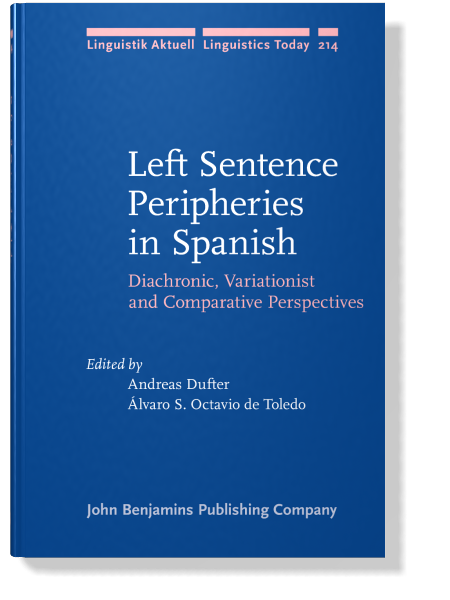
In:Left Sentence Peripheries in Spanish: Diachronic, Variationist and Comparative Perspectives
Edited by Andreas Dufter and Álvaro S. Octavio de Toledo y Huerta
[Linguistik Aktuell/Linguistics Today 214] 2014
► pp. 185–214
Chapter 7. The article at the left periphery
Published online: 31 July 2014
https://doi.org/10.1075/la.214.11ser
https://doi.org/10.1075/la.214.11ser
In Spanish, the definite determiner el ‘the’ can optionally appear in the left periphery of subject/complement clauses. The previous studies devoted to these clauses (henceforth el que clauses) propose that they should be analyzed as NPs instead of CPs. From the semantic point of view, it has been claimed that since el que clauses can only be selected by factive verbs, the propositions conveyed by them are presupposed. The aim of this paper is twofold. First, it seeks to describe more accurately the distribution of el que clauses since I show that certain other verbs that are not factives can also take these clauses. And second, I claim that their propositional content would be better analyzed as background non-asserted information rather than as presupposed propositions.

References (38)
Abney, Steven. 1987. The English Noun Phrase in its Sentential Aspect. PhD dissertation, Indiana University.
Brucart, José María. 1999. La estructura del SN: Las oraciones de relativo. In
Gramática descriptiva de la lengua española
, Vol. 1, Ignacio Bosque & Violeta Demonte (eds), 395–522. Madrid: Espasa Calpe.
Cabeza Pereiro, Carmen. 1997.
Las completivas de sujeto en español
. Santiago de Compostela: Universidad de Santiago de Compostela.
Chierchia, Gennaro & McConell-Ginet, Sally. 1990.
Meaning and Grammar. An Introduction to Semantics
. Cambridge MA: The MIT Press.
Delbecque, Nicole & Lamiroy, Béatrice. 1999. La subordinación sustantiva: Las subordinadas enunciativas en los complementos verbales. In
Gramática descriptiva de la lengua española
, Vol. 2, Ignacio Bosque & Violeta Demonte (eds), 1965–2081. Madrid: Espasa Calpe.
Eguren, Luis. 1989. Algunos datos del español a favor de la hipótesis de la frase determinante.
Revista Argentina de Lingüística
5: 163–203.
Hegarty, Michael. 1990. On adjunct extraction from complements. In
Papers on Wh-movement
[MIT Working Papers in Linguistics 13], Lisa Cheng & Hamida Demirdache (eds), 101–124. Cambridge MA: MIT.
Heim, Irene. 1982. The Semantics of Definite and Indefinite Noun Phrases. PhD dissertation, University of Massachusetts at Amherst.
Hooper, Joan B. & Thompson, Sandra A. 1973. On the applicability of root transformations.
Linguistic Inquiry
4(4): 465–497.
Kadmon, Nirit. 2001.
Formal Pragmatics: Semantics, Pragmatics, Presupposition and Focus
. Malden MA: Blackwell.
Kiparsky, Paul & Kiparsky, Carol. 1970. Fact. In
Progress in Linguistics
, Manfred Bierwisch & Karl Erich Heidolph (eds), 143–173. The Hague: Mouton.
Lapesa, Rafael. 1983. El infinitivo con actualizador en español: Condicionamiento sintáctico de su forzosidad o su rechazo. In Serta Philologica F. Lázaro Carreter, 279–298. Madrid:Cátedra.
. 1984. El uso de actualizadores con el infinitivo y la suboración sustantiva en español: Diacronía y sentido. In
Homenaje a Ana María Barrenechea
, Lía Schwartz & Isaías Lerner (eds), 65–89. Madrid: Castalia.
. 1985. Uso potestativo de actualizador con infinitivo. In
Philologica Hispaniensia: in honorem Manuel Alvar
, 317–373. Madrid: Gredos.
Leonetti, Manuel. 1996. El artículo definido y la construcción del contexto.
Signo y seña
5: 101–138.
. 1999a. El artículo. In
Gramática descriptiva de la lengua española
, Vol. 1, Ignacio Bosque & Violeta Demonte (eds), 787–890. Madrid: Espasa Calpe.
. 1999b. La subordinación sustantiva: Las subordinadas enunciativas en los complementos nominales. In
Gramática descriptiva de la lengua española
, Vol. 2, Ignacio Bosque & Violeta Demonte (eds), 2083–2104. Madrid: Espasa Calpe.
Lleó, Conxita. 1976. La presuposición y los verbos factivos en castellano. In
Estudios de Gramática Generativa
, Víctor Sánchez de Zavala (ed.), 119–141. Barcelona: Labor.
Luján, Marta. 1980. Clitic promotion and mood in Spanish verbal complements.
Linguistics
18(5–6): 381–484.
Melvold, Janis. 1991. Factivity and definiteness. In
More Papers on Wh-Movement
[MIT Working Papers in Linguistics 15], Lisa Cheng & Hamida Demirdache (eds), 97–117. Cambridge MA: MIT.
Octavio de Toledo, Álvaro. 2011. Anteposición de constituyentes y sintaxis histórica del español: Tres aplicaciones. Talk given at 18th Deutscher Hispanistentag, Passau.
Ormazábal, Javier. 2005. The syntactic distribution of factive complements.
Recherches linguistiques de Vincennes
33: 91–110. [URL]
Pérez Jiménez, Isabel. 2006. La gramática de las cláusulas absolutas de predicación en español. PhD dissertation, Universidad Complutense de Madrid/Instituto Universitario de Investigación Ortega y Gasset.
Picallo, Carme. 2001. Nominalized clauses, clausal arguments and agreement.
Catalan Working Papers in Linguistics
9: 69–84.
Plann, Susan. 1981. The two el + infinitive constructions in Spanish.
Linguistic Analysis
7(3): 203–240.
RAE-ASALE 2009 = Real Academia Española & Asociación de Academias de Lengua Española (eds). 2009.
Nueva gramática de la lengua española
. Madrid: Espasa Libros.
Serrano, Silvia. 2008. Un caso poco estudiado de la subordinación en español: sustantivas en posición de objeto precedidas por el. Trabajo de investigación para la obtención del DEA. MA thesis, Universidad Autónoma de Madrid/Instituto Universitario de Investigación Ortega y Gasset.
Simons, Mandy. 2007. Observations on embedding verbs, evidentiality and presupposition.
Lingua
117(6): 1034–1056.
. 1974. Pragmatic presuppositions. In
Semantics and Philosophy
, Milton K. Munitz & Peter K. Unger (eds), 197–213. New York NY: New York University Press.
Cited by (1)
Cited by one other publication
Wall, Albert & Álvaro S. Octavio de Toledo y Huerta
2016. Exploring and recycling. In Exaptation and Language Change [Current Issues in Linguistic Theory, 336], ► pp. 341 ff.
This list is based on CrossRef data as of 20 november 2025. Please note that it may not be complete. Sources presented here have been supplied by the respective publishers. Any errors therein should be reported to them.