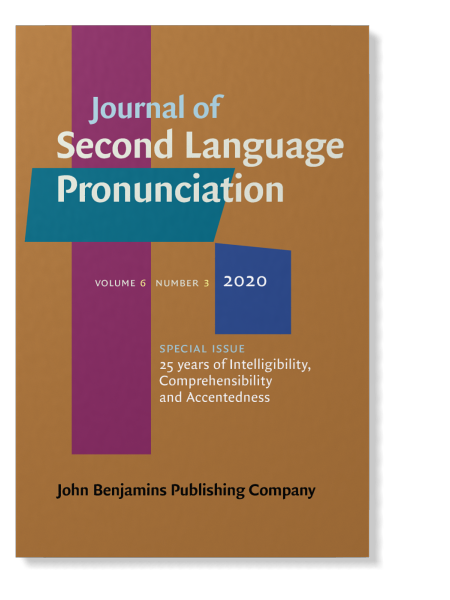
Introduction published In: 25 years of Intelligibility, Comprehensibility and Accentedness
Edited by John M. Levis, Tracey M. Derwing and Murray J. Munro
[Journal of Second Language Pronunciation 6:3] 2020
► pp. 277–282
Introduction
Changes in L2 pronunciation
25 years of intelligibility, comprehensibility, and accentedness
This article is available free of charge.
Published online: 25 November 2020
https://doi.org/10.1075/jslp.20054.lev
https://doi.org/10.1075/jslp.20054.lev
Abstract
This special issue revisits an extraordinarily influential paper for L2 pronunciation research and teaching (Munro, M. J., & Derwing, T. M. (1995). Foreign accent, comprehensibility, and intelligibility in the speech of second language learners. Language Learning, 45(1), 73–97. ) by looking again at the original paper with new eyes and new analyses. The
special issue also includes invited papers addressing current approaches based on the three key constructs in Munro, M. J., & Derwing, T. M. (1995). Foreign accent, comprehensibility, and intelligibility in the speech of second language learners. Language Learning, 45(1), 73–97. : Intelligibility, comprehensibility, and accentedness. Papers in the issue include a
reconsideration of the Intelligibility and Nativeness principles from Levis, J. M. (2005). Changing contexts and shifting paradigms in pronunciation teaching. TESOL Quarterly, 39(3), 369–377. , applications
of the constructs to L2 Spanish (Nagle & Huensch), a consideration of how everyday L2 use affects comprehensibility (Zielinski &
Pryor), long-term effects of intensive instruction (French, Gagné & Collins), influences on listener reaction to L2 speech (Isaacs &
Thomson), empirical evidence for the dynamic nature of comprehensibility (Trofimovich et al.), a study on ELF intelligibility and functional
load considerations (Thir), the relationship between comprehensibility and social evaluation of speech (Vaughn & Whitty), and one book
review.
Article outline
- Introduction
- The Special Issue
References

References (19)
Derwing, T. M., & Munro, M. J. (2013). The development of L2 oral language skills in two L1 groups: A 7-year study. Language Learning, 63(2), 163–185.
Derwing, T. M., Munro, M. J., Foote, J. A., Waugh, E., & Fleming, J. (2014). Opening the window on comprehensible pronunciation after 19 years: A workplace training study. Language Learning, 64(3), 526–548.
Derwing, T. M., Munro, M. J., & Thomson, R. I. (2008). A longitudinal study of ESL learners’ fluency and comprehensibility development. Applied Linguistics, 29(3), 359–380.
Derwing, T. M., Munro, M. J., & Wiebe, G. (1998). Evidence in favor of a broad framework for pronunciation instruction. Language Learning, 48(3), 393–410.
Foote, J. A., & McDonough, K. (2017). Using shadowing with mobile technology to improve L2 pronunciation. Journal of Second Language Pronunciation, 3(1), 34–56.
Gordon, J., & Darcy, I. (2016). The development of comprehensible speech in L2 learners: A classroom study on the effects of short-term pronunciation instruction. Journal of Second Language Pronunciation, 2(1), 56–92.
Isaacs, T., & Trofimovich, P. (2012). Deconstructing comprehensibility: Identifying the linguistic influences on listeners’ L2 comprehensibility ratings. Studies in Second Language Acquisition, 34(3), 475–505.
Jenkins, J. (2000). The phonology of English as an international language. Oxford: Oxford University Press.
Kang, O., Thomson, R. I., & Moran, M. (2018). Empirical approaches to measuring the intelligibility of different varieties of English in predicting listener comprehension. Language Learning, 68(1), 115–146.
Levis, J. M. (2005). Changing contexts and shifting paradigms in pronunciation teaching. TESOL Quarterly, 39(3), 369–377.
(2018). Intelligibility, oral communication, and the teaching of pronunciation. Cambridge University Press.
Munro, M. J., & Derwing, T. M. (1995). Foreign accent, comprehensibility, and intelligibility in the speech of second language learners. Language Learning, 45(1), 73–97.
(1999). Foreign accent, comprehensibility, and intelligibility in the speech of second language learners. Special reprint of the decade’s best papers in Language Learning, 491, 285–310.
(2006). The functional load principle in ESL pronunciation instruction: An exploratory study. System, 34(4), 520–531.
Nagle, C. L. (2017). Individual developmental trajectories in the L2 acquisition of Spanish spirantization. Journal of Second Language Pronunciation, 3(2), 218–241.
O’Brien, M. G. (2016). Methodological choices in rating speech samples. Studies in Second Language Acquisition, 38(3), 587–605.
Reid, K. T., Trofimovich, P., & O’Brien, M. G. (2019). Social attitudes and speech ratings: effects of positive and negative bias on multi-age listeners’ judgments of second language speech. Studies in Second Language Acquisition, 41(2), 419–442.
Ruivivar, J., & Collins, L. (2019). Nonnative accent and the perceived grammaticality of spoken grammar forms. Journal of Second Language Pronunciation, 5(2), 269–293.
Cited by (11)
Cited by 11 other publications
Chamroeun, Hak
Fathi, Jalil, Masoud Rahimi & Timothy Teo
Kostromitina, Maria, Ekaterina Sudina & Eman Baghlaf
Crowther, Dustin & Daniel R. Isbell
Ali, Saandia, Marie Garnier & Linda Terrier
Crowther, Dustin, Daniel R. Isbell & Hitoshi Nishizawa
Gallant, Jordan
Rodríguez-Fuentes, Rodrigo A. & Luzkarime Calle-Díaz
Whitehead, George E.K. & YoungMok Ryu
This list is based on CrossRef data as of 13 november 2025. Please note that it may not be complete. Sources presented here have been supplied by the respective publishers. Any errors therein should be reported to them.